


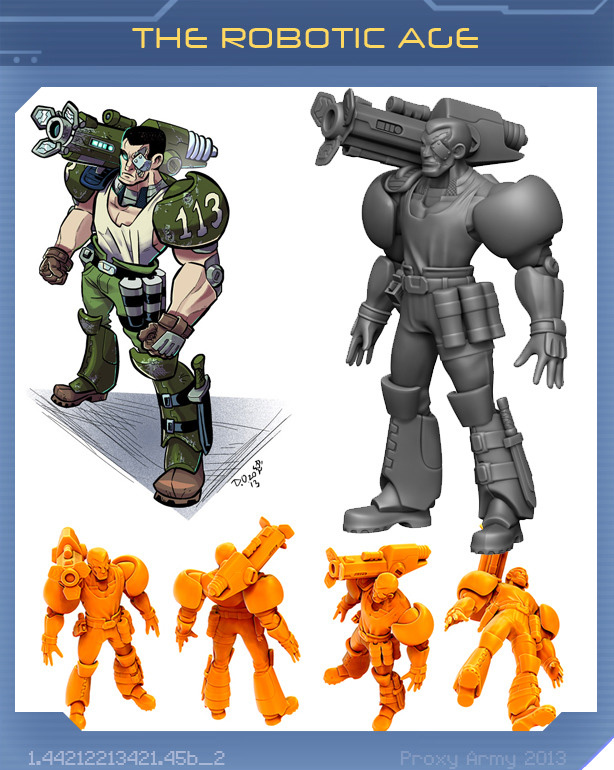
Kickstarter start-up Proxy War is offering tailor-made miniature soldiers set in the sci-fi universe of videogame X-Com, for tabletop wargaming. Its project could be the first to truly revolutionize strategic tabletop gaming, a world that has not changed much in the past two decades and may be in need of new ideas. Many enthusiasts have long theorized, and hoped, that such new ideas could come out of 3D printing and the possibilities it creates for character customization.
 Playing with toy soldiers is a hobby for adults: nowadays there are wargames of all kinds, from historical ones with Assyrians, Romans and English of the 100 Years War, to those set within Fantasy and Sci -Fi worlds. In these last two segments in particular, the company that has most captivated global audiences through its gaming properties for the past 20 years is Games Workshop. Its games, Warhammer Fantasy Battles and Warhammer 40,000, are the real deal: buy the miniatures in metal or plastic, assemble them, colour them (which is already a hobby in and of itself), and then challenge thousands of other fans on the gaming board, unleashing winning tactics, strokes of strategic genius and — most importantly — an avalanche of “sixes” at the dice.
Games Workshop, however, must be careful: its weakness is its prices. Each one of its miniatures is a real work of art. Moulded with exceptionally accurate, and as of yet undisclosed, techniques, they are not cheap. The challenge, in this case, comes from independent producers, who are starting to create better models using increasingly accessible personal 3D printers. Proxy War intends to help more people do just that, in an even more personalized manner.
Players will be able to log onto an online database and assemble their own custom miniatures from a wide array of parts and pieces, much like in a videogame character editor or in My Robot Nation, an interesting service offered by 3D Systems and Cubify to create your own 3D printed robot. Once assembled, the pieces can be professionally printed, allowing everyone to create their own personalized models or even entire personalized armies.
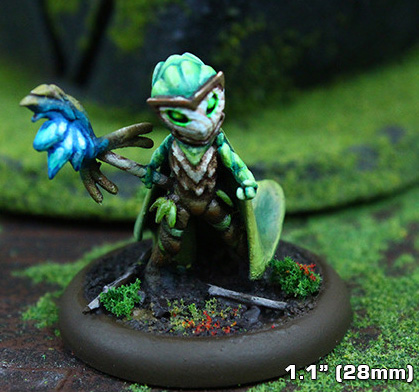 The Fine Detail material option for the smaller pieces promises a better than 25 micron resolution, superior even to many current fine cast models, while the Regular Reinforced material option offers less detail but larger and virtually indestructible models. Proxy War’s Titan-class models can be as tall as 240 millimeters. The system includes a three-man design team that will provide support on character art, illustrations and 3D modelling, as well as a complete set of rules applicable to all types of different armies. The potential for this type of personalized gaming is undoubtedly enormous, as may be the costs involved, at least in these early stages of the personal manufacturing industry. Proxy War may thus, temporarily, become an elite type of personalized tabletop wargaming, until it is able to reduce production and materials costs.
At the time of writing, Proxy War has reached about 40% of its funding goal with 20 days to go. Deadline is December 10th so if personalized tabletop wargaming is your thing, you might want to pay them a visit. In the meantime here is a video on making a personalized miniature model.