


Despite the dangers posed, many desktop 3D printer users leave their machines unattended while lengthy print jobs are being performed. Maker Andrew Maurer, however, knows that doing so opens up users to the risk of fire caused by some mis-printed plastic onto the printer’s electronics or other hazardous possibilities. For that reason, Maurer has launched a Kickstarter campaign for Smoke Signal, a small-scale smoke detector that can be placed directly on one’s 3D printer in the case of a small fire.
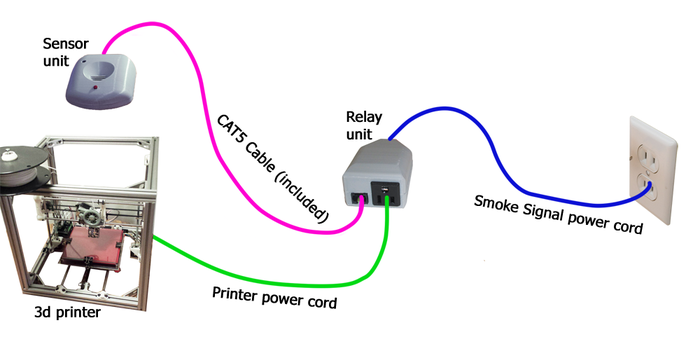
Smoke Signal is a small sensor that interrupts the circuit between a 3D printer and a power outlet so that, in the case of a small fire, it can shut down a printer as quickly as possible. The device is placed inside of the print area, on the ceiling of an enclosure or above the printer’s microcontroller, where it can detect smoke and stop a print job before the fire becomes unmanageable. Maurer lists a few examples in which a 3D printer was left unattended and burned down entire rooms. And, though a building’s smoke detector could prevent the entire place from becoming rubble, standard smoke detectors, Maurer writes, only go off when rooms are filled with smoke.
Maurer is seeking a humble $7,000 to order the PCB boards to make 100 Smoke Signal units, which he is selling $60 and up (though this early bird price is now sold out). The Smoke Signal isn’t a foolproof method for preventing fires that result from sloppy wiring or cheap connectors, but it’s one more precautionary measure for protecting users. Along with air filters for dealing with particulates from ABS, a device like the Smoke Signal could become a standard feature in future generations of 3D printers.
If you’re interested in learning more about the Smoke Signal, head over to the KS page and/or watch the campaign video below: