

And you thought that the dusty and dark United States Post Office (USPS) in your neighborhood or town was only good for registered mail and “Wanted” posters…USPS letter carriers at your door were really magazine and junk-mail haulers…and everything else was served by FedEx, UPS, email, Facebook and Twitter.
Oh wait…you forgot our Fourth Disruptor: 3D Printing! (The first three Disruptors were {1} the PC, {2} the Internet and {3} Social Media.) All three initial Disruptors were essentially based on digits. The Fourth — 3DP — is grounded in atoms. Things not thoughts.
Now — if you’re the USPS — then you’re an institution that has been around since Ben Franklin (yes, THAT Founder) was the very first Post Master General. You are billions of dollars in debt because you’re no longer government-funded. And, you are constrained from making needed changes in rates, operations and positioning by DCOTUS (the Dysfunctional Congress Of The United States).
Hence, you might welcome some creative destruction. Some positive disruption of your stultified and sterile stasis. Especially if your institution is under siege by the AGIB (All Government Is Bad) Republican Party — despite the fact that you are now a quasi-private company. (Go figure…)
To paraphrase an unknown wit, being hanged in the morning focuses the mind. The status quo will be fatal. So, USPS management has seized on 3D printing as a route to a more certain future. (WHY, exactly, this 3D printing epiphany has gained traction at the USPS would make another great story.) And, institutional survival…if not renaissance.
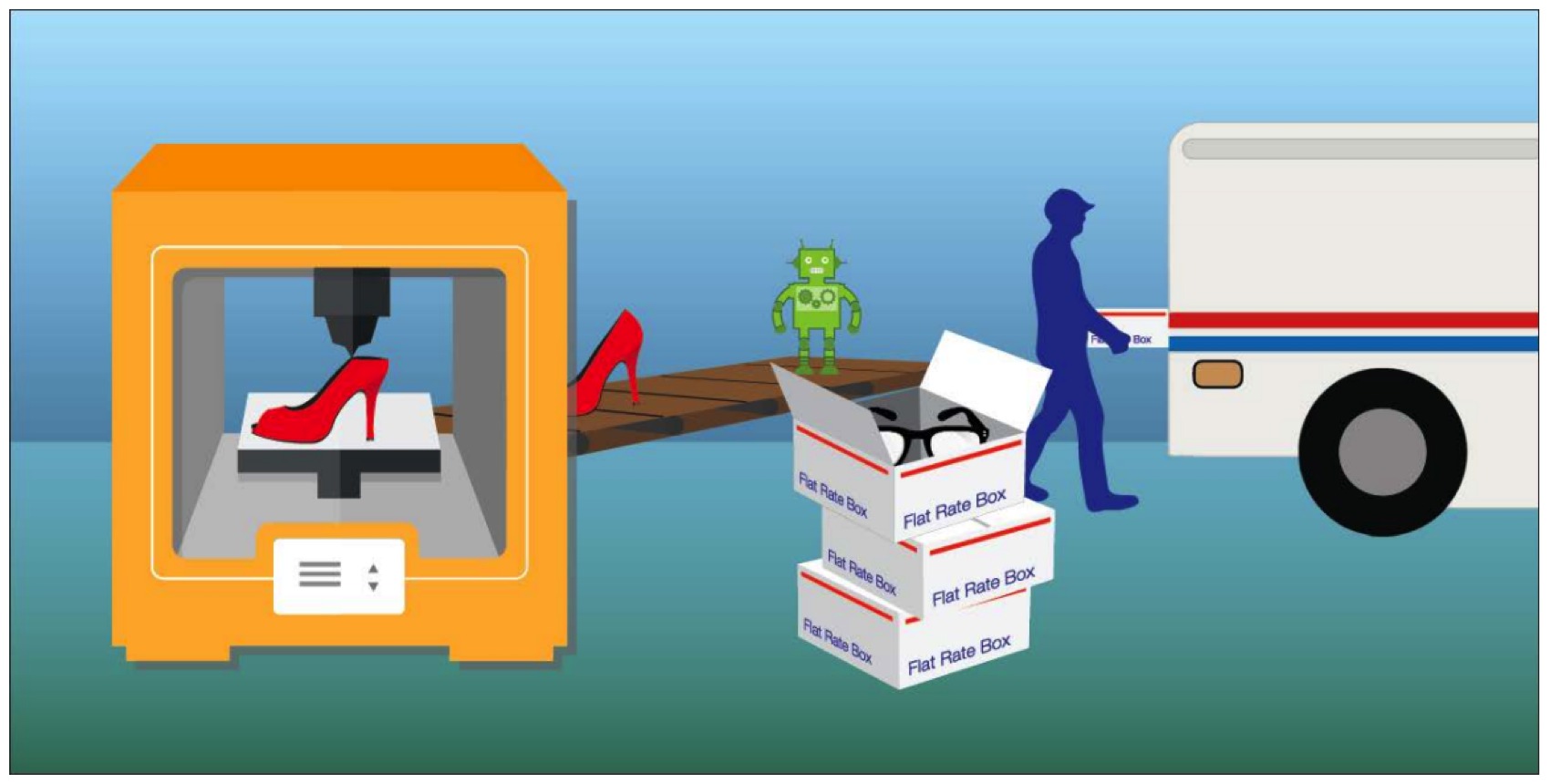
Still, the USPS “delivering” 3D printing — in whatever shape or form, ways or means — is truly radical thinking. If today’s USPS isn’t being vilified, it’s being laughed at. Nothing pushing the printed envelope — to pun feebly — this far has been considered by the Postal Service management since its abortive attempt to fax first-class mail.
The USPS saw “electronic mail” coming. They just thought it was faxes … not email. (This latter had not been invented — along with the Internet as transport — at the dawn of faxing.) The Postal Service vision was stationing early fax machines at Post Offices for the creation of last-mile, hand-delivered, first-class letters — with electronic transport in-between POs.
With the USPS up to its Blue Corner-Mailboxes in 3DP, this dowdy institution promises to contribute mightily to the democratization of manufacturing. Think the revenge of the Maker Movement and the “re-shoring” of jobs lost to globalization — and off-shoring of the American Middle-Class.
Besides this unwonted entrepreneurial chutzpa, the USPS possesses some unbeatable assets. Chief among these is its physical, on-the-ground, hyper-local, ubiquitous network. And, the hundreds of thousands of people who man and woman it.
Nothing in logistics matches the USPS’ scale and scope. No corporation or institution matches its geographic coverage. It’s as close and more accessible to more Americans than any other entity. It got that way because of its original (and still un-assailed) monopoly on first-class (snail-)mail delivery. (Of course — with email in ascendance for most purposes of “written” communication — many might say: “Meh.”)
The other salient logistical strength of the USPS — developed over recent decades in response to UPS and FedEx competition — is effectiveness in handling and transporting lightweight goods. A perfect match with today’s 3DP’d offerings.
Supported by these strengths, the USPS is unrivalled in serving needs covered by its “first mile” and “last mile” logistical offerings
When it was part and parcel (stop me before I pun again) of the U.S. Government, it WAS the Government to most citizens. It still has that look and feel — and a warm institutional memory in the hearts of many Americans.
Here’s how the USPS sees it…right in an official White Paper just put out by the Office of Inspector General, USPS. It’s even got a tagline-esque and pun-ish title: “If It Prints, It Ships: 3D Printing and the Postal Service.”
Perhaps the most provocative discussion in this White Paper is around the proactive role the USPS might take in helping to (re)foster American manufacturing. This idea circles back to the democratization effect of 3DP. Think the Maker Movement on steroids as supported, coached and mentored by the Postal Service. This might include the provision of 3DP production space, warehousing, service bureau output, printing materials depot, digital security, ancillary services and — of course — 3D printed product delivery from micro business to micro business, from edge-to-edge of USPS’ dispersed network.
In the micro biz acorn is the oak of the growing small business…still THE engine of employment. in the U.S
In its projected role as logistics engine to the renaissance in Kitchen-Table Factories, eCottage Industry and Garage Makeries, the USPS could enjoy a renaissance of its own. “In fact,” states the White Paper, “the movement, storage, and home delivery of 3D printing materials alone could become a major new sector of the logistics industry. The Postal Service has many existing assets that could help it play an expanded role in helping products move throughthe supply chain.”
The USPS might also create entirely new categories of logistics-centered business: such as the digital “middle mile.” Here’s how the White Paper describes this novel entrepreneurial prospect:
“The Postal Service could create a platform for 3D printing that uses its national retail network and last-mile capabilities. By doing so, the Postal Service would create a digital “middle mile” where, at a basic level, designs are sent to the platform and then 3D printed and shipped via same-day or next-day delivery. This could be considered a “hybrid parcel” product, similar to the concept of hybrid mail where digital communications are converted into physical letters.”(This last smacks of the faxed first-class mail of decades ago…!)
The innovative entrepreneurial positioning of the USPS is a welcome advance by an important U.S. institution. The American Postal Service seems intent on a remake of its staid and sterile reputation for slow-motion stumbles from bad to worse on its colossal scale (a scale that is still its primary advantage).
As a great American asset, the USPS organization is still positioned to serve this country’s commerce and common-good. And, 3DP may “print” the road to that success. As the White Paper concludes:
“By establishing a role in the 3D printing market, the Postal Service could put a compelling 21st century twist on its historical mission to serve citizens and facilitate commerce.”