

Last Friday Stratasys Asia Pacific hosted an Innovation Day in Singapore to provide an overview of the company’s current status and to introduce customers from the region to the latest addition to the Stratasys portfolio — the Objet500 Connex3 multi-material multi-colour 3D printer.
3DPI’s co-founders were able to attend the event, which saw two formal presentations ahead of the more informal niceties. The presenters at the Singaporean venue were Stratasys’ General Manager, Asia Pacific & Japan: Jonathan Jaglom and Ofer Nir Director, Product line Manager DESIGN 3D Printing Solutions.
Focusing on both the technical achievements of the Connex3 and the opening up of new applications as a result, one of the highlights of the event was the on-site revelation of the work of Japanese fashion designer Yuima Nakazato, who unveiled his 2014 Accessory Collection. Yuima’s work was a captivating and vivid demonstration of the capabilities of the Connex3’s full colour and multi-material capabilities and the collection is subsequently due to be premiered on an Asia Pacific tour that includes Japan, South Korea, China and Hong Kong.
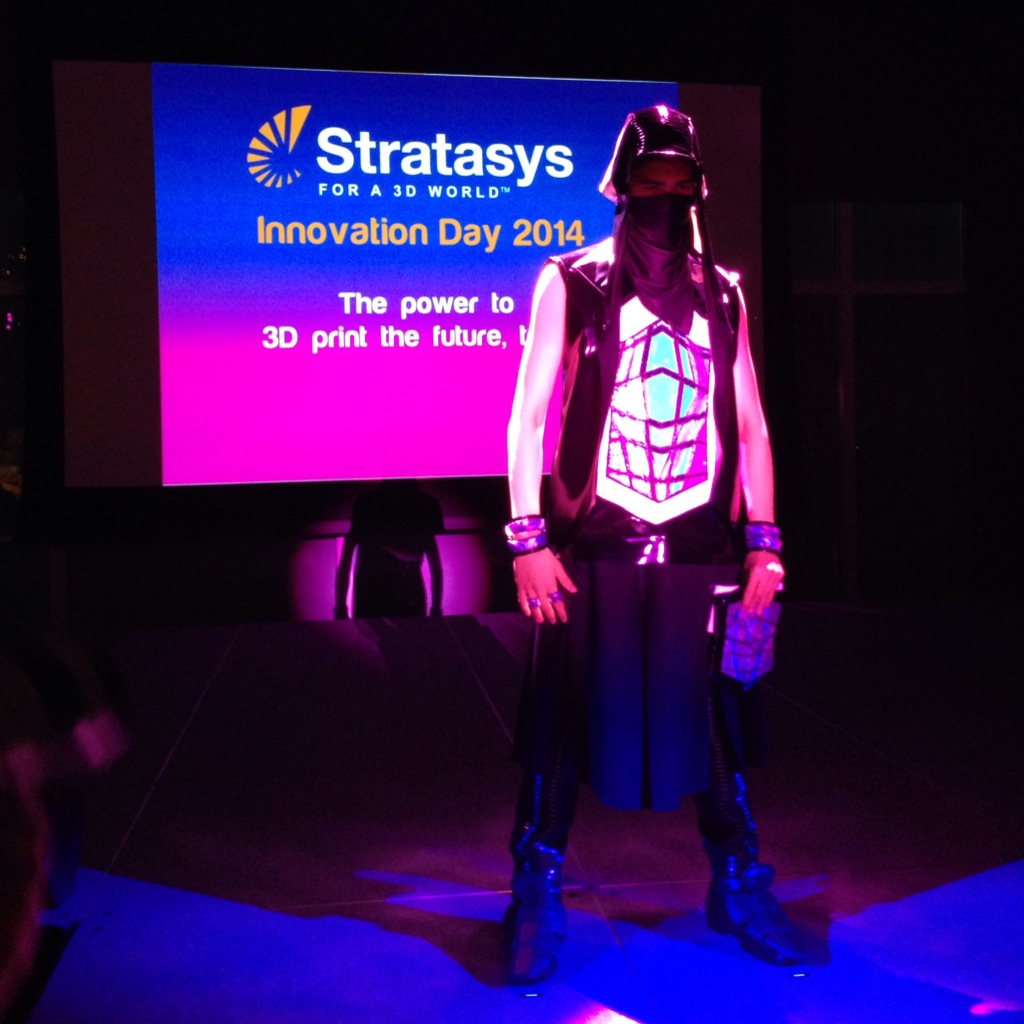
Nakazato is an alum of the Antwerp Royal Academy of Fine Arts with an MA in fashion design, graudating in 2004. His first collection was presented in Paris and he has since gone on to establish his own fashion brand YUIMA NAKAZATO. Nakazato was selected as the hottest young designer by Japanese industry magazine and he is currently working in Tokyo. Working with the Connex3 has added an exciting new dimension — literally — to his 2014 collection.
Stratasys distributor partner in Singapore, Creatz3D, was also present at the event together with more than 350 guests.



We own the Objet 260 Connex printer which capabilities and print quality is hugely impressive. Was it not for the absurdity of the running cost of these machines the Connex 3 would have been my heart’s desire. The problem with the Connex technology is the unbelievable amount of material that goes to waste in the building of a model. Depending on the geometry of the model it would waste up to 7 grams of material for each gram of model weight. Yes, seven times and it it does not stop there! The amount of support material wasted could easily be 7 times more than what you find on the tray of the completed build! We are yet to see a geometry where this waste is less than four times the expected amount!
Now, the retail price for a 3.6 Kg cartridge of Connex material is typically more than $1000, i.e. $0.28 per gram – which is already ridiculous when compared to other 3D printing technologies! But in most of the other technologies waste is not a factor whilst in the Connex technology the final cost could easily exceed $2.00 per gram for model material alone and $3.00 per gram if support material waste is also taken into account!
Stratasys has a policy of chip-protecting their cartridges so as to block out any competion. They can and they do charge just what they want for these cartridges, which can be produced and sold for a fifth of of the price was it not for this anti-competitive behaviour. For this reason the cost of Stratasys FDM technology is extremely high at about $0.30 per gram.
It will be interesting to see how they will justify their $3.00 per gram Connex technology as opposed to their own (already very expensive) FDM technology at $0.30 per gram!
Is the Connex technology 10 times better than the FDM technology? Definitely not – from someone who uses both.
Hi Len! What a great input you are sharing here! Thank you for your insight.