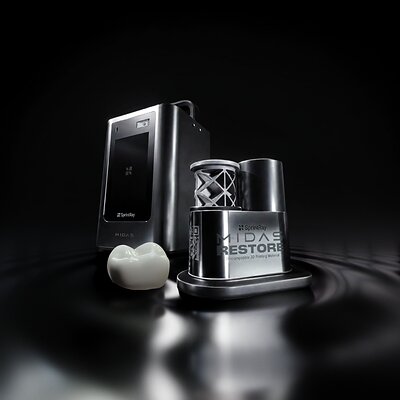
SprintRay has introduced Midas Restore, an FDA-cleared restorative resin built around glass ceramic and zirconia fillers, made specifically for use with the company’s Midas Digital Press. The material extends that printer, launched in 2024 for chairside 3D printing of dental restorations, into definitive ceramic-based crowns, inlays, onlays and veneers completed in a single visit.
With filler content above 75 percent by weight, the resin was developed to balance several properties at once, including how it holds a polish, resists wear, and behaves optically once cemented in place. SprintRay says the material’s internal structure is meant to slow crack growth instead of just resisting it, and that its flexibility is closer to natural dentin than to rigid ceramic.
“Traditional dental 3D printing forces a compromise: the material has to be fluid enough to print, which limits how highly filled it can be,” said Amir Mansouri, CEO and Founder of SprintRay. “Midas Restore was designed in our material science lab to address that limitation. By pairing a highly filled glass ceramic and zirconia formulation with Midas Digital Press, we can give clinicians access to a new class of definitive restorative materials and bring them into an efficient same-visit workflow.”
Strength, Wear and Gloss Retention
Internal testing cited by SprintRay found the material kept 98 percent of its original shine after 5,000 rounds of simulated brushing, and lasted roughly five times longer than the company’s existing SprintRay Ceramic Crown material across 200,000 wear cycles, putting it in range of a milled hybrid ceramic. Flexural strength testing under ISO 6872 produced a peak reading of 215 MPa (mean 180 MPa), which SprintRay identifies as the highest of any of its definitive restorative materials to date.
Hardness came in above 80 HV, a figure SprintRay compares to a well-known nanofilled composite and roughly twice that of its earlier printed restorative resins. Translucency, measured at 13.5 in shade A1, falls near the range typically associated with milled lithium disilicate.
“We engineered Midas Restore around how a restoration actually behaves once it is bonded to a tooth, not around a single strength number,” said Hossein Bassir, Chief Product Officer at SprintRay. “Filler content, polish retention, wear resistance, modulus and optics are not separate features. They are one system, and the tooth is part of it.”
From Capsule to Chairside Polish
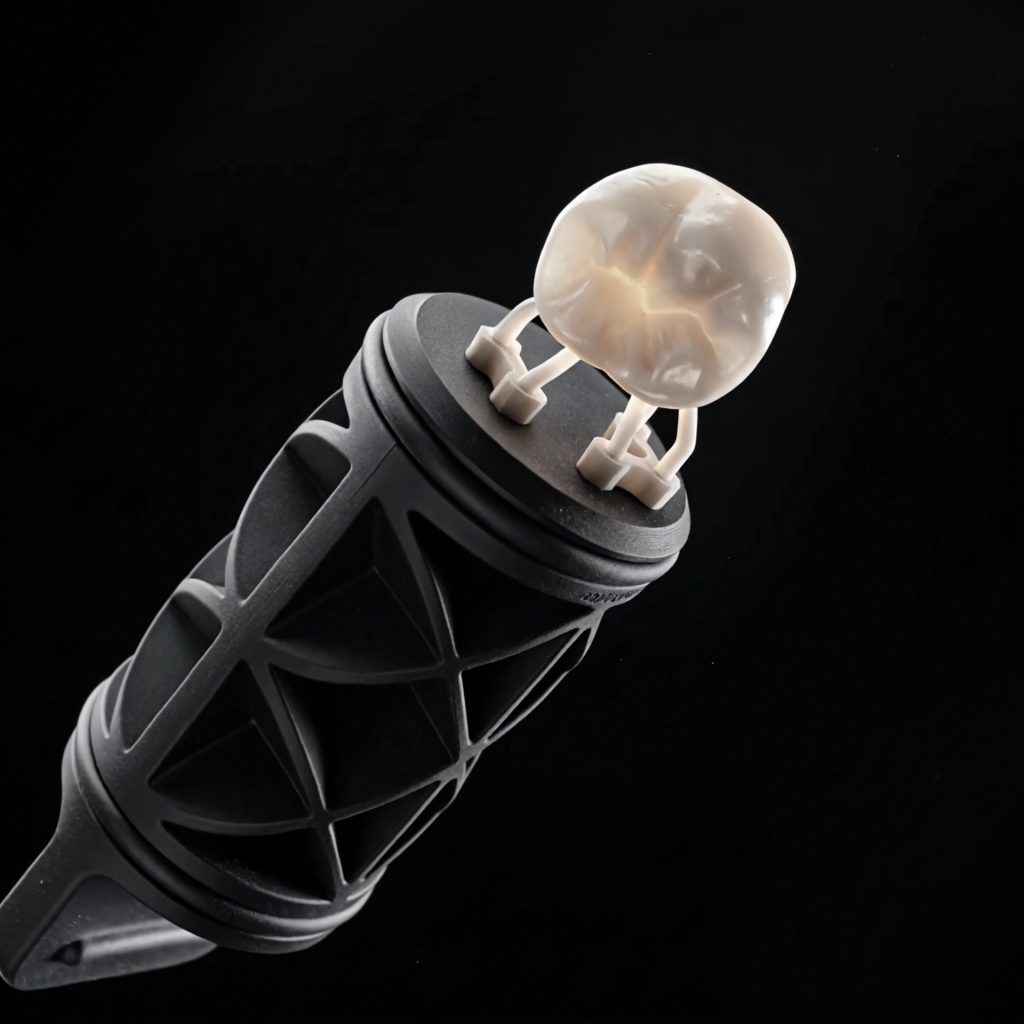
The formulation’s density requires equipment capable of moving thick material into position, which SprintRay addresses through what it calls Digital Press Stereolithography (DPS): sealed capsules that force viscous resin into the print zone, a step standard desktop 3D printing setups aren’t built to handle.
Once printed, a single capsule can yield multiple units, and post-curing takes about four minutes. SprintRay notes the material can still be shaped, built up or repaired in the mouth before final bonding, letting dentists skip a temporary restoration, a follow-up appointment, or outside lab work.
“With Midas Restore, I can achieve a beautiful, lasting surface gloss in just two or three quick polishing steps with a standard polishing system,” said Andrew C. Johnson, DDS, MDS, CDT, FACP, a prosthodontist at OmniSmile Digital Dental Solutions who evaluated the material during early clinical testing. “That combination of durability, aesthetics and straightforward finishing is what I expect as a clinician from a definitive restorative material.”
Pricing and Availability
SprintRay reports that clinicians in 33 countries have produced over 100,000 restorations with the Midas Digital Press since its debut two years ago.
Midas Restore has started shipping in the U.S. since September 1, 2026, in five shades (A1, A2, A3, B1, C2). A three-pack of single-unit capsules costs $135 through SprintRay’s store and its authorized distributors. The material works with both the Midas Digital Press and SprintRay NanoCure, and holds FDA 510(k) clearance (K260661) as a Class II, prescription-only device.
Hardware-Material Pairings Across Dental 3D Printing
Midas Restore reflects a gap that runs across dental 3D printing: standard desktop 3D printers can’t process resin filled heavily enough to match milled ceramic performance, so vendors are pairing dedicated hardware with a purpose-built material to clear that viscosity ceiling.
SHINING 3D took a related route with its Ceramix-Nano 3D printer, pairing a capsule-based material system with its proprietary Adaptive Pneumatic Stereolithography process to print and cure highly filled LumiCera crowns in one compact, FDA-cleared unit. It shares SprintRay’s capsule-delivery approach to the viscosity constraint, though it folds printing and curing into a single enclosure instead of using a separate press dedicated to that step.
Both point to a pattern already building across the sector: hardware built around a specific material is emerging as a route to definitive chairside restorations.
3D Printing Industry is inviting speakers for its 2026 Additive Manufacturing Applications (AMA) series, covering Energy, Healthcare, Automotive and Mobility, Aerospace, Space and Defense, and Software. Each online event focuses on real production deployments, qualification, and supply chain integration. Practitioners interested in contributing can complete the call for speakers form here.
To stay up to date with the latest 3D printing news, don’t forget to subscribe to the 3D Printing Industry newsletter or follow us on LinkedIn.
Explore the full Future of 3D Printing and Executive Survey series from 3D Printing Industry, featuring perspectives from CEOs, engineers, and industry leaders on the industrialization of additive manufacturing, 3D printing industry trends 2026, qualification, supply chains, and additive manufacturing industry analysis.
Featured image shows Midas Restore, a Ceramic-Zirconia Material for Same-Visit Restorations. Image via SprintRay.