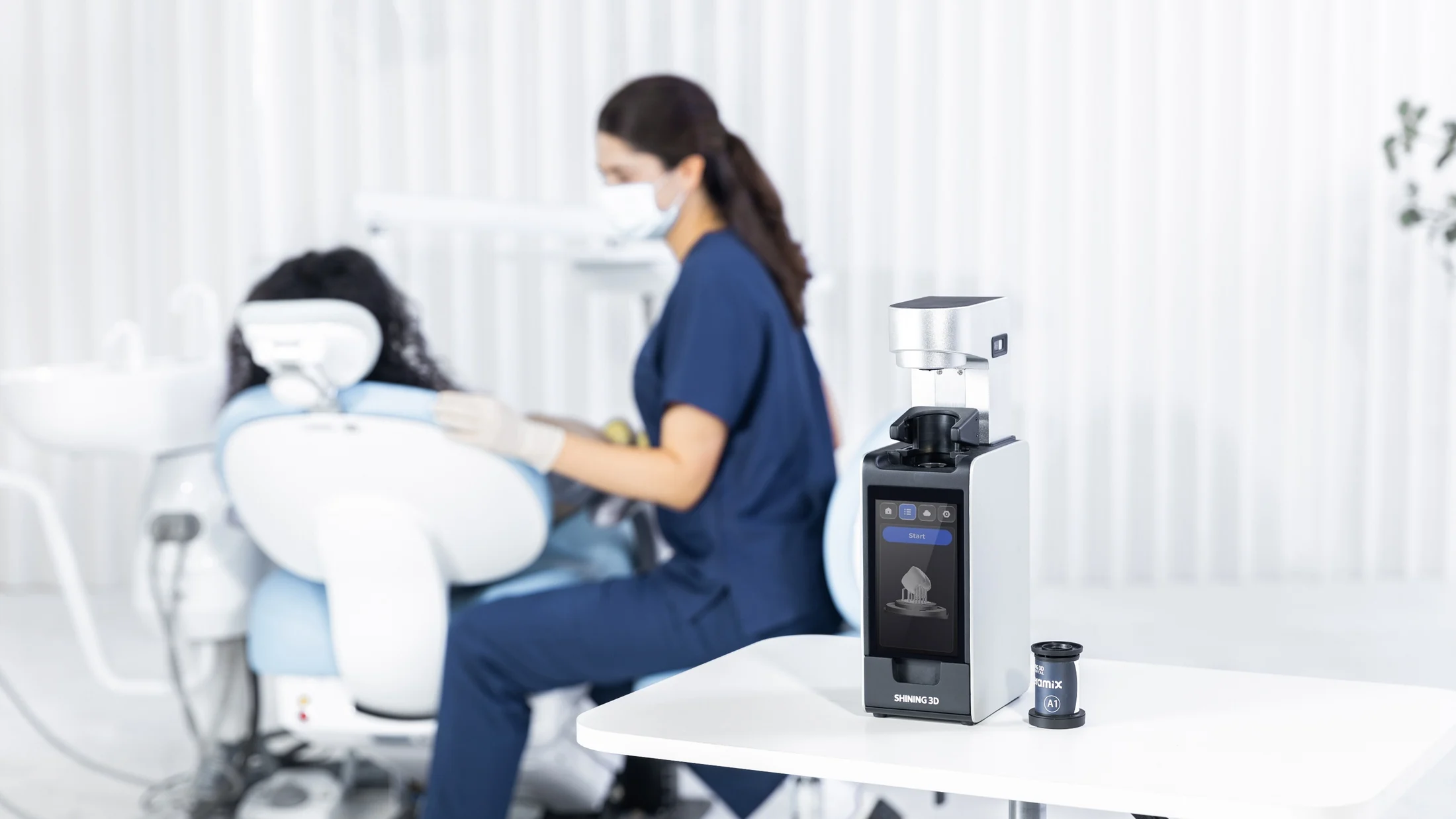
SHINING 3D Dental, dental division of Chinese company SHINING 3D, officially brought the Ceramix-Nano to market on June 18, stepping into the growing race for compact, clinic-ready ceramic printers with a device that sits on a countertop and delivers permanent restorations before a patient leaves the chair.
The machine produces crowns, veneers, inlays, onlays, and Maryland bridges, and does it without requiring a separate lab, a secondary curing unit, or extensive technical knowledge. The entire scan-to-cementation sequence, driven by the company’s SHINING FLOW cloud platform, runs in as little as 30 minutes: design in under two minutes, printing in 8 to 11 minutes, curing in three.

Compact by Design, Capable by Intention
At 2 kg and roughly shoebox-sized, the Ceramix-Nano is built around the argument that chairside printing should not require a room reorganization. Its patented APS (Adaptive Pneumatic Stereolithography) process handles both printing and curing in one enclosure, while a capsule-based material system handles the rest of the setup burden: scan a QR code, and the printer configures itself, stirs the resin, and begins. Each capsule yields up to three restorations.
The proprietary material, LumiCera, carries FDA Class II 510(k) clearance and comes in five VITA shades, BL, A1, A2, B1, and C2. Practices already working with SAREMCO CROWNTEC can continue doing so, as the Ceramix-Nano supports it as well.
Early clinical reaction has leaned positive. As Dr. Isaac Tawil, DDS MS, put it: “What continues to impress clinicians about SHINING 3D is their ability to deliver powerful capability in such a compact design. This new capsule printer brings powerful chairside printing for long-term restorations into an incredibly small and efficient system.”
The Ceramix-Nano is available now in North America and Asia through authorized SHINING 3D Dental distributors. EU availability and other regions are expected to follow shortly.

The Broader Race for the Chairside Crown
SHINING 3D’s move fits squarely into a pattern that has been building across the dental 3D printing sector. A new generation of chairside systems capable of producing ceramic crowns in roughly 10 minutes of print time is pushing same-visit dental restorations closer to routine practice.
The global dental 3D printing market sits at roughly $5.2 billion as of 2024 and is forecast to approach $10 billion by 2033, with around 15% of U.S. dental practices now owning an in-office printer, up from near zero a decade ago. Industry analysts have noted that vendors coupling hardware to validated resins, software, and service contracts are best positioned to protect revenue share even as unit prices compress, a stack-economics play that rewards integration over standalone products.
Others are pushing from different angles. PioCreat’s PioNext Mini delivers ceramic crowns at 0.1 mm resolution in roughly ten minutes, while carimatec’s IML chairside printer demonstrated crowns and bridges at under 40μm precision in just eight minutes at Formnext 2024.
The gap between lab-based and in-office printing is narrowing faster than most expected. The next test is not whether the hardware can deliver, it is whether permanent ceramic restorations produced chairside will match the long-term track record of lab-fabricated alternatives.
3D Printing Industry is inviting speakers for its 2026 Additive Manufacturing Applications (AMA) series, covering Energy, Healthcare, Automotive and Mobility, Aerospace, Space and Defense, and Software. Each online event focuses on real production deployments, qualification, and supply chain integration. Practitioners interested in contributing can complete the call for speakers form here.
To stay up to date with the latest 3D printing news, don’t forget to subscribe to the 3D Printing Industry newsletter or follow us on LinkedIn.
Explore the full Future of 3D Printing and Executive Survey series from 3D Printing Industry, featuring perspectives from CEOs, engineers, and industry leaders on the industrialization of additive manufacturing, 3D printing industry trends 2026, qualification, supply chains, and additive manufacturing industry analysis.
Featured image shows SHINING 3D Dental’s Ceramix-Nano. Photo via SHINING 3D Dental.