Hear from the experts shaping additive manufacturing software. Join 3D Printing Industry on 22 October for AMA: Software 2026, featuring exclusive presentations, panels and live Q&A!
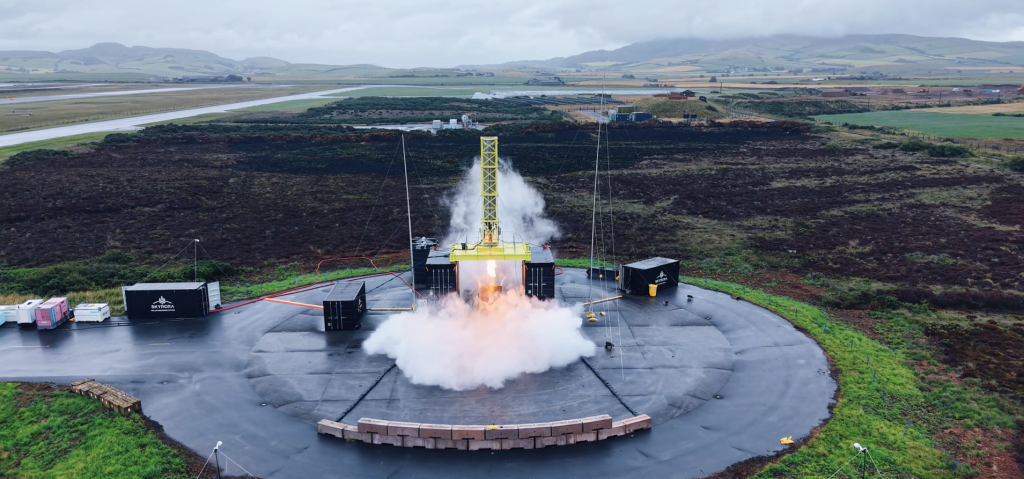
UK launch services company Skyrora has completed a 45-second static hot-fire test of a scaled-down version of its Skyrora XL orbital launch vehicle. The test took place at Machrihanish, on Scotland’s west coast. Initial data indicates that all subsystems performed successfully for the full duration.
The test vehicle was built to validate subsystems and components similar to those planned for the full Skyrora XL. During the firing, engineers collected data on the pressurisation system and on key engine parameters, including propellant flow rate and chamber pressure. The team is now analysing the results before carrying out a second test.
Integrated Testing Before Scale-Up
Skyrora’s development approach is to test early and often, and to test subsystems together rather than one at a time before scaling up. Running integrated systems at reduced scale lets engineers find and fix problems earlier in the program, when changes are cheaper and faster. It also builds up evidence of component and subsystem performance ahead of a planned series of larger, more demanding trials and eventual integration into the full vehicle.
Chief operating officer Dr Jack James Marlow said, “This scaled-down XL system lets us test and validate the technology, subsystems and components together, understand how they perform and make improvements before scaling up to the full vehicle.” He added, “Our approach is simple: test, learn, refine and test again, so that when Skyrora XL reaches the pad, we have confidence grounded in evidence.”
How Skyrora Builds Its Engines
Although the press release doesn’t say whether the scaled-down vehicle uses printed hardware, most of Skyrora’s propulsion program is built with its own 3D printers. The central machine is Skyprint 2, which the company describes as the largest hybrid 3D printer in Europe. It makes large rocket engine parts up to 2.3 meters long for Skyrora’s launch vehicles, and it is compatible with Inconel, a nickel-based superalloy that holds up at high temperatures.
Skyprint 2 is used to produce the company’s 70 kN engine, cutting production times by a reported 66 per cent and costs by 20 per cent. Skyrora is also working with the National Manufacturing Institute of Scotland to qualify the printer, its materials and its machining process, which would allow third parties to use Skyprint 2 commercially. At Space-Comm Expo 2025, head of business development Derek Harris said 70 to 80 per cent of the 70 kN engine is printed in-house, including the combustion chambers and gas generators, and that six of the nine main first-stage engines had already been printed.
Skyrora is also developing new materials. Under ESA‘s General Support Technology Programme, it is leading work on Tanbium, a high-temperature alloy developed with Metalysis and Thermo-Calc Solutions and 3D printed on the Skyprint 1 and 2 DED platforms. Earlier this month, Skyrora finished hot-fire testing a 3.5 kN low Earth orbit engine with a titanium-coated component developed through the EU-funded MADE-3D programme. Replacing a nickel-based alloy with titanium deposited on Skyprint 2 reduced that component’s weight by about 44 per cent.

Testing Small Before Building Big
Skyrora’s scaled-down XL test is designed to reduce risk before full-size hardware is built. Because its engines are printed in-house, lessons from each firing can quickly become new parts.
Dubai-based LEAP 71 follows a similar step-by-step approach, with AI-designed engines in place of conventional engineering. The company hot-fired two 20 kN methane–liquid oxygen engines, a bell nozzle and an aerospike, both intended for orbital launch vehicles and taken from initial specification to ignition in under three weeks. Over the previous 18 months it had tested roughly one engine per month, deliberately varying each design to find the limits of its physics model and feeding the results back into the next iteration. The 20 kN units represent about 10 per cent of the thrust LEAP 71 plans to test in 2026.
In the US, New Frontier Aerospace completed a series of hot-fire tests of its additively manufactured Mjölnir engine, which uses a full-flow staged combustion cycle. The work was seed-funded by National Security Innovation Capital, part of the U.S. Defense Innovation Unit, and NASA funded the sustained test series. Only after proving the engine on the stand does the company plan to integrate it into its Pathfinder hypersonic VTOL vehicle and its Bifröst orbital transfer vehicle.
In each case, 3D printing allows engines to be built quickly, and repeated firings show whether they are ready for the full vehicle.
Register now for AMA: Software 2026. Join 3D Printing Industry on 22 October for expert presentations, panel discussions and live audience Q&A exploring the software shaping additive manufacturing. Register here.
To stay up to date with the latest 3D printing news, don’t forget to subscribe to the 3D Printing Industry newsletter or follow us on LinkedIn.
Explore the full Future of 3D Printing and Executive Survey series from 3D Printing Industry, featuring perspectives from CEOs, engineers, and industry leaders on the industrialization of additive manufacturing, 3D printing industry trends 2026, qualification, supply chains, and additive manufacturing industry analysis.
Featured image shows Skyrora Hot-Fires Scaled-Down Orbital Vehicle for 45 Seconds in Scotland. Photo via Skyrora.