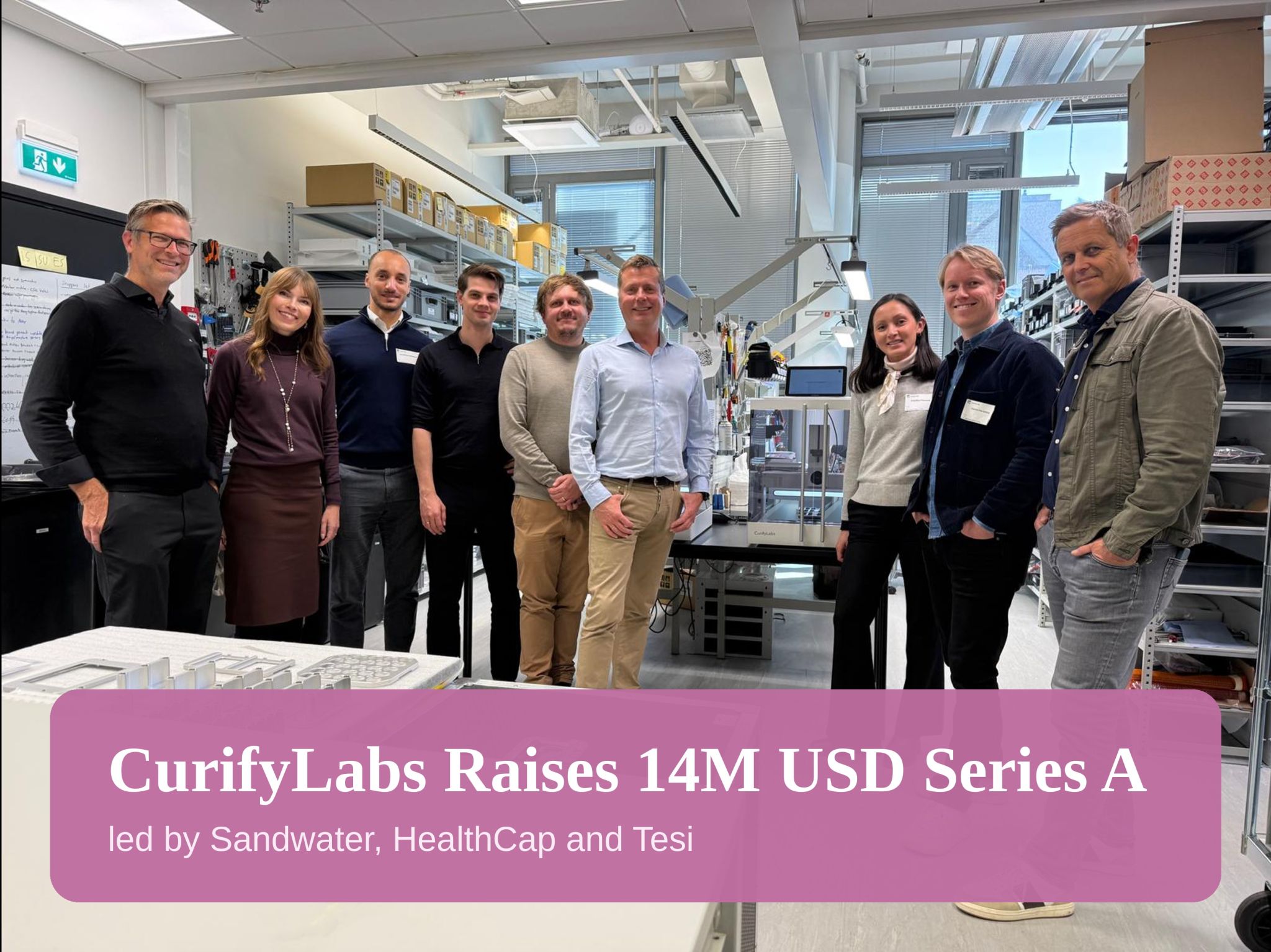
Helsinki-based health technology firm CurifyLabs has closed a $14 million Series A round to grow its automated system for producing personalized medications. The round was co-led by Sandwater and HealthCap, with Tesi and existing backers including Lifeline Ventures joining, alongside participation from U.S. customers and employees. The company, which also operates out of Jacksonville, Florida, will direct the capital toward expanding its American footprint, reinforcing supply chain infrastructure, improving customer support and speeding up product development.
At the core of the business is the Compounding System Solution (CSS), a platform pairing proprietary software with GMP-manufactured excipient bases and 3D printing hardware to automate pharmacy compounding. With integrated quality control, the system delivers customized doses and dosage forms faster and more precisely than the manual methods most pharmacies still rely on. The technology is currently deployed in pharmacies across 21 U.S. states and throughout Europe, where it compounds and dispenses thousands of doses daily.
“Personalized medicine is one of the most important frontiers in healthcare enabling better patient outcomes and is experiencing solid growth. We are enabling more pharmacies to deliver personalized medicine in a safer and more efficient way”, said Morten E. Iversen, partner at Sandwater. “CurifyLabs has built something rare, technology that combines clinical rigor with the speed and precision that busy pharmacy teams depend on. We are excited to support their rapid growth in the U.S. and beyond.”

Faster Compounding and Regulatory Alignment
Part of the funding will advance the CurifyLabs platform itself, including the recently launched PharmaPrinter Aurum, which the company says compounds medications up to nine times faster than manual workflows. The technology carries ISO 13485 certification and is designed to comply with FDA 503A/503B standards governing non-sterile compounding, a regulatory positioning that matters as the company deepens its U.S. presence.
Charlotta Topelius, who founded and leads CurifyLabs, described the raise as evidence of the confidence backers place in the company’s vision. “We have set a high bar for clinical rigor, product quality, and customer support, and this funding gives us the resources to raise that bar further.”
“We have backed more than 136 life sciences companies over nearly three decades, and what sets the best founders apart is their ability to combine scientific depth with real-world execution,” said Daniel Karsberg, partner at HealthCap. “The CurifyLabs team has done exactly that.”

Automating a Manual Corner of Pharmacy
The CurifyLabs round lands in a sector where investors have been steadily building positions: pharmaceutical additive manufacturing aimed at personalized dosing. The company’s angle is distinct, though, instead of developing drugs, it automates compounding inside the pharmacy itself, and the $14M will scale the supply chain and U.S. presence that model requires.
Venture capital has been circling this space for years. Chinese startup Triastek raised $15 million in Series A funding to accelerate 3D printed drugs, backing a platform designed to mass-produce medicines with programmable release profiles that enable personalized medication for individual patients.
The clinical case for personalization is equally established. UCL spin-out FabRx demonstrated it early, when it 3D printed personalized tablets for children with a rare metabolic disease, chewable “Printlets” that matched conventional treatments in effectiveness while scoring higher on patient acceptability. The company later commercialized the approach bylaunching the M3DIMAKER, a 3D printer for personalized medicine, built to move tailored dosing out of the lab and into hospitals and pharmacies, the same battleground CurifyLabs is now scaling into.
Capital is converging on personalized medicine AM from drug developers to printer makers. CurifyLabs’ bet is that pharmacies, not factories, will be where it scales first. This Series A gives that thesis $14 million worth of runway.
3D Printing Industry is inviting speakers for its 2026 Additive Manufacturing Applications (AMA) series, covering Energy, Healthcare, Automotive and Mobility, Aerospace, Space and Defense, and Software. Each online event focuses on real production deployments, qualification, and supply chain integration. Practitioners interested in contributing can complete the call for speakers form here.
To stay up to date with the latest 3D printing news, don’t forget to subscribe to the 3D Printing Industry newsletter or follow us on LinkedIn.
Explore the full Future of 3D Printing and Executive Survey series from 3D Printing Industry, featuring perspectives from CEOs, engineers, and industry leaders on the industrialization of additive manufacturing, 3D printing industry trends 2026, qualification, supply chains, and additive manufacturing industry analysis.
Featured image shows CurifyLabs Secures $14M Series A to Scale Pharmacy-Based 3D Printed Medication. Image via CurifyLabs.