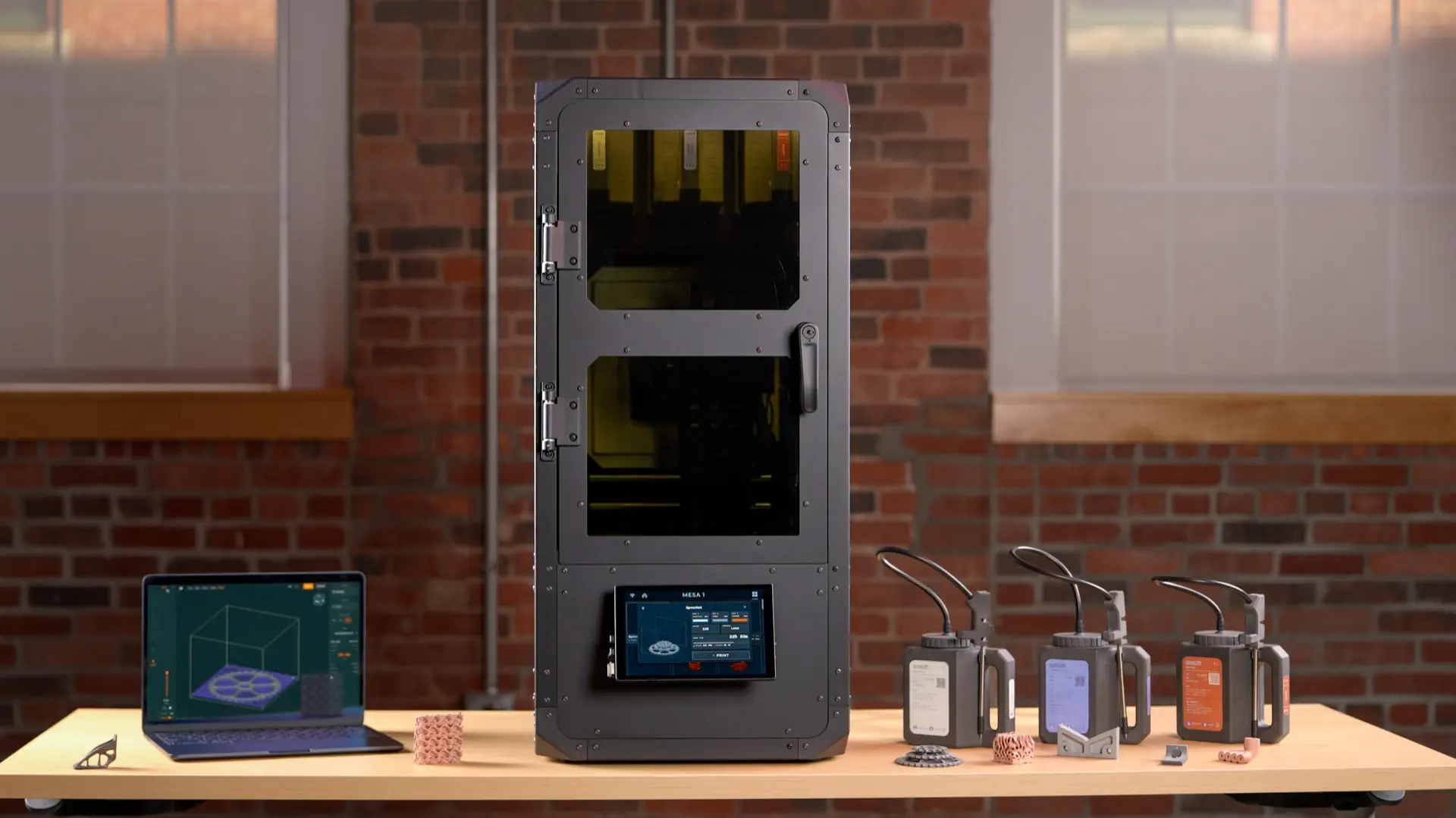
Somerville, Massachusetts-based Studio 3e8 has introduced the Mesa 1, a desktop metal 3D printer with a built-in sintering furnace. The company will open a Kickstarter campaign for the system on December 1, 2026, with pricing starting at $3,500.
Studio 3e8 developed a new printing process for the Mesa 1, along with supporting software, hardware, and materials. The company says the goal is to address the barriers to owning and using a metal printer and to bring metal additive manufacturing (metal AM) to the desktop. Ahead of the campaign, it has released a reveal video and opened sign-ups for launch updates on its website.
A Two-Material Approach to Metal AM
According to the company, the Mesa 1 does not use lasers or binders. After printing, users have no loose metal powder to clear and no support structures to remove. To start a job, users import a 3D model, slice it, and upload the file to the printer.
The slicer divides each print into two materials. Metal forms the part, and a scaffold material keeps the part’s shape. Both materials load into the machine from fully sealed powder cartridges.
The printer deposits the part directly into a crucible inside its integrated furnace. The furnace then sinters the part into dense metal automatically, with no handling step in between.
From Attic to Greentown Labs
Casey Johnson founded Studio 3e8 in 2023 and serves as CEO. Cassie Lowell joined as co-founder and Chief Product Officer. The startup began in an attic and moved to a garage. It now operates out of Greentown Labs in Somerville and was selected for the Launch Lab X accelerator at Harvard Innovation Labs.
Johnson explained what motivated the project: “Our team saw the barriers to metal printing firsthand working on industrial 3D printing and manufacturing systems. We built the tool we always wanted.”
Printing and Sintering Inside One Machine
Office-friendly metal AM is a goal that predates the Mesa 1 by nearly a decade. Desktop Metal pursued it with the Studio System, detailed in 2017. Its printer extruded bound metal rods, and the resulting parts needed debinding (binder removal) and sintering afterward. The $120,000 package combined a printer, a debinder, and an automated furnace sized to fit through an office door with cloud-based software, consumables, installation, and training. Like the Mesa 1, the system aimed to bring sinter-based metal parts into office settings. It split the process across three machines, however, and fed the printer with metal rods instead of powder.
Earlier this year, a desktop printer capable of metal parts took the crowdfunding route Studio 3e8 now plans to follow. Kare 3D launched a Kickstarter campaign for the Kare S1, describing it as a printer for both metal and plastic filaments. For metal parts, the company offered an optional Kare Metal Set with a sintering furnace and a washing unit to process parts once printing ends. Unlike the Mesa 1, the S1 left sintering to equipment sold apart from the printer.
Read together, these systems place the Mesa 1 among desktop and office approaches to sinter-based metal AM, with the built-in furnace as a key point where its design diverges.
To stay up to date with the latest 3D printing news, don’t forget to subscribe to the 3D Printing Industry newsletter or follow us on LinkedIn.
Explore the full Future of 3D Printing and Executive Survey series from 3D Printing Industry, featuring perspectives from CEOs, engineers, and industry leaders on the industrialization of additive manufacturing, 3D printing industry trends 2026, qualification, supply chains, and additive manufacturing industry analysis.
Featured image shows Mesa 1 by Studio 3e8. Photo via Studio 3e8.