Sandia National Laboratories has shared early results from its Center for Advanced Manufacturing and Innovation (CAMINO), the facility that opened earlier this year to help the lab meet its national security missions more quickly. According to CAMINO manager Mohan Karulkar, the center used additive manufacturing (AM) to deliver parts to an internal team in one week. Producing those parts through machining takes four to six months.
The results point to a broader goal at Sandia: shortening design cycles for war-reserve parts and increasing the use of AM and other advanced manufacturing methods in national security programs, where Karulkar says these technologies are still not widely deployed.
Faster Iteration on Power Source Components
CAMINO has been producing several versions of a piece part for Sandia’s Power Sources Technology Group, which is redesigning one of its components. Karulkar explained that the parts are expensive and difficult to obtain through conventional machining.
“The fast turnaround creates an opportunity to actually experiment with designs and try out new ideas, whereas before the process was too slow to allow meaningful innovation. What’s more, some of the new ideas were only achievable using additive manufacturing, so there was a double benefit,” he said.
Sarah Dudley, a manager in power sources, said her team took part in a three-day, hands-on design sprint at the facility focused on one specific engineering problem. She added that a 3D printed thermoplastic polyurethane (TPU) surrogate was developed as a mechanical stand-in for an insulation material that is difficult to machine. The original material is costly and has a long lead time, while CAMINO can produce new surrogate iterations from low-cost material in 12 hours instead of 12 weeks.
“This allowed my team to perform rapid design and test iterations related to mechanical performance in a very quick, low-cost and low-hazard way, accelerating the design cycle for war-reserve parts,” Dudley said.

Training Engineers, Students and the Local Workforce
Karulkar stressed that “CAMINO is not a production facility.” He described its role as building familiarity with and confidence in advanced manufacturing by giving engineers direct access to the equipment, linking them with specialists who can refine their designs, and teaching them how to design for these processes so parts meet requirements.
Sandia is also working with The University of Texas at Austin to expand its instruction in this area. CAMINO and Sandia’s Academic Programs currently host a group of employees who attend an advanced manufacturing class virtually from the facility. Working with Academic Programs, Karulkar has finalized plans with UT Austin to launch a new course on advanced manufacturing for national security next year.
“This is a class to highlight the unique aspects of national security versus, say, automotive or aerospace, that make it difficult to use advanced technologies. This is something that students struggle with when they enter our field,” Karulkar said.
CAMINO will be able to host UT Austin students and faculty on visits, while Sandia participants can use the center’s equipment for lab activities linked to the virtual coursework.
In Albuquerque, Karulkar sees workforce development as the main opportunity for local collaboration. This includes training people to operate and design for these systems, as well as encouraging middle and high school students to consider engineering careers.

Shortening Development Cycles for Defense Hardware with 3D Printing
CAMINO was opened on February 12 by the National Nuclear Security Administration (NNSA), Sandia and the Kansas City National Security Campus (KCNSC). Sandia serves as the design agency for many non-nuclear components in the U.S. nuclear deterrent, while KCNSC serves as the production agency. At CAMINO, AM is used to supply development hardware and test surrogates for parts that can take months to machine.
In 2015, KCNSC Chief Technology Officer David McMindes said the campus was using 3D printing to prototype fixtures and to characterize alloys for use in non-nuclear components. He said the campus bought 30 MakerBot desktop printers for its engineers and saved $10 million in development costs, since whole prototypes could be printed without metal parts or assembly. This approach parallels CAMINO in two ways: it put printers directly in engineers’ hands, and it used printed hardware in place of costly conventional parts during development. The difference lies in the goal, as McMindes described bringing that capability into production as the next step, while Karulkar said one of CAMINO’s goals is to iterate faster.
Outside the nuclear security enterprise, the Defense Logistics Agency (DLA) Weapons Support Product Test Center in Columbus, Ohio, replaced machined test fixtures with thermoplastic ones printed on a Stratasys Fortus 450mc, alongside a new 3D laser scanner. Fixtures that took weeks to months to produce can now be designed in about an hour and printed in as little as six hours. Like CAMINO, the lab cut machining lead times from its testing work by switching to printed polymer hardware. The purpose differs: DLA prints fixtures to clear quality assurance testing of supplied parts within a 30-day window, while CAMINO prints parts and surrogates to iterate on component designs.
At KCNSC, DLA and CAMINO, printed hardware took the place of conventionally made parts during development or testing.
To stay up to date with the latest 3D printing news, don’t forget to subscribe to the 3D Printing Industry newsletter or follow us on LinkedIn.
Explore the full Future of 3D Printing and Executive Survey series from 3D Printing Industry, featuring perspectives from CEOs, engineers, and industry leaders on the industrialization of additive manufacturing, 3D printing industry trends 2026, qualification, supply chains, and additive manufacturing industry analysis.
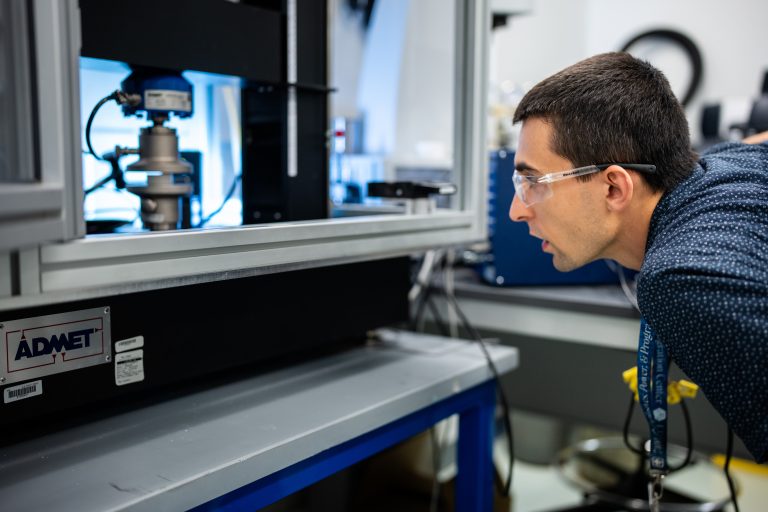
Featured image shows an employee at Sandia National Laboratories conducts mechanical testing of a surrogate material at the Center for Advanced Manufacturing and Innovation. Photo via Craig Fritz.