Italian machinery manufacturer CMS SpA will present its Krearob robotic large format additive manufacturing (LFAM) system at Formnext in Frankfurt. This will be the system’s first appearance at the trade show, and CMS plans live demonstrations at Hall 12.0, Stand D51.
Krearob is the newest system in CMS’s additive manufacturing (AM) portfolio. The company will show it next to its gantry-based Kreator A3, so visitors can see a robotic system and a gantry printer for large thermoplastic parts on one stand.
Robot Arm Paired With In-House Software
CMS, part of SCM Group, introduced the six-axis Krearob earlier this year. The system produces thermoplastic tooling, molds, and components with complex geometries at scale. According to the company, it can cut material use and part weight by up to 80% compared with traditional manufacturing technologies, while offering optimized material deposition, consistent quality, and high productivity.
Krearob combines an extrusion unit developed by CMS with the company’s own slicing software and human-machine interface (HMI). Programming, simulation, and printing are handled within one platform. CMS lists aerospace, automotive, and industrial manufacturing as the system’s target sectors.

Kreator A3 Also on Display
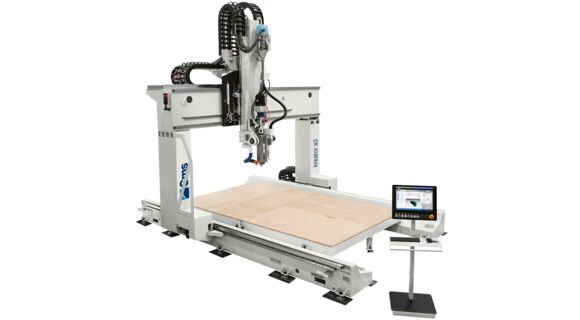
CMS will also exhibit the Kreator A3, an industrial 3D printer that uses screw extrusion to build sizable thermoplastic parts, including composite tooling and molds. The machine processes up to 30 kg of material per hour and can print in vertical, horizontal, and 45° orientations. CMS describes it as an alternative to conventional production that may be more resource-efficient.
Marino Chiappa, Division Director, Advanced Materials & Plastic at CMS, explained how the two machines differ. “While Krearob meets the needs [of] manufacturers in applications that demand multi-axis positioning and robotic flexibility, our gantry-based Kreator A3 takes a different approach to achieving manufacturing flexibility and is particularly suited to large-format printing applications within a defined machine envelope.”
Range of LFAM Configurations
Founded in 1969, CMS builds CNC machining centers and LFAM systems through its Advanced Materials Technology division. Its additive offering includes standalone 3D printing, hybrid additive/subtractive, and robotic systems. The company processes composites, carbon fiber, aluminum, light alloys, plastics, glass, stone, and metals for customers in aerospace, automotive, motorsport, marine, and industrial manufacturing.
Chiappa pointed to the breadth of the company’s lineup. “With one of the industry’s broadest LFAM portfolios – spanning standalone 3D printing, hybrid and double-bridge systems, and robotic solutions – these two solutions demonstrate our ability to offer manufacturers the right technology for their specific production requirements,” he said. He added that CMS aims to match its systems to each customer’s production needs instead of requiring manufacturers to fit a single approach.
Pairing Robotic and Gantry LFAM Platforms
CMS is keeping robotic and gantry LFAM as parallel product lines, each matched to a different production requirement.
Netherlands-based CEAD has also built a lineup that includes both machine types. At Formnext 2024, the company introduced the Flexcube, a cartesian pellet extrusion 3D printer with integrated CNC milling and a 4 m by 2 m build volume, alongside its robot-based Flexbot. The Flexcube’s extruder rotates to print at 45°, which CEAD said enables geometries previously possible only with robotic systems. CMS also lists 45° printing for the Kreator A3, and CEAD uses its proprietary extruder on both its robotic and cartesian machines.
CEAD CTO Maarten Logtenberg framed the Flexcube around floor space and ease of adoption. He said three or four units fit in the space a robotic system with an equivalent print area would occupy, and called the machine less intimidating than systems with large robotic arms. CEAD also kept developing its robotic line at that show, adding a wider printing option to the Flexbot that uses a vertical print bed to extend print width beyond four meters.
To stay up to date with the latest 3D printing news, don’t forget to subscribe to the 3D Printing Industry newsletter or follow us on LinkedIn.
Explore the full Future of 3D Printing and Executive Survey series from 3D Printing Industry, featuring perspectives from CEOs, engineers, and industry leaders on the industrialization of additive manufacturing, 3D printing industry trends 2026, qualification, supply chains, and additive manufacturing industry analysis.
Featured image shows CMS’ six-axis Krearob robotic large format additive manufacturing system will make its Formnext debut in Frankfurt. Image via CMS.