After the 60th launch of Electron rocket, Californian space launch company Rocket Lab has announced plans for Return On Investment, an ocean landing platform designed to recover its reusable Neutron rocket at sea.
For this development, the company has acquired a 400 ft (122 m) modified barge, which will be converted into a floating landing zone capable of securing the booster after it returns from space.
These modifications will include autonomous ground support systems to capture and secure the booster, blast shielding to protect onboard equipment, and station-keeping thrusters for precise positioning. Construction will take place throughout 2025, with the platform expected to be fully operational by 2026.
In a statement, Rocket Lab Founder and CEO, Sir Peter Beck, says, “We’re working hard to bring Neutron online with one of the fastest development schedules in history for a new rocket, because we know medium-lift launch opportunities are limited and space access is being stifled. Neutron’s debut launch planned for later this year will help to ease that bottleneck, and our new landing platform will open space access even further by enabling even more mission opportunities that require maximum Neutron performance.”

Advancing reusability and manufacturing efficiency
Neutron, Rocket Lab’s medium-lift launch vehicle, is designed with reusability at its core. Built from carbon composite materials, it is being developed to support satellite constellation deployments, national security operations, and even missions beyond Earth orbit.
With a payload capacity of up to 33,000 pounds (15,000 kg), Neutron is moving through development at a rapid pace, capitalizing on Rocket Lab’s experience as one of the industry’s most active launch providers.
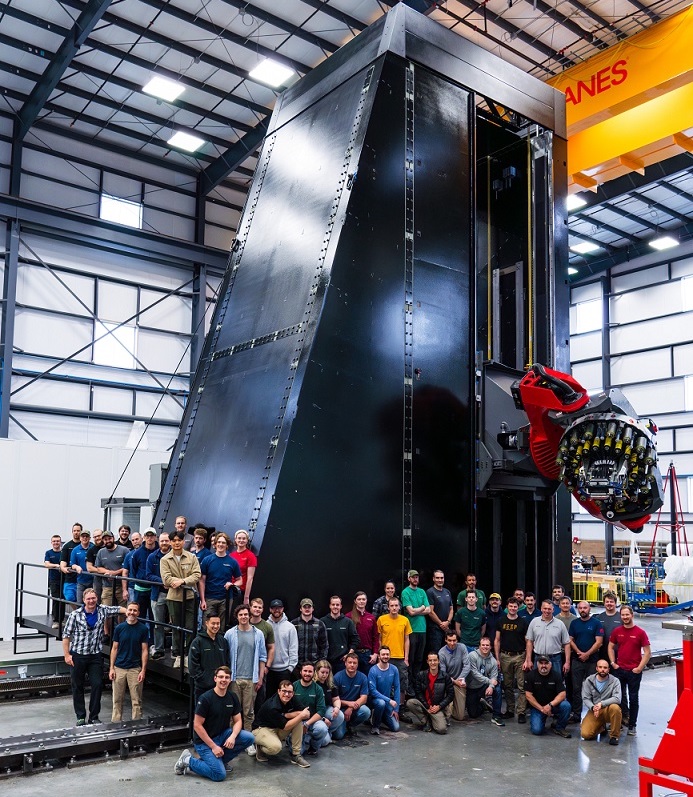
To accelerate the development of this rocket, Rocket Lab is reportedly utilizing a 90-ton automated fiber placement (AFP) machine to produce carbon composite structures for Neutron. Manufactured by Electroimpact, the custom-built AFP system is one of the largest of its kind, capable of laying 328 feet (100 meters) of carbon fiber per minute.
Located at Rocket Lab’s Space Structures Complex in Maryland, the machine automates the construction of major Neutron components, including its 91-foot interstage, 7-meter-diameter first stage, and second stage tanks. By reducing production times from weeks to hours, the system is expected to save over 150,000 hours in fabrication.
Aiming for optimized performance and recovery, Neutron will follow one of two mission profiles. For certain flights, the first stage will return directly to Rocket Lab’s Launch Complex 3 in Virginia via a propulsive landing. In cases where extended range is needed, the booster will instead execute a Down Range Landing (DRL), touching down on Return On Investment at sea.
Rocket Lab expects Neutron’s maiden launch to take place in the second half of 2025.
Rocket Lab’s space and aerospace efforts
Since its launch, Rocket Lab has built a strong reputation for reliable commercial launches, successfully deploying over 100 satellites. This success is largely driven by its Electron and Neutron rockets, powered by its 3D printed Rutherford engine.
One of Rocket Lab’s notable space projects came in 2022 when the Californian company launched NASA’s CAPSTONE satellite toward lunar orbit using its Electron rocket, marking a major step in the Artemis program. Designed to test a unique Near Rectilinear Halo Orbit (NRHO), CAPSTONE became the first spacecraft to follow the planned trajectory for NASA’s Gateway lunar outpost.
Built by Tyvak Nano-Satellite Systems, the microwave-sized CubeSat lifted off on June 28, beginning a months-long journey to the Moon. After a series of orbit-raising maneuvers, it accelerated to 24,500 mph, relying on solar gravity to extend its reach up to 963,000 miles from Earth. Following deep-space gravitational contours, CAPSTONE moved into position, setting the stage for future lunar exploration under Artemis.
In a recent development, the space company has joined Kratos Defense & Security Solutions in a $1.45 billion Pentagon-backed hypersonic missile testing program, one of the largest investments in U.S. hypersonic infrastructure. The five-year MACH-TB 2.0 initiative aims to accelerate the development of hypersonic technologies by increasing flight test capacity and reducing risks in transitioning new capabilities to operational use.
As part of the project, Rocket Lab will provide its Hypersonic Accelerator Suborbital Test Electron (HASTE) launch vehicle, a modified version of the Electron rocket designed for hypersonic testing. Equipped with Rutherford engines and carbon composite structures, HASTE has already supported multiple test flights.
What 3D printing trends should you watch out for in 2025?
How is the future of 3D printing shaping up?
To stay up to date with the latest 3D printing news, don’t forget to subscribe to the 3D Printing Industry newsletter or follow us on Twitter, or like our page on Facebook.
While you’re here, why not subscribe to our Youtube channel? Featuring discussion, debriefs, video shorts, and webinar replays.
Featured image shows the sea-based landing platform for Neutron rockets returning to Earth. Photo via Rocket Lab.