Chinese metal additive manufacturing equipment maker Eplus3D has collaborated with Young-Will Aerospace to validate a laser powder bed fusion (LPBF) process for copper-nickel (CuNi) alloy aerospace components.
The project produced crack-free parts with a tensile strength of 570 MPa, 18% above what conventional forging achieves for the same alloy. The result is worth pausing on, because nickel-copper alloys have long carried a reputation as difficult candidates for powder bed processing.
Copper tends to segregate at grain boundaries during laser fusion, and if that segregation is not managed carefully, cracks follow. The fact that the team eliminated cracking entirely suggests the process window they established is genuinely stable, not marginal.

Validating CuNi Processing on EP-M400
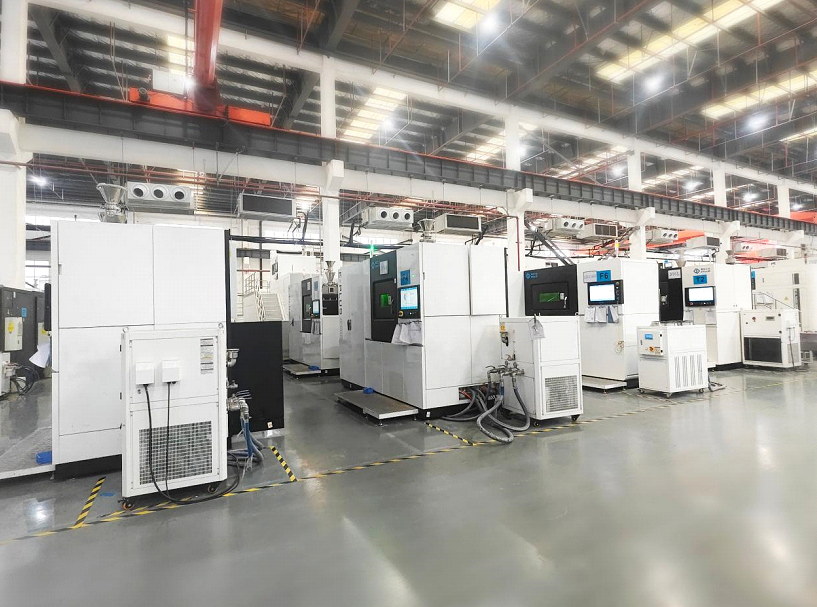
The validation was conducted on Eplus3D’s EP-M400, a system the company positions toward medium-to-large metal part production. It carries a build chamber of 400 × 400 × 450 mm, supports up to six lasers, and reaches a maximum build rate of 210 cm³/h. That multi-laser configuration likely mattered here, since the scanning strategy is one of the primary levers for controlling heat distribution and, by extension, the grain boundary behavior that drives cracking risk in this alloy class.
Getting to that 570 MPa figure required coordinated work across several variables simultaneously. Powder behavior, process parameters, scanning strategy, and final part performance all had to be matched to each other, not optimized in isolation. The project’s framing as a process validation reflects that distinction. A single successful build proves little in a production context. A validated process window is what actually enables repeatable manufacturing.
For Young-Will Aerospace, the practical interest in this alloy is straightforward. Nickel-copper alloys offer corrosion resistance, stable strength at medium temperatures, and generally good processability, which makes them candidates for components that operate in chemically aggressive or thermally variable environments.
The application list the two companies have pointed to includes fuel pipelines, hydraulic components, landing gear parts, aircraft engine combustion chambers, fasteners, rocket engine pipe joints, sealing structures, and liquid hydrogen storage and transfer systems.
Many of those components share a manufacturing challenge that goes beyond material selection. In conventional production, complex fluid-handling and sealing parts often require multiple machining, welding, and assembly steps. Each additional step introduces another potential failure point, whether structural, dimensional, or related to joint integrity. LPBF offers a route to producing some of those geometries as single integrated structures, which reduces the number of joints and interfaces that need to be managed downstream.
For Eplus3D, the project demonstrates that the EP-M400 can serve as a development platform for special alloys, not just a production tool for established materials. Whether Young-Will Aerospace moves toward component qualification and eventual flight use will depend on factors well beyond tensile strength. A validated process window and crack-free parts at 570 MPa is the foundation those next steps require.

LPBF Challenges Persist for Nickel Alloys
How difficult CuNi alloy qualification in LPBF can be is also visible in the resources being mobilized elsewhere for the same material class. Velo3D secured a $6 million US Navy contract to develop and qualify copper-nickel alloy on its Sapphire printer line, with the company describing itself as the first US-based LPBF OEM to develop CuNi for its systems.
The contract is tied to the Navy’s Maritime Industrial Base Program and supports the qualification of CuNi parts on Velo3D’s Sapphire XC system. The scale of that effort, a multi-million dollar defense contract supporting CuNi development and qualification, provides context for the process development represented by Eplus3D and Young-Will’s validated process window and 570 MPa result.
Cracking in nickel-based alloys under LPBF remains an active constraint elsewhere in the field. Researchers at IMDEA Materials Institute developed a dedicated microstructure control tool to predict and control the microstructure of nickel-based superalloys during metal 3D printing. Inconel 939, a nickel-based superalloy used in aerospace and energy applications, is prone to cracking during LPBF production, which limits its processability.
The research demonstrated how processing parameters such as laser power, scan speed, hatch distance, and scan track length can be used to control the resulting microstructure in IN939. It illustrates the process control that can be required to manage material behavior in nickel-based LPBF.
3D Printing Industry is inviting speakers for its 2026 Additive Manufacturing Applications (AMA) series, covering Energy, Healthcare, Automotive and Mobility, Aerospace, Space and Defense, and Software. Each online event focuses on real production deployments, qualification, and supply chain integration. Practitioners interested in contributing can complete the call for speakers form here.
To stay up to date with the latest 3D printing news, don’t forget to subscribe to the 3D Printing Industry newsletter or follow us on LinkedIn.
Explore the full Future of 3D Printing and Executive Survey series from 3D Printing Industry, featuring perspectives from CEOs, engineers, and industry leaders on the industrialization of additive manufacturing, 3D printing industry trends 2026, qualification, supply chains, and additive manufacturing industry analysis.
Featured images shows Eplus3D Metal PBF Systems operating at Young-Will Aerospace’s workshop. Photo via Eplus3D.