Researchers working on the European AM2SoftMag project have developed an iron-based metallic glass designed for Laser Powder Bed Fusion (LPBF), targeting soft-magnetic components for more energy-efficient electric motors.
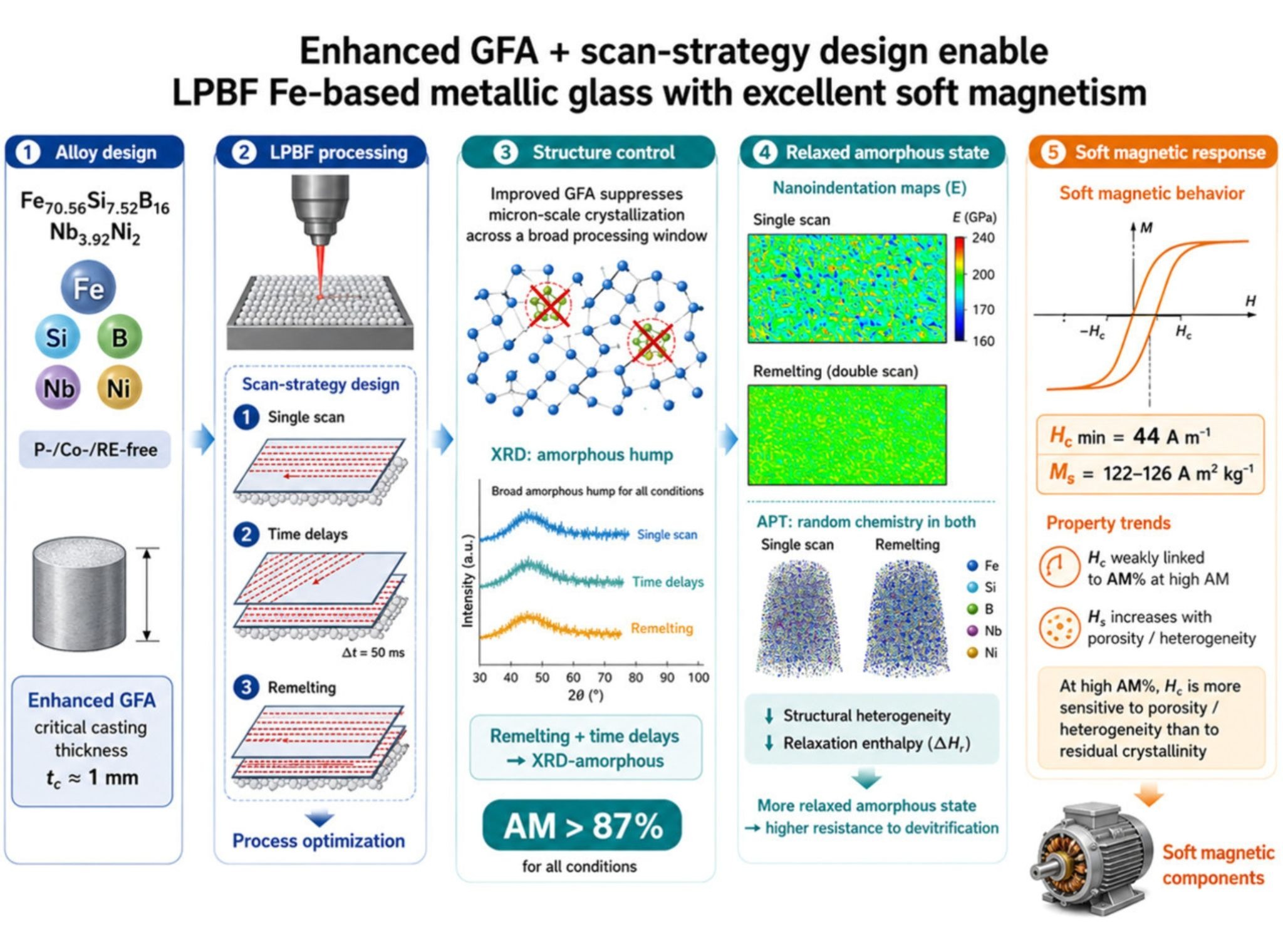
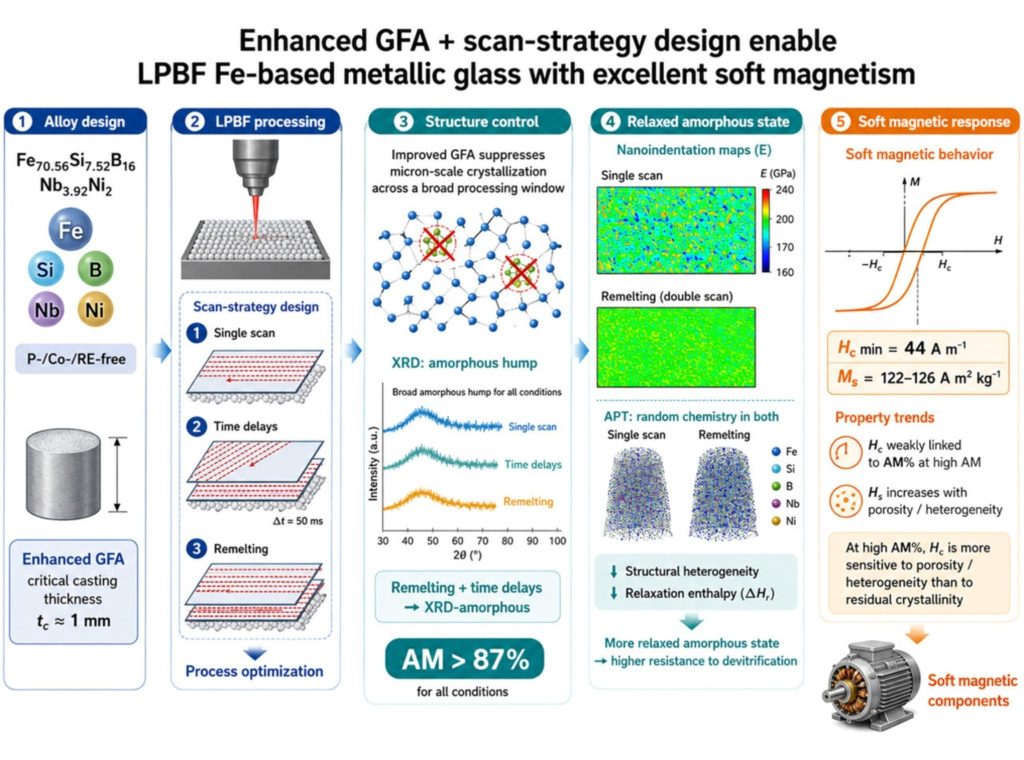
Designed by researchers at Saarland University (UdS) in Germany, the alloy can be processed by LPBF while retaining a highly amorphous structure. The material contains iron, silicon, boron, niobium and nickel, while avoiding phosphorus, cobalt and rare-earth elements commonly used to improve glass-forming ability.
Researchers from IMDEA Materials, a materials research institute based in Madrid, optimized the LPBF processing parameters used to manufacture the alloy. The study found that combining remelting with controlled laser-off time delays produced samples that were fully amorphous by X-ray diffraction.
The work, recently published in Acta Materialia, is intended to support the future production of 3D printed rotor and stator components for high-efficiency electric motors.
Preventing crystallization during LPBF
Iron-based metallic glasses can reduce hysteresis and eddy-current losses, making them attractive for electric motors. However, LPBF repeatedly heats and cools the material, which can trigger devitrification and degrade its soft-magnetic properties.
The AM2SoftMag alloy was designed to improve resistance to crystallization. Its critical casting thickness is around 1 mm, compared with roughly 150 µm for commercial P-, Co- and rare-earth-free alloys such as Kuamet 6B2 and Finemet.
Researchers tested the material on a RenAM500Q Flex LPBF system using different laser powers, exposure times, scan delays and double-scanning strategies. The team found that remelting did not improve chemical homogeneity. Instead, calorimetry and nanoindentation suggest that the second melt creates a more relaxed and less structurally heterogeneous amorphous state, increasing resistance to later crystallization.
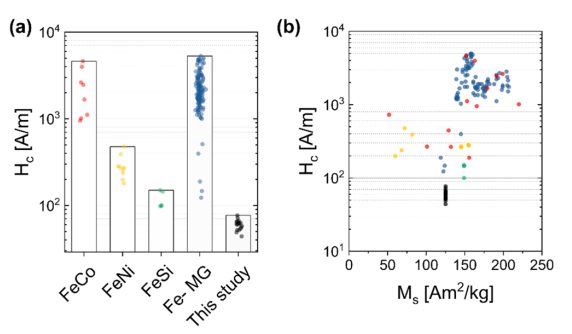
Coercivity ranged from 44 to 77 A/m, with the lowest value measured in a single-scan specimen using a 20 ms delay. The study reports 44 A/m as at least an order of magnitude lower than values previously achieved in comparable LPBF-processed P-, Co- and rare-earth-free Fe-based metallic glasses.
At these high amorphous fractions, coercivity showed no clear relationship with amorphous fraction. The researchers suggest porosity, residual stresses and magnetostriction may instead play a greater role in magnetic performance.
Moving toward electric motor prototypes
The research remains at the material and process-development stage. The consortium has not yet demonstrated the alloy’s effect on the efficiency of a complete operating electric motor.
Manufacturing defects also remain an important constraint. The printed specimens contained both pores and cracks, and the researchers note that further work is needed before the material can be translated into functional motor components. Magnetic permeability was also not measured because variations in sample geometry made the demagnetizing factor difficult to evaluate accurately.
Next steps will focus on reducing manufacturing defects, scaling the LPBF process and evaluating the material in physical prototypes of high-efficiency motor rotors and stators. Alongside Saarland University and IMDEA Materials, this next stage will involve the Italian National Metrology Institute and Technische Universität Berlin. AM2SoftMag is funded by the European Innovation Council through the Horizon Europe Pathfinder Open program under grant agreement 101046870.
Additive manufacturing targets electric motor performance
Additive manufacturing is being applied to different parts of electric motor development. In February 2026, German manufacturer Additive Drives secured a mid-double-digit million euro investment to scale its 3D printed electric motor technology. The company produces rare-earth-free induction motors and reports efficiencies of up to 98% for its industrial systems.
Later that month, researchers at the Massachusetts Institute of Technology demonstrated a multimaterial extrusion platform capable of producing a functional linear electric motor in around three hours. The system combines conductive, magnetic and structural materials using four extrusion tools, with rotary motors planned for future development.
AM2SoftMag addresses an earlier-stage materials constraint. Rather than manufacturing a complete motor, the project is seeking to retain the amorphous structure and soft-magnetic properties of an LPBF-processed alloy while reducing the defects that currently limit its use in functional rotors and stators.
Register now for AMA: Software 2026. Join 3D Printing Industry on 22 October for expert presentations, panel discussions and live audience Q&A exploring the software shaping additive manufacturing. Register here.
To stay up to date with the latest 3D printing news, don’t forget to subscribe to the 3D Printing Industry newsletter or follow us on LinkedIn.
Explore the full Future of 3D Printing and Executive Survey series from 3D Printing Industry, featuring perspectives from CEOs, engineers, and industry leaders on the industrialization of additive manufacturing, 3D printing industry trends 2026, qualification, supply chains, and additive manufacturing industry analysis.
Featured image shows design approach combining enhanced glass-forming ability (GFA) with LPBF scan-strategy optimization. Image via IMDEA Materials Institute