Hear from the experts shaping additive manufacturing software. Join 3D Printing Industry on 22 October for AMA: Software 2026, featuring exclusive presentations, panels and live Q&A!
Myrava, formerly known as Ricoh 3D for Healthcare, has received U.S. Food and Drug Administration 510(k) clearance for a patient-specific 3D printed bolus used in radiation therapy. The clearance adds a treatment accessory to a portfolio that has so far centered on diagnostic anatomical models. It also gives the company a regulated product for radiation oncology departments, a hospital segment where custom 3D printing has mostly been done in-house on an ad hoc basis.
A bolus is a layer of tissue-equivalent material placed directly on a patient’s skin during radiotherapy. It changes how the radiation dose is deposited, and clinicians typically use it to bring more of the dose to the surface when treating superficial targets. Myrava’s version is built to the design a radiation therapist prepares for each patient and to the specifications of that patient’s treatment plan. The goal is a closer match between the accessory and the dose calculation than generic materials can provide.
From DICOM file to printed device
Clinicians send the treatment plan as a DICOM package containing the radiotherapy (RT) structure file, and Myrava handles production from there. The company says no additional software or manual creation time is needed on the hospital side, which matters in departments where dosimetrists and physicists have limited time for fabrication work.
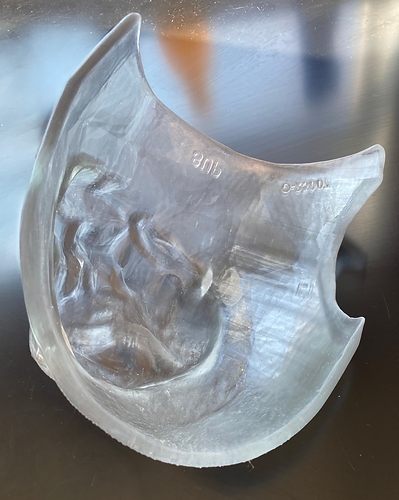
The device is printed directly rather than cast from a printed mold, which removes a step common in many custom bolus workflows. Myrava uses a translucent, flexible material. The translucency lets therapists see skin marks and other surface features underneath when positioning the bolus, and the flexibility is meant to make it more comfortable to wear across repeated sessions. Each bolus can be reused on the same patient throughout a course of treatment when it is maintained according to the Instructions for Use.
Myrava positions the product against the improvised options many oncology teams still rely on, such as gelatin sheets, wet cloths, and other makeshift materials that are not shaped to individual anatomy or planned around a specific treatment. Off-the-shelf sheets can sit unevenly on curved or irregular surfaces like the nose, ear, scalp, or chest wall. That uneven fit is the main problem a patient-specific shape is designed to solve.
Gary Turner, CEO and Co-Founder of Myrava, pointed to where the devices can be made as a key differentiator. “The Myrava Bolus can be manufactured at co-located point-of-care facilities offering additional benefits, such as closer contact to the clinicians for iterative design and faster turnaround times,” he said.
Building on a point-of-care network
That manufacturing model is where Myrava has put much of its operational effort. The company runs FDA-registered point-of-care printing sites inside health systems, including a facility with Advocate Health in North Carolina and its most recent location at IU Health. Placing production inside or next to the hospital shortens the loop between the therapist who designs a bolus and the team that prints it. That is useful when a patient’s anatomy changes during treatment or a fit needs adjusting before the next fraction.
The bolus is Myrava’s first clearance outside anatomical modeling. The company already holds 510(k) clearances for diagnostic anatomic models across craniomaxillofacial, orthopedic, cardiovascular, neurological, gastrointestinal, genitourinary, and breast applications. Those models are used mainly for surgical planning and patient communication, while the bolus takes part in the delivery of treatment itself.
The company operates under ISO 13485:2016 certification for medical device quality management and maintains SOC 2 compliance for data security. The security side matters here because the workflow depends on hospitals sending patient imaging and treatment planning data to an outside manufacturer.
Why Ricoh 3D for Healthcare became Myrava
The name change follows a change of ownership. On July 6, 2026, Ricoh USA announced the sale of Ricoh 3D for Healthcare, LLC to Myrava, Inc. The business will now focus on FDA-cleared personalized medical devices and point-of-care manufacturing for healthcare providers across the United States under dedicated ownership.
Ricoh had been moving the unit toward independence for some time. It formed the LLC in 2025 after incubating the business for five years. By 2026, the unit no longer fit Ricoh’s focus on process automation, workplace experience, and business process services.
For Myrava, independence means dedicated investment. “As an independent company, Myrava, Inc. will benefit from dedicated investment and leadership fully focused on advancing personalized, FDA‑cleared medical devices and point‑of‑care manufacturing for healthcare providers,” said Turner. The company also keeps its medtech partnerships, including Kallisio (oral stents for head and neck cancer) and Insight Surgery (oncology and osteotomy surgical guides). The bolus is its first clearance under the new name.

Between in-house printing and mail-order bolus
Myrava gives hospitals patient-specific radiotherapy devices without requiring them to run their own 3D printing program. It manages production and regulatory compliance like an outside vendor, but prints at FDA-registered sites inside or next to partner health systems. The bolus extends that model from surgical planning to daily treatment delivery.
Commercial providers have been moving toward that market. 3D Systems partnered with Klarity to widen distribution of its FDA-cleared VSP Bolus, which became part of Klarity Prints, a service-based line of patient-specific 3D printed radiotherapy accessories. Like Myrava’s device, VSP Bolus is printed from treatment plans prepared by radiotherapy professionals, and it is made from a soft, biocompatible material that contours to the patient’s anatomy.
Other centers have built the capability themselves. At BC Cancer Kelowna, clinicians use a small 3D printer to make patient-specific brachytherapy tools for cervical, vaginal, and recurrent endometrial cancers. Getting there took several years: the team had to secure funding, develop its own software, and bring the printer into clinical use, and it now produces applicators from each patient’s MRI and CT scans.
That split defines the opportunity. Mail-order services lack proximity, and in-house programs take years to build. Myrava is betting it can offer regulated devices with a local turnaround.
Register now for AMA: Software 2026. Join 3D Printing Industry on 22 October for expert presentations, panel discussions and live audience Q&A exploring the software shaping additive manufacturing. Register here.
To stay up to date with the latest 3D printing news, don’t forget to subscribe to the 3D Printing Industry newsletter or follow us on LinkedIn.
Explore the full Future of 3D Printing and Executive Survey series from 3D Printing Industry, featuring perspectives from CEOs, engineers, and industry leaders on the industrialization of additive manufacturing, 3D printing industry trends 2026, qualification, supply chains, and additive manufacturing industry analysis.
Featured image shows 3D printed bolus. Photo via Myrava.