
My first reactions to Gather3d — the brain child of designer and model maker Pierre Papet — were a confused jumble of “that’s just taking 3D printing backwards” and “how cool, I wish I’d seen this before Christmas for Jamie, he’d love it.” It seems those reactions were kind of what Pierre was going for, describing the Gather3D product as “an analogue 3d printer.” What this means is — no digital 3D input required. Gather3D is a “manual system as well as a mechanical machine” that allows the user to entirely control the deposition process with their hands, courtesy of two knobs controlling the X and Y axes, while the Z axis, the height of the extruder, is controlled by other buttons.
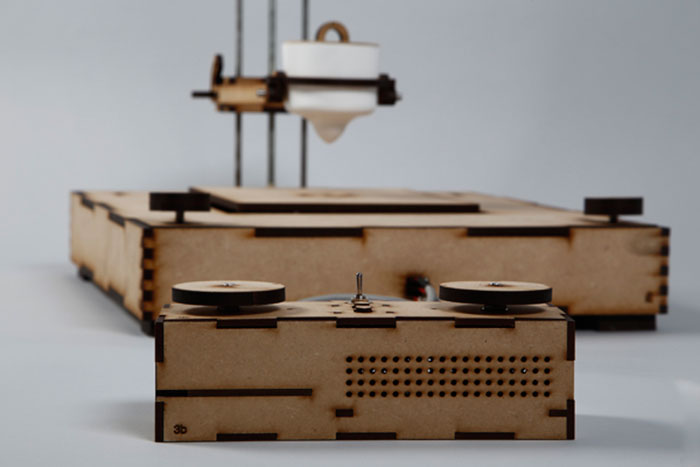
The initial thoughts of a backwards step for 3D printing were likely triggered by the aesthetics of the design of the Gather3d platform (reminiscent of Makerbot Cupcake styling) together with the images Pierre has put out that show the achievable resolution when ‘printing’.
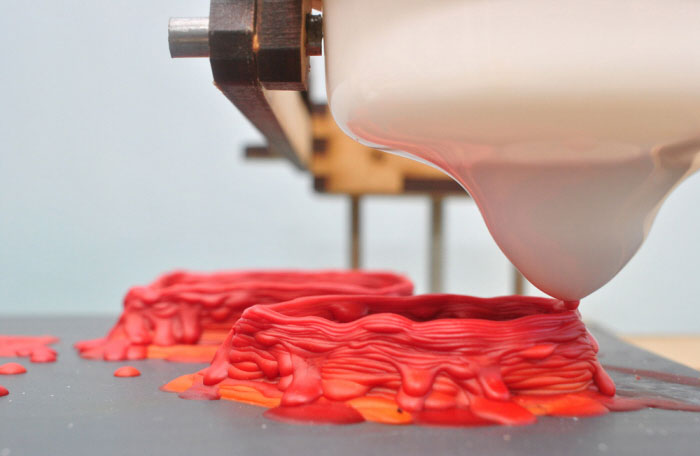
The latter in particular resulted in an inadvertent heavy sigh, and yet I knew my son would love this. And that was before reading about Pierre’s motivation for developing the Gather3d, namely: “to introduce craft and the art of making to a broad audience. Gather3d is designed to be an accessible and evolutive creative platform. It allows younger, web-native generations, who have been used to permanent connectivity, to reengage with making and the real world.”
It makes sense in so many ways, and when Pierre says it is “a critique of digital manufacturing and the 3D printer seen as a technological divinity”, he makes a pertinent point, specifically that 3D printing is not a solve-all technology, it is an enabling tool for industry and for individuals. As such the developments with 3D printing, Pierre sees as “symptomatic of our ‘Everything, now!’ era.” And with Gather3d he wants to ask the question: “What happens if we take the time to reengage with a making activity?” And proposes that: “Hours of practice might allow users to experience a jubilation of real mastering, in contrast with the illusion of know-how provided by deskilling technologies.”
Considering the hours of ‘real mastering’ that are also required to successfully use an entry-level 3D printer, I personally think that Pierre goes a step too far with his proposition. The skills and learning curve involved with entry-level 3D printing are extremely valuable, not to mention necessary, for the wider manufacturing sector as well individual creativity.
That said, there is no getting away from this being a fun development, and kids, I think, would love it.