Advanced manufacturing technology company Impossible Objects has closed a $40 million Series B round to scale its industrial 3D printing technology, adding to $20 million in U.S. government contracts the company has already secured for defense and aerospace applications.
The round was led by Inflection Equity, with participation from Aaron Wealth Management, OCA Ventures, Impact Capital and Excell Partners, and will fund production of the company’s printing systems, customer deployments, and the commercial and service teams needed to support a growing installed base.
Betting on speed to move 3D printing past prototyping
Impossible Objects positions additive manufacturing as a technology that has largely remained a prototyping tool for decades, citing speed, material limitations and cost as the reasons. Its Composite-Based Additive Manufacturing (CBAM) technology targets the speed constraint: the company’s CBAM 25 system can print up to 25 layers per minute, which the company says is 15 times faster than competing production-grade additive technologies.
The company pairs that speed claim with a materials one. CBAM uses advanced composites, including carbon fiber, and the company says the resulting parts can reach strengths of up to 200 MPa, up to four times that of competing additive processes, with minimal shrinkage and warping. Impossible Objects markets this combination as an alternative to CNC machining and injection molding, arguing it lets manufacturers skip the tooling costs those processes require. None of these performance figures are independently verified in the release; they come from the company’s own characterization of its system.
“We’ve created a fundamentally new way to manufacture,” said Robert Swartz, founder and chairman of Impossible Objects. He compared the shift to historical manufacturing milestones like the mill, precision measurement and interchangeable parts, framing the new funding as the resource needed to “make it real at scale.”

From lab systems to defense production lines
The technology isn’t still theoretical. Since the CBAM 25 launched in early 2025, Impossible Objects has taken five orders and moved into active deployment across aerospace, defense and advanced manufacturing settings, including with the U.S. Air Force, the National Institute for Aviation Research, the Oregon Manufacturing Innovation Center and Rochester Institute of Technology. At the U.S. Army’s Rock Island Arsenal, the system is positioned to support production of up to 10,000 drone bodies per month, a scale that pushes the technology well past the one-off prototyping additive manufacturing is traditionally known for.
The company’s $20 million in government backing includes Small Business Innovation Research (SBIR) Phase I and Phase II awards, funding work on high-strength long-range drones, composites with strength comparable to conventionally manufactured composites, integrated wiring embedded inside printed parts, and lightweight aircraft wing and fuselage structures. Impossible Objects’ technology has also been deployed with the Air Force Research Laboratory and is included in the U.S. Air Force’s official technology roadmap.
Retired U.S. Army major general Stephen Farmen tied that defense interest to a broader shift in how militaries need to manufacture. “The nature of warfare is changing as new technologies are deployed,” he said, arguing that the defense industrial base needs manufacturing capable of “robust and flexible distributed production” to get systems like drones and counter-drone equipment, along with repair parts, to soldiers faster.
Scaling to meet demand
Gintaras Vaisnys, managing partner at Inflection Equity, framed the firm’s decision to lead the round around that same demand curve, pointing to what he called “explosive demand” for the technology across both commercial and government customers. Impossible Objects CEO Steve Hoover said the CBAM 25 was built specifically to combine high productivity and reliability with the tool-less flexibility that modern, adaptive supply chains increasingly require, positioning the company, in his words, “at the forefront of creating the modern manufacturing supply chains that advanced economies need.”
With the new capital, Impossible Objects is now focused on ramping up production of its printing systems and expanding its footprint with the customers it has already signed on, betting that the same speed and strength advantages that attracted defense and aerospace buyers will carry the technology into broader industrial use.
Capital Is Chasing Production, Not Prototypes
Impossible Objects’ pitch rests on a specific gap: AM has struggled to compete with CNC machining and injection molding at real production volumes. The company is trying to close that gap on two fronts at once, print fast enough to matter at scale (25 layers a minute) and produce parts strong enough to replace, not just approximate, traditionally manufactured composites.
Investors have been funding similar goals elsewhere, often at a larger scale. Hadrian launched Hadrian Additive, built specifically to take 3D printing “from prototype to production” for U.S. defense programs, the same framing Impossible Objects uses for CBAM. Hadrian had already closed a $260 million Series C in mid-2025 (part of nearly $500 million raised to date) to fund the factories behind that push, underscoring how much capital is flowing toward companies promising to convert additive manufacturing into a certified, high-throughput production process rather than a prototyping shop.
A second recent raise shows the same production-scale goal applied further up the supply chain. 6K Additive went public on the Australian Securities Exchange in an A$48 million IPO, with proceeds earmarked for expanding production capacity to meet what the company reported as a $240 million sales pipeline, driven largely by aerospace and defense demand. Like Impossible Objects, 6K’s raise was framed around scaling existing demand rather than funding new research.
Different points in the supply chain, same underlying signal: investors are increasingly funding the infrastructure needed to make 3D printing a production technology, not just a research one.
3D Printing Industry is inviting speakers for its 2026 Additive Manufacturing Applications (AMA) series, covering Energy, Healthcare, Automotive and Mobility, Aerospace, Space and Defense, and Software. Each online event focuses on real production deployments, qualification, and supply chain integration. Practitioners interested in contributing can complete the call for speakers form here.
To stay up to date with the latest 3D printing news, don’t forget to subscribe to the 3D Printing Industry newsletter or follow us on LinkedIn.
Explore the full Future of 3D Printing and Executive Survey series from 3D Printing Industry, featuring perspectives from CEOs, engineers, and industry leaders on the industrialization of additive manufacturing, 3D printing industry trends 2026, qualification, supply chains, and additive manufacturing industry analysis.
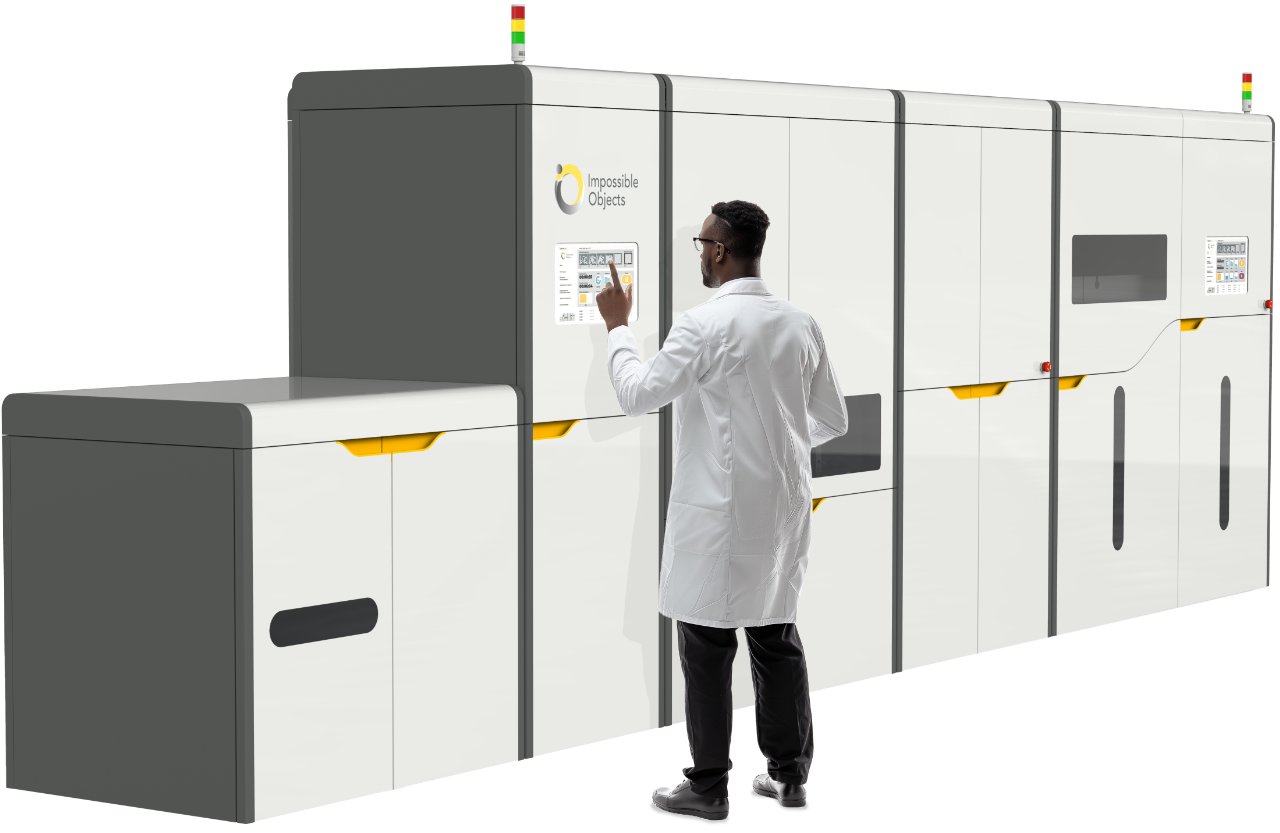
Featured image shows Composite-based additive manufacturing technology (CBAM). Image via Impossible Objects.