
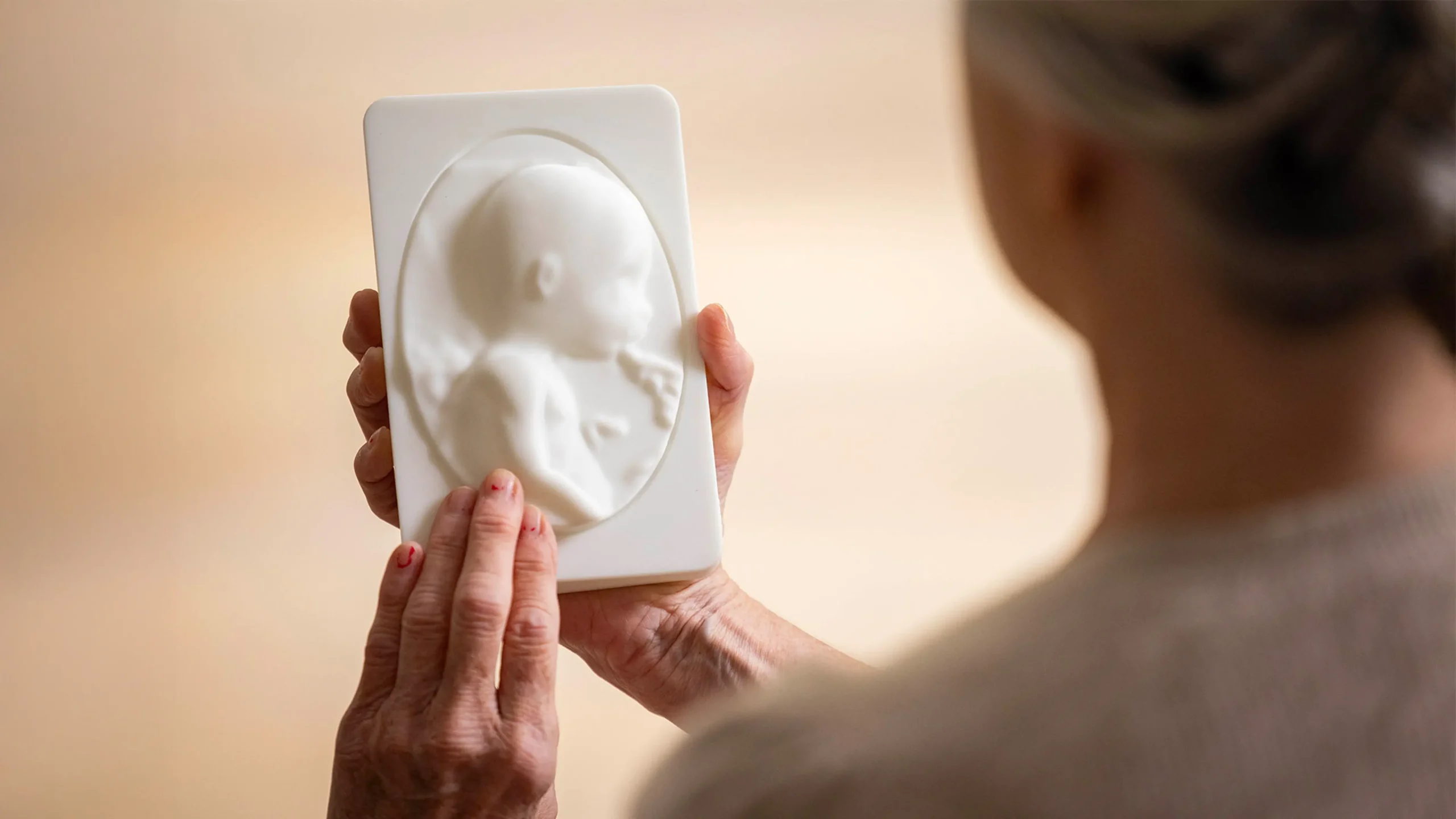
A UK sight loss charity has begun offering visually impaired expectant parents free 3D printed replicas of their baby’s ultrasound scan, letting them feel the shape of their unborn child for the first time. The pilot, called First Hello, comes from Guide Dogs, the UK’s largest sight loss charity, and is capped at 50 prints during its initial run.
From Flat Scan to Physical Object
The process starts with a standard appointment. Parents upload a JPG or PNG of their 20-week 2D ultrasound scan, capped at 10MB, through a dedicated ordering site set up for the programme. From there, the image is converted into a 3D render and printed, then shipped to the family. Guide Dogs says most parents should receive their tactile sonogram within about a week, and the service costs nothing. Sighted parents with visually impaired relatives can also request one, extending the offer beyond the expectant parent alone.
Day-to-day delivery of the service sits with a company called Hope and Glory, operating on Guide Dogs’ behalf; any personal data submitted, including the shipping address and the scan itself, is collected and processed by Hope and Glory rather than the charity directly.

A Gap Identified Through Survey Data
Guide Dogs built the case for First Hello on a survey of 2,000 UK adults with visual impairment. Just over half, 54%, said standard pregnancy scans should be made more inclusive, while 80% felt every parent should be able to experience milestones such as seeing a baby’s first sonogram. Nearly two-thirds, 64%, said visually impaired family members would feel more included in that moment if they could physically feel a version of the scan.
Kerry Bevan, head of support services at Guide Dogs, framed the initiative as addressing a recurring exclusion: “Every parent, grandparent and loved one deserves to experience the joy of early parenting milestones,” she said, adding that “too often, people with sight loss are excluded from significant life moments that others take for granted.”
Making Health Information Physically Accessible
First Hello’s underlying move, turning a private health moment normally locked inside a screen or a form into something that can be felt, has a direct parallel in how 3D printing has already reached other parts of healthcare. The gap is consistent across cases: visual-only formats (a scan, a label, a result) exclude visually impaired people from information that’s otherwise routine, personal and often private.
Pharmaceutical 3D printing company FabRx tackled that same problem from the medicine cabinet. Working with University College London, the company produced “Printlets,” orodispersible 3D printed tablets with Braille and Moon patterns embossed directly onto the surface, letting patients identify their own medication by touch once it’s out of its original packaging, something standard pill design has never accounted for.
A separate effort tackled access from the other side of healthcare: training people to deliver it. France’s Organisation for Blind and Partially Sighted Students (GIAA), working with the Dassault Systèmes Foundation, built a library of 3D printed anatomical models to support blind and visually impaired students training as massage therapists, a profession that relies almost entirely on touch, yet had long lacked adequate tactile teaching materials for anatomy and physiology.
Whether it’s a pill bottle, a training room, or an ultrasound printout, the pattern holds: give people direct, physical access to health information and health work that visual-only formats have quietly kept out of reach.
3D Printing Industry is inviting speakers for its 2026 Additive Manufacturing Applications (AMA) series, covering Energy, Healthcare, Automotive and Mobility, Aerospace, Space and Defense, and Software. Each online event focuses on real production deployments, qualification, and supply chain integration. Practitioners interested in contributing can complete the call for speakers form here.
To stay up to date with the latest 3D printing news, don’t forget to subscribe to the 3D Printing Industry newsletter or follow us on LinkedIn.
Explore the full Future of 3D Printing and Executive Survey series from 3D Printing Industry, featuring perspectives from CEOs, engineers, and industry leaders on the industrialization of additive manufacturing, 3D printing industry trends 2026, qualification, supply chains, and additive manufacturing industry analysis.
Featured image shows 3D Printed Tactile Ultrasounds. Photo via Guide Dogs.