
Formnext expects around 800 exhibitors in Frankfurt this November, with China now by far the largest foreign exhibitor group. Organisers say domestic competition, industrial policy and geopolitical barriers are pushing Chinese additive manufacturing companies towards Europe, while the show itself expands into defence and a more application-led format.
China’s rapidly expanding additive manufacturing industry is increasingly looking towards Europe as intense competition at home and barriers to the US market push manufacturers towards exports, according to Formnext Vice President Sascha F. Wenzler.
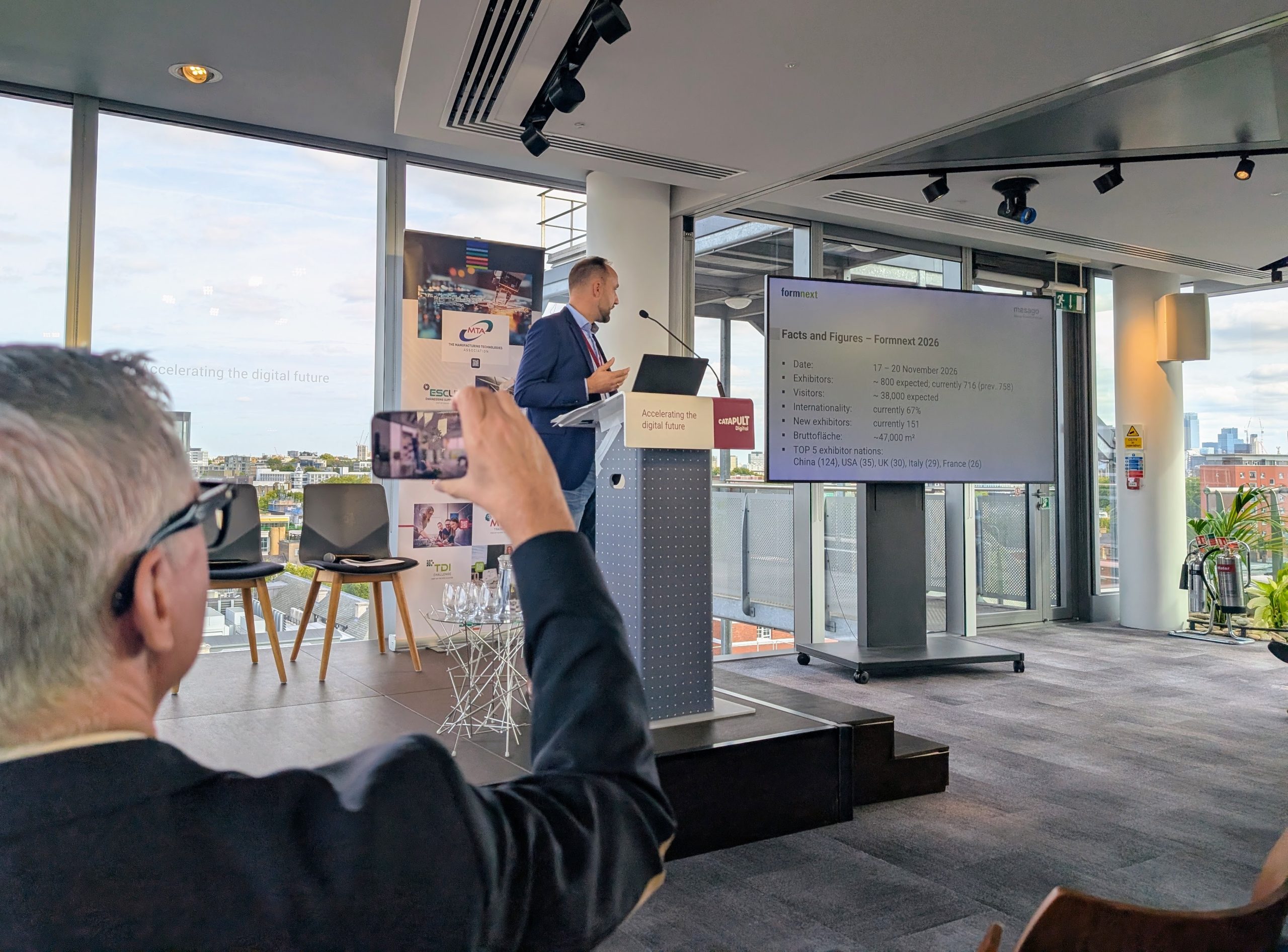
Speaking at an Additive Manufacturing UK event in London this week, Wenzler and fellow Formnext Vice President Christoph Stüker outlined plans for Formnext 2026, which takes place in Frankfurt from 17 to 20 November.
Around 800 exhibitors are expected. At the time of the presentation, more than 720 had registered, with 67% coming from outside Germany. China stands out with some 124 Chinese companies are currently scheduled to exhibit, compared with 35 from the United States, 30 from the UK, 29 from Italy and 26 from France. China therefore has more exhibitors than the US, UK and Italy combined.
The numbers follow a period of rapid expansion across the Chinese AM sector. I recently returned from Formnext Asia Shenzhen, where the depth of the domestic supply chain was increasingly difficult to ignore. Beyond machine manufacturers, Chinese companies were competing in materials, lasers, optics, components and other parts of the additive manufacturing stack.
National Policy Growing Additive Manufacturing Market
For Wenzler, the expansion visible in Shenzhen and the growing Chinese presence in Frankfurt are closely connected. “The Chinese market there is mainly driven by a clear governmental strategy,” he said, pointing to sustained state support for advanced manufacturing. That support, he argued, has helped create large numbers of new companies. The resulting domestic competition is now pushing established Chinese AM manufacturers to look overseas.
“The bigger, older companies, they need to find a way out of this competitive pressure,” said Wenzler. “How to do it? To go more into export.” The US is increasingly difficult to enter, he noted. “So where to go? There’s Europe.” Wenzler described the growth of Chinese exhibitors at Formnext Frankfurt as a direct consequence of this development.

China moves from policy support to industrial competition
Additive manufacturing was mentioned directly for the first time in China’s 13th Five-Year Plan from 2016 and again in the 2021 14th national plan. While the national 15th Five-Year Plan for 2026-2030 does not explicitly identify additive manufacturing or 3D printing in those terms, it does place greater emphasis on advanced manufacturing, intelligent manufacturing, high-end equipment, advanced materials, industrial software and strengthening manufacturing supply chains.
Rather than being treated as an isolated emerging technology, AM increasingly sits inside a broader advanced manufacturing system. Regionally, Shenzhen’s own 15th Five-Year Plan is more explicit, calling for further development of subtractive, formative and additive manufacturing processes as part of the city’s advanced manufacturing strategy.
When I raised the distinction with Wenzler, he agreed with the broader interpretation. “It’s not a single technology solving future manufacturing problems,” he said. AM may be a large or small part of a production strategy depending on the application, but must increasingly operate alongside software, automation, IoT and cybersecurity. “That’s a smart way of describing it as smart manufacturing, advanced manufacturing. That’s the frame.”
The dynamic in China also reminded Wenzler of an earlier stage in the Western AM market.
He compared the energy around new companies in Shenzhen with Formnext Frankfurt around 2016 and 2017, when new machine manufacturers and technologies were appearing rapidly. China, he argued, is at a different point in the industry’s maturity cycle. There is still “a lot of dynamic” and “a lot of new companies”, creating competitive pressure not only against overseas manufacturers but between Chinese companies themselves.
A different route to industrialising AM
One development in Shenzhen particularly caught Wenzler’s attention: the proliferation of relatively inexpensive professional and “prosumer” 3D printers. These machines are broadening the user base beyond traditional industrial AM customers. Architectural practices, small companies and designers can increasingly access capable additive manufacturing equipment without making a conventional industrial capital-equipment investment.
But the more consequential development may be what happens when those machines are deployed by the hundred or thousand. Stüker pointed to the rise of print farms built around large numbers of lower-cost systems. Rather than producing a small number of very high-value components, he said, the business case can be built around volume production of relatively low-value parts.
Wenzler described this as “another way of scaling.”
“You can scale it with an industrial machine, and you can also scale it having hundreds of smaller machines running,” he said. “It’s a different way of industrialising AM.”
That distinction is becoming increasingly difficult to dismiss as merely a desktop printing phenomenon. During the discussion, I relayed an example received from a Chinese print farm operator shortly before the interview: an order for 60,000 small industrial components delivered within seven days.
The economics, reliability and limits of these production systems still matter. Thousands of cheap printers do not automatically constitute a profitable factory. Labour, utilisation, failure rates, maintenance, order routing and downstream processing remain critical. But the scale changes the argument. Industrial AM no longer necessarily means a small number of expensive industrial machines.
Frankfurt and Shenzhen remain different ecosystems
Despite the growing flow of Chinese companies into Europe, Wenzler said there is still limited overlap between the Shenzhen and Frankfurt communities. “There is a certain overlap, but not a big one,” he said.
Even where the same large companies operate in both markets, different business units may be responsible for selling, sourcing or visiting. Wenzler still sees Frankfurt as Formnext’s global marketplace, where leading suppliers and international visitors converge. Shenzhen plays a different role, providing access to an increasingly innovative Chinese and Asian manufacturing ecosystem.
“There is also a lot of innovation in China,” he said. The flow between the two markets, however, appears increasingly asymmetric. European and US manufacturers were once a conspicuous presence at Chinese AM trade shows. While international companies remain present, Shenzhen is today overwhelmingly shaped by Chinese manufacturers and visitors from China and neighbouring markets.
Wenzler broadly agreed that Chinese companies are travelling west in greater numbers than Western companies are moving in the opposite direction. He attributed much of that imbalance to geopolitical and competitive conditions.
“I’m not expecting a quick change that many European companies will attend China,” he said, adding that the economic and competitive environment makes selling there difficult. For European AM suppliers, this creates an awkward combination. China is developing an increasingly complete domestic manufacturing ecosystem while its manufacturers are simultaneously becoming more aggressive exporters.
Wenzler’s answer is a stronger European AM ecosystem based around what he described as three priorities: resilience, sovereignty and competitiveness.
“It’s not about just selling a machine,” he said. “It’s about selling a solution for a certain manufacturing problem.” In my review of the first ten years of Formnext, I call this the slow stubborn industrialisation of imagination.
UK Takes the Partner Country role at Formnext 2026
The UK is Formnext’s Partner Country for 2026, following France in 2025.
Thirty UK exhibitors are currently registered. Formnext has highlighted British strengths in aerospace, energy, motorsport, advanced automotive manufacturing and defence, while also pointing to the country’s large research base. The organisers announced the UK partnership earlier this year, describing the country as a long-standing global AM player with strengths spanning systems, software and industrial applications.
Wenzler said the Partner Country designation is intended to create something more durable than additional branding during a single trade show.
He pointed to France and the Nordic countries as previous examples where the programme helped create more coordinated national representation and longer-term connections between companies and organisations. Success for the UK, in that sense, will be easier to judge after Frankfurt than during it.
The more immediate contrast is already visible in the exhibitor numbers. The UK arrives as Formnext’s Partner Country with 30 exhibitors. China arrives with 124. That does not by itself measure technological leadership or industrial capability. But it does illustrate how quickly the geography of additive manufacturing is changing.

Register now for AMA: Software 2026. Join 3D Printing Industry on 22 October for expert presentations, panel discussions and live audience Q&A exploring the software shaping additive manufacturing. Register here.
To stay up to date with the latest 3D printing news, don’t forget to subscribe to the 3D Printing Industry newsletter or follow us on LinkedIn.
Explore the full Future of 3D Printing and Executive Survey series from 3D Printing Industry, featuring perspectives from CEOs, engineers, and industry leaders on the industrialization of additive manufacturing, 3D printing industry trends 2026, qualification, supply chains, and additive manufacturing industry analysis.