
Site preparation is advancing at Bambu Lab’s planned 3D printing manufacturing headquarters in Shenzhen, where the company intends to create production capacity for more than three million 3D printers per year.
Bambu Lab’s enormous new manufacturing base in Shenzhen is beginning to move from an industrial land deal toward a physical construction project.
A notice published by the Guangming District government on September 18 reveals that Shenzhen Zhuhe Technology, the Bambu Lab subsidiary developing the site, has applied to create a temporary construction entrance at the planned 3D Printing Intelligent Manufacturing Headquarters Base.
The application seeks permission to temporarily occupy 75.25 square metres of urban green space and relocate five roadside trees at the northwest corner of Tongguan Road and Chengde Road in Shenzhen’s Yutang Subdistrict. The reason given by the authorities is straightforward: the temporary entrance is required for construction.
The consultation opened on September 19 and runs until September 25. According to the notice, the project has already been registered with the Guangming District development authority and approved by the local administration of Shenzhen’s planning and natural resources bureau.
It is a small piece of municipal paperwork, but an important one. The filing does not establish that construction of the factory buildings themselves has begun. It does, however, show that access and construction logistics for the site are now being put in place.
The latest work follows earlier preparation of the land. In April, Guangming authorities sought approval to relocate ten trees and remove another 24 to allow the site to be cleared and levelled. A subsequent July notice said no public objections had been received during that consultation.
Together, the filings provide a clearer picture of a project progressing beyond announcements and renderings.

A factory built for millions of machines
The scale of what Bambu Lab intends to build is unusual even for Shenzhen.
On June 29, Shenzhen Zhuhe Technology acquired industrial plot A609-0275 in Guangming for RMB 141.2 million. The site covers 83,590.87 square metres, while the planned complex has a total building area of approximately 376,158 square metres.
Earlier planning documents describe around 281,000 square metres of high-standard production space, approximately 36,000 square metres of offices and R&D facilities, and another 56,000 square metres for dormitories, dining and supporting infrastructure.
Bambu Lab plans an annual capacity of more than three million 3D printers at the development.
That number needs some qualification. Three million machines represents intended manufacturing capacity, not a forecast that Bambu Lab will immediately produce or sell three million printers every year. Nevertheless, it puts the scale of the project into territory more normally associated with consumer electronics manufacturing than the traditional 3D printing industry.
Shenzhen government reporting has described the facility as potentially becoming one of the world’s largest 3D printer manufacturing centres. The wording is significant: the project is fundamentally a manufacturing and R&D campus rather than a general 3D printing “hub.”
The factory will not simply assemble finished printers.
According to Guangming District’s project-selection plan, the campus is intended to cover development and manufacturing of core components, R&D and trial production of 3D printing materials, complete machine manufacturing and software development.
The manufacturing system itself is also intended to be highly automated.
Plans call for industrial robots, automated production lines, intelligent warehouse and logistics systems, MES manufacturing software and WMS warehouse management. The district document describes automation extending from incoming materials through precision assembly and inspection to packaging and finished-goods dispatch. Incoming inspection is expected to include coordinate measurement and X-ray inspection.
That makes the project as much an exercise in manufacturing engineering as factory expansion.
Those plans also contain interesting figures: “From 2022 to 2025, China exported 1.87 million, 3.55 million, 3.78 million, and 5.03 million 3D printers respectively, with an average annual growth rate of approximately 40%.”
From rented factories to a permanent manufacturing base
The project also gives an unusual glimpse at the infrastructure behind Bambu Lab’s rapid growth.
Guangming’s March project documentation states that Bambu Lab and its related companies had no self-owned industrial land in Shenzhen. Headquarters, production and warehousing operations were being conducted from rented locations described as increasingly fragmented and constrained by available space.
Bambu Lab has not waited for the permanent site to be completed.
When Guangming District and Bambu Lab signed a strategic cooperation agreement on February 25, authorities said an interim manufacturing operation at the district’s Minghu Zhigu Industrial Park had already entered production.
The permanent campus therefore represents a transition from leased and distributed production towards a purpose-built manufacturing system designed around Bambu Lab’s expected long-term volumes.
That transition has happened quickly. The framework agreement was signed in February. The project selection plan appeared in March. The land was awarded in June. By September, temporary access required for construction was going through the approval process. The pace of the project reinforces a recurring theme when reporting on Shenzhen: the city is not only about scale but also speed.
Guangming is already home to the world’s largest 3D printer farm, an operation running 15,600 Bambu Lab 3D printers.
Economics behind the three-million-printer figure
The land comes with substantial economic obligations. Guangming requires the project to generate at least RMB 2 billion (USD 298M) in revenue or industrial output during its first year of production. After that, average annual output must reach at least RMB 4.5 billion (USD 507M) for most of the remaining land-use period. The project documentation also specifies cumulative output of no less than RMB 22.5 billion (USD 3.4B) over each five-year operating cycle.
Those requirements underline the distinction between capacity and actual production.
At three million printers per year, even the RMB 4.5 billion annual minimum would equate to only RMB 1,500 (USD 220) of revenue per unit before accounting for materials, components and other products manufactured on the site. The economic covenant therefore does not assume anything close to full utilisation of the headline production capacity.
Instead, three million units should be understood as the scale for which Bambu Lab is building. It is still a remarkable number.
Chinese government statistics cited in the project plan put China’s total 3D printer exports at 5.03 million units during 2025, up from 1.87 million in 2022. Shenzhen officials are effectively preparing a single Bambu Lab facility capable of annual output equivalent to a substantial portion of that recent national export volume. The significance may ultimately extend beyond Bambu Lab itself.
Desktop 3D printing spent much of its history looking like a specialist machine-tool industry: relatively low production volumes, fragmented suppliers and products assembled in quantities measured in thousands or tens of thousands.
Bambu Lab’s Guangming project is being designed on a different assumption.
If the company eventually needs anything approaching the capacity it is building, desktop 3D printer manufacturing will increasingly resemble consumer-electronics manufacturing, automated, vertically integrated and measured in millions of units.
For now, the latest development is more mundane: 75 square metres of grass, five trees and a temporary entrance. But that entrance is being created for a factory capable of changing the scale at which the 3D printing industry operates.
Register now for AMA: Software 2026. Join 3D Printing Industry on 22 October for expert presentations, panel discussions and live audience Q&A exploring the software shaping additive manufacturing. Register here.
To stay up to date with the latest 3D printing news, don’t forget to subscribe to the 3D Printing Industry newsletter or follow us on LinkedIn.
Explore the full Future of 3D Printing and Executive Survey series from 3D Printing Industry, featuring perspectives from CEOs, engineers, and industry leaders on the industrialization of additive manufacturing, 3D printing industry trends 2026, qualification, supply chains, and additive manufacturing industry analysis.
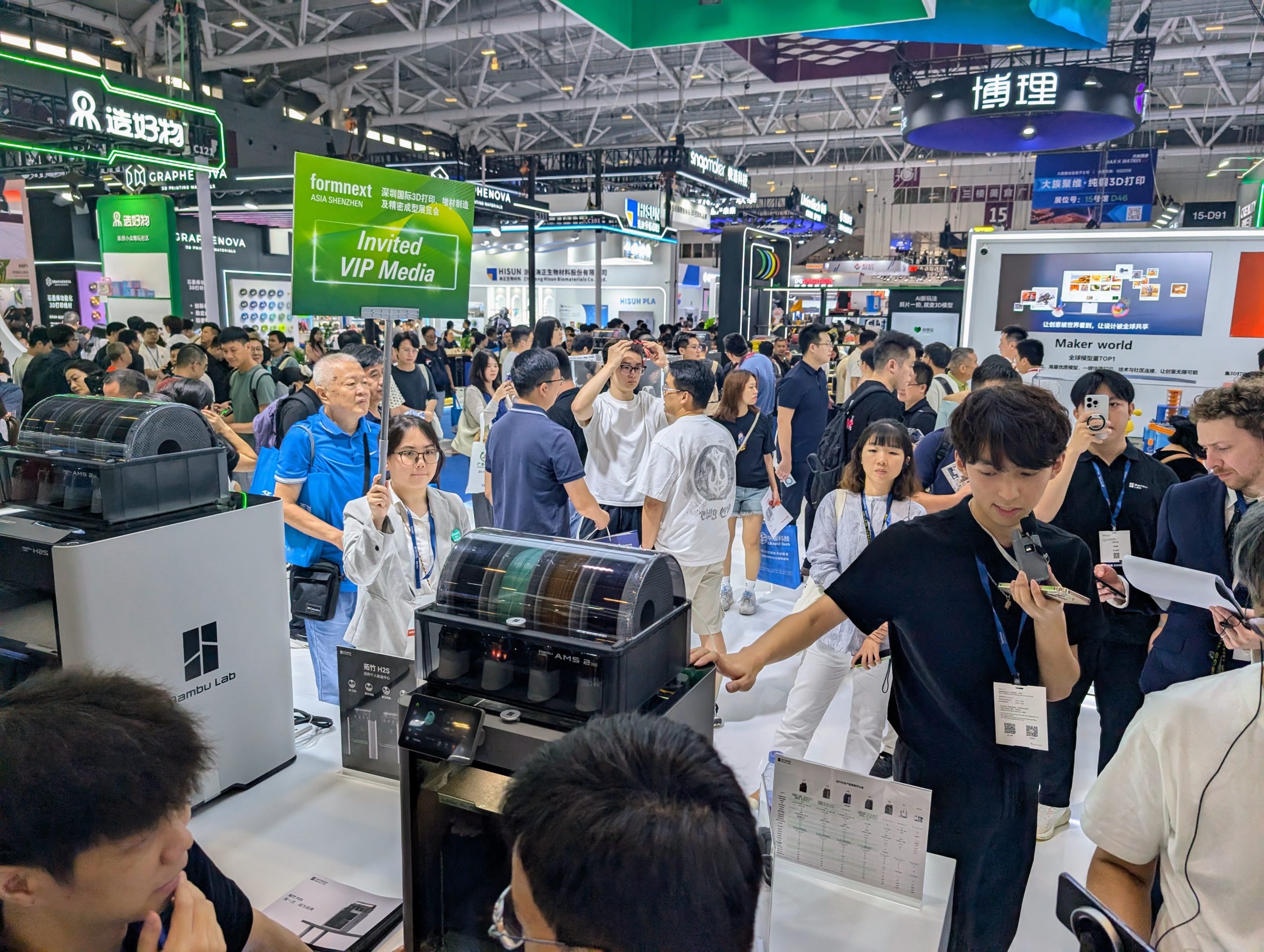
Featured image shows Bambu Lab’s booth at Formnext Asia Shenzhen 2026. Photo by Michael Petch.