

Researchers at Rochester Institute of Technology (RIT) have developed a new approach to finger and hand prosthetics that integrates four previously separate disciplines, hybrid materials, bioprinting, smart sensors and mechanical design, into a single customizable device. The work, led by a team of researchers across RIT’s Rochester and Dubai campuses, was published in the Journal of Manufacturing and Materials Processing.
Four Disciplines, One Prosthetic
Replicating fingers complexity in a prosthetic has typically meant choosing between flexibility, strength, sensory feedback and manufacturability, rather than achieving all four at once. The RIT team set out to close that gap by combining each of their individual specialties into one prototype.
The team’s approach centered on four integrated advances. First, hybrid materials, a biodegradable thermoplastic paired with flexible, biocompatible silicone silicone, were optimized for flexibility, strength and biocompatibility in the prosthetic structure. Second, the team refined 3D printing methods to incorporate those hybrid materials, improving extrusion and print performance while allowing for customizable output. Third, they built “smart” sensors using piezoelectric principles, where certain materials generate an electrical signal under mechanical stress, giving the device a functional sense of touch. Fourth, they integrated mechanical properties designed to support more natural movement and usage.
Habib said the combination addresses a persistent shortfall in prosthetic manufacturing. “One of the greatest needs in prosthetics is the ability to produce patient-specific devices that closely match an individual’s anatomy, mechanical properties, and functional requirements,” he said, adding that traditional manufacturing methods often struggle to produce structures that complex and customized.

Additive manufacturing and sensor technology have each been explored for prosthetics before, but usually by separate research groups working in isolation. That separation has left recurring problems unresolved: limited mechanical durability, poor fit between a device and an individual’s limb, and inconsistent 3D print quality. By running all four disciplines through one coordinated project, the RIT team produced a prototype intended to address those issues simultaneously, resulting in a design its researchers describe as customizable and affordable enough to be developed toward commercialization.
Pervaiz framed the effort as addressing two requirements he sees as central to next-generation prosthetics: material variation within a single device, and built-in intelligence. “The first was to bring together multi-material printing, so it’s not like the whole prosthetic should be printed with one material,” he said. “The second was to make it smart, so it can be used not only for gripping but other functions.” He added that the four researchers’ combined lab capabilities, and their shared background at RIT, made the collaboration possible.
Challenges and Limitations
The prototype is a proof of concept, not a finished device, and several gaps remain. The sensors haven’t been tested for real-time tracking of joint movement, that’s planned future work, not something the current build does. The team’s viscosity models only cover PDMS’s pre-cure behavior; they don’t account for curing or gelation, so a thermoset-specific model is still needed.
Material choices bring their own trade-offs. PLA isn’t especially impact-resistant, so the design compensates through infill geometry rather than raw material toughness, and the long-term durability of the PDMS-to-SLA bond under sustained stress remains untested.
Looking ahead, the team plans to refine sensor sensitivity, explore new material combinations, and bring in machine learning to reduce the amount of physical testing required.
Closing the Integration Gap in Printed Prosthetics
RIT’s strategy is integration. Hybrid materials, bioprinting, piezoelectric sensing and mechanical modeling already existed separately in prosthetics research, RIT’s contribution was running all four through one coordinated workflow. That targets a real weakness in the field: research groups tend to specialize in one discipline at a time, leaving durability, fit and print consistency as recurring problems even as individual techniques improve.
Researchers at Johns Hopkins, Florida Atlantic University and the University of Illinois Chicago built a hybrid robotic finger combining independently actuated soft silicone joints with 3D printed rigid PLA skeletal structures, aiming to give a prosthetic hand a working sense of touch rather than just mechanical grip.

Separately, researchers from China’s Zhejiang University of Technology, Tianjin University, and Nanjing Institute of Technology, along with Japan’s Ritsumeikan University, pushed the sensing side further on its own, 3D printing a self-powered robotic finger that senses changes in curvature without a conventional battery, using a multi-material additive approach intended to inspire further self-powered soft robotics.
Each of these efforts solves one piece of the puzzle, sensing, actuation, or materials, but RIT’s approach is one of the few pushing to combine all of them into a single printable, customizable structure.
Titled “Foundations for Future Prosthetics: Combining Rheology, 3D Printing, and Sensors,” the study was by Salman Pervaiz, Krittika Goyal, Jun Han Bae, and Ahasan Habib.
3D Printing Industry is inviting speakers for its 2026 Additive Manufacturing Applications (AMA) series, covering Energy, Healthcare, Automotive and Mobility, Aerospace, Space and Defense, and Software. Each online event focuses on real production deployments, qualification, and supply chain integration. Practitioners interested in contributing can complete the call for speakers form here.
To stay up to date with the latest 3D printing news, don’t forget to subscribe to the 3D Printing Industry newsletter or follow us on LinkedIn.
Explore the full Future of 3D Printing and Executive Survey series from 3D Printing Industry, featuring perspectives from CEOs, engineers, and industry leaders on the industrialization of additive manufacturing, 3D printing industry trends 2026, qualification, supply chains, and additive manufacturing industry analysis.
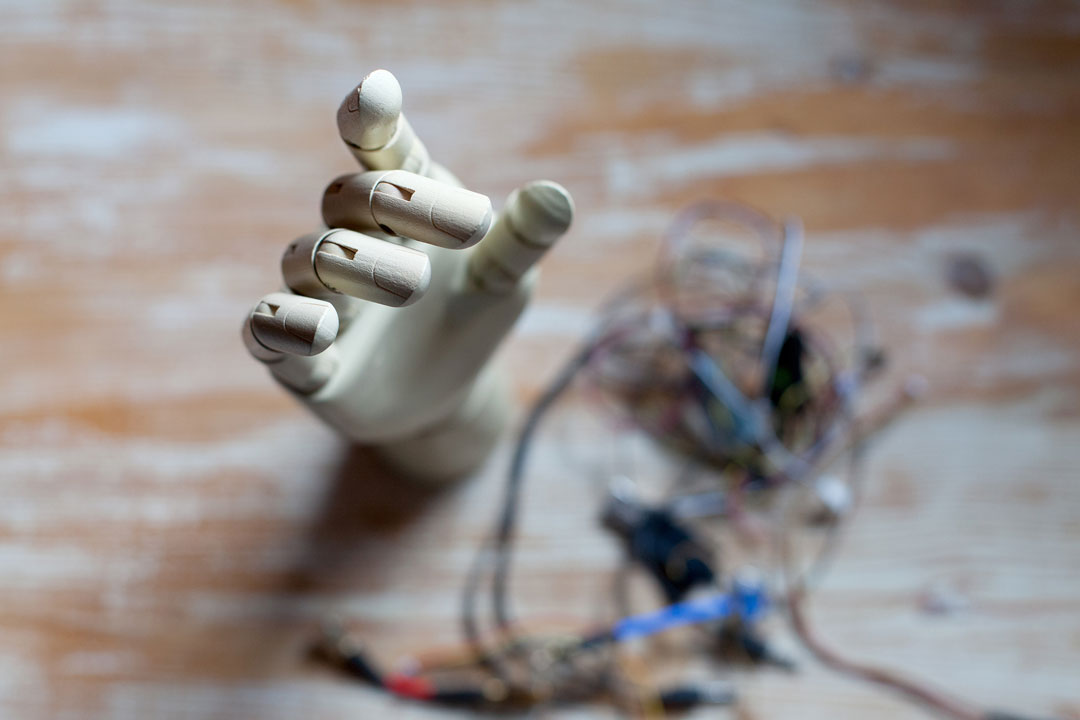
Featured image shows RIT faculty researchers from the Rochester and Dubai campuses collaborated to improve finger and hand prosthetics. Photo via RIT.







