

As our Editor Rachel said to me, “This is HUGE news!” CEO of Autodesk, Carl Bass, has announced that the company is releasing its own 3D printer, along with its own open software platform for 3D printing. As a software company, Autodesk has given the software, called Spark, first billing in the announcement and explained that the Autodesk 3D printer is merely a method for implementing Spark, as if it’s no big thing!
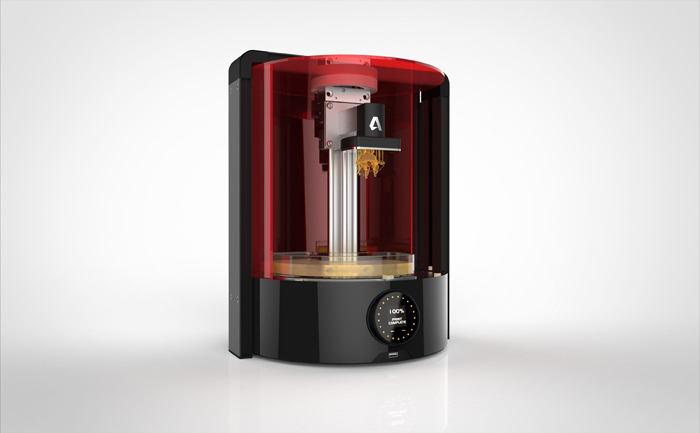
Both Spark and Autodesk’s 3D printer will be open source: “Spark will be open and freely licensable to hardware manufacturers and others who are interested. Same for our 3D printer – the design of the printer will be made publicly available to allow for further development and experimentation.” Bass has also said that the 3D printer will use a “broad range of materials, made by [Autodesk] and by others.” From the image provided and information from the BBC, the new machine will use stereolithography to print objects, hardening UV-curable resin layer by layer. The software and 3D printer (the entire Spark platform) will be released later this year and, until then, Autodesk will be working with hardware manufacturers “to integrate the Spark platform with current and future 3D printers.” No price for the machine mentioned as of yet!
Bass explains that he decided to pursue the Spark platform when 3D printing left him unfulfilled (which he mentioned during his keynote at Inside 3DP in New York). Inspired by Google’s adoption of Android, he believes that the company’s new Spark platform, which includes help from the open source community, will overcome many of the current limitations of 3D printing. He tells the BBC that he hopes the use of resin will inspire a new wave of materials for 3D printing, “One of the limitations right now is on the material sciences side – the kind of chemistry. We’re making a printer that, rather than just being able to load in proprietary materials, you can load in any material you want. You can formulate your own polymers and experiment with those. That’s an important next step because we think material science is a breakthrough that has to happen to make [the industry] go from low-volume 3D-printed stuff to where it really starts changing manufacturing.”
Research director at Gartner, Pete Basiliere, thinks that the Spark platform will cause a new wave of SLA machines to come to market, saying, “The printer is a bona fide attempt to prove the interoperability and open source nature of Autodesk’s platform. And by sharing its design we could see a second wave of small start-ups creating stereolithography machines just as the makers did when the early material extrusion patents expired.”
Though the printer and software will be open, the CEO still believes the company will profit, drawing people to their other products, “If 3D printing succeeds we succeed, because the only way you can print is if you have a 3D model, and our customers are the largest makers of 3D models in the world. My feeling is that 3D printing has been over-hyped for home use but under-appreciated for its industrial possibilities. I think we’re really at the beginning of a new way of making stuff and we’re just trying to kickstart it.”
I definitely commend the company on its idea to release the entire Spark platform as open source, potentially giving hackers and Makers the potential to do some pretty awesome things with it.
Read Bass’s original announcement, visit Autodesk, or read the interview with BBC to try and ferret out more details. All rumor and speculation welcome in the comments section below!



I kind of get where Carl Bass is coming from in making the 3D printer secondary — the really striking thing here is the open source angle and the drive to really make 3D printing more accessible from such a large corporate entity. The implications are far reaching and the potential for growth massive.
I’d also love to be a fly on the wall in the board rooms of a few of the 3D printing companies today! This is going to shake things up a bit.
Love this industry — I nearly fell off the floor when I saw this break last night (on my way to bed!!).
I nearly fell of the bed when I saw this break last night (on my way to the floor!!)
Three open source catalysts for 3D printing and counting: RepRap for FDM, MTU’s metal project (http://ow.ly/wS8nS) and now Autodesk’s SL.
U.S. Patent No. 5,569,349 No. 5,609,812 No. 5,609,813 No. 5,610,824 are all stereolithography patents that have expired in recent months and on July 29, 2014 U.S. Patent No. 5,651,934 expires.
Given this, Autodesk’s decision is more predicable. Will Autodesk try to assimilate as many expired stereolithography patents as possible into their open source project?
“Both Spark and Autodesk’s 3D printer will be open source” – Not quite – Spark looks like it’s going to be ‘open’ / free and able to be licensed but NOT open source, Hopefully the entire printer will be open source with a license that allows commercial use.
So for the printer, my first question would have to be what license will it be released under and how much information will be shared.
For it to be really open (open-source) and useful as next generation DLP/Resin ‘reference platform’ for the community, Autodesk need to release all the mechanical design files, all the electronics/electrical design files, all firmware code and also any documentation they have developed for the platform along with how to do the integration with the Spark software API’s etc.
If they are also prepared to support further open-developments by the community or by other commercial companies then that would truly be a significant and ground-breaking achievement for them and the entire 3D printing industry.
This was basically exactly what happened with RepRap, and the range of diversity, development and cooperation that flourished should be something to aim for. The power of a motivated community is bigger than any single business. Harness that and wow, it’s going to get really interesting.
I really hope they do, but they seem to be downplaying the 3D printer, so I hope this is not just using the ‘open-source’ term for marketing effect.
Until we have home desktop sintering printers, DLP and Resin fill a good gap that Formlabs and 3D Systems are currently aiming at.
Can you tell I’m excited 🙂 don’t let us down Autodesk.
I am interested to see the price tag on this. That alone will tell us who they are targeting.
~$5k – Autodesk see the printer as a ‘reference platform’ so doubtful they will sell them at very low cost, exactly the opposite, selling high would encourage more people to make ‘clones’ of the core technology to mass-sell that’s where Autodesk wants to sell/license it’s Spark software as the driving force.
The raw works cost on this style of 3Dprinter will be under $1200.
But who knows, if they get enough interest, they may start selling lots of 3D printers 🙂 and turn into a hardware company too.
Interesting to watch nonetheless. As a manufacture I look at it is free marketing for the industry. 😉
– “Why is everyone talking and reporting about the printer and not about the Spark software platform…”
” Oh, hang on…”
🙂
Interesting times…
Rachel is definitely right, this is BIG news. Given Autodesk’s reputation and development power, I have no doubt that the Spark platform could be big. The printer itself, sure whatever, but its the combination of the platform with the hardware that’s going to have the real game changing potential.
Watching this, is like reading about the industrial revolution of our past history, many new 3d printer and 3d printer software hitting the market at a record pace, when will it climax, if ever, I would say hold on to your seats, the best is yet to come. speaking of open source did you see how maker juice is being forced to stop selling vats for the b-9 creator and the form 1, I would guess, their is a fine line to be taken when it comes to open source. I think it is kind of funny how a company like the b-9 creator, considers them self to be open source and then when some one comes along and makes a part, a critical part that has a small life cycle I’m talking about the vat and the layer of silicone referred to as the PDMS.
When I bought my b-9 the first day my PDMS came apart after my first print, this really sucked because I had to buy the silicone from a third party, and this also sucked because the manufacture of the b9 should of included this silicone when you purchased the machine,
I mean it is a part that does not last long until you gain experience with this machine, If you read the b9 blog this PDMS is a common problem with new users of this machine. Buying a new vat is an option, but the mark up on the cost from the MFG is usably big, this is when you feel like the MFG is bending you over, this by any means does not contribute to a positive out look and when any one ask me how do I like my b9 creator, I have to pause and sy, and say bleeding edge technology is what it is, bleeding edge technology!. Please don’t get me wrong, the b9 was one of the best resin based 3d printers under 5 grand. but very limited because of limited resin choices.
So when a company like maker juice comes along and produces replacement parts for a better price, this actually makes me feel better about my purchase of the b-9, but when I’m forced to by this replacement part at a much higher price I feel like, he could at lease used lube when I got Fuc#ed on the price from the MFG.
When Mike made this machine I would bet he did not realize his main market would be a bunch of Jewelers and dental labs. Super high mark-ups on consumables replacement parts is common in the market place, However, in the next few months are a who new arousal of new resin 3d printers like the x fabs new line up, this machine looks dreamy and the prints are the best out their by far,10 micron surface finish. The new upgrade 1.2 V from the b-9 MFG can’t touch many new machines coming out in the next few months. A new page is getting ready to turn!
I think they have twelve different resins, They have a model for $2500 and a bigger build volume for $5000. I can’t wait to see them this weekend at the makers fair in San Mateo CA, I’m going to by one, unless I find a better machine for the price!
Thanks, I didn’t know about MakerJuice, that is unfortunate and disappointing about the Cease and Desist letter forcing them to remove the b9 creator compatible resin vat from sale.
It would be good to get some feedback from Mike at b9 on the reasons behind this and how they now feel about compatible resins and machine parts being used on their 3D printer.
It makes it harder to see where companies that build on or release as Open-Source hardware take a different view on licenses like GPL and Creative Commons that are designed to be very clear about what you can and can’t do.
In the end open-source or not, where money and business is involved, lawyers will also follow. Open Innovation and community development is supposed to be a better way and get around a lot of these issues and put the customer back as the most important part of any business.
It’s also interesting so see b9 going down the patent pending route, it’s now often not the best way to protect innovation and can cost a lot more in lawyers fees than most ‘inventions’ are worth these days. Also having very specific patents, only make them weaker and easier to circumvent and again cause more dispute on the implementations of infringements of competing products – again leading to spiraling costs of defending them.
From the MakerJuice website –
Vat removed from store Posted on May 14, 2014 by Josh in Uncategorized with 3 Comments
Hi guys, quick note here. We’ve had to remove our vat we had listed as compatible with the B9Creator™ from the store. We got a cease and desist from lawyers representing Mike Joyce / B9. While we certainly haven’t tried to represent that we are endorsed or supported by B9, we thought our selling a vat of our design that was compatible with their printer was okay. Especially given the open source nature of his machine. It turns out he doesn’t think this is the case, so we’ve pulled the vat from our store while we have lawyers review the C&D and their claims.
Being a more affordable supplier of resin and printing materials is certain to ruffle some feathers in this industry, as we try to make things more accessible and give up the large profit margin some other companies have. It’s inevitable some people won’t like giving up those profit margins.
But we will continue to fight the good fight to bring SLA printing to the masses, and try to stay legal in the process. In this case it means taking down the vat for now.
We’ll try to keep everyone updated if there are any developments, and appreciate any support our awesome customers give us!
Indeed big news. Since the RepRap initiative 2005 this is the first time that a big player in the 3D Printing industry supports the movement and further development of 3D Printing on open source / open hardware basis.