


Researchers at the University of Freiburg have introduced a process for volumetric 3D printing that enables complex multi-material parts and microscale internal channels to be produced in a single curing step. The method, called Embedded Extrusion-Volumetric Printing (EmVP), was detailed in a peer-reviewed study published in Nature Communications and integrates embedded 3D printing (EMB3D) with tomographic volumetric additive manufacturing (TVAM), eliminating the need for vat exchanges or post-print alignment.
The process embeds one material into another before projection, using EMB3D to deposit an ink into a photopolymerizable support bath. Both materials are then polymerized simultaneously using TVAM. To achieve synchronization, the Freiburg team engineered the gelation times of the materials to converge: 59.8 seconds for the embedded high-modulus ink (Mat 1) and 64.7 seconds for the low-modulus support bath (Mat 2). Each resin was modified with Aerosil R805 to create a thixotropic matrix suitable for both extrusion and volumetric curing. Refractive index differences were minimized to reduce light scattering during exposure.

Mat 1, based on hexanediol diacrylate (HDDA), exhibited a Shore D hardness of 27.4 and an elastic modulus of 122 MPa. Mat 2, based on Genomer 1122TF, showed a Shore D hardness of 4.9 and an elastic modulus of 1.28 MPa. To prevent sedimentation during printing, both resins were thickened beyond 2000 mPa·s. Recovery times were measured at 4.7 seconds for Mat 1 and 1.7 seconds for Mat 2 following shear removal, enabling precise ink deposition and stabilization. UV-Vis spectroscopy confirmed that both materials maintained sufficient transmittance at the 450 nm projection wavelength used in the TVAM setup.
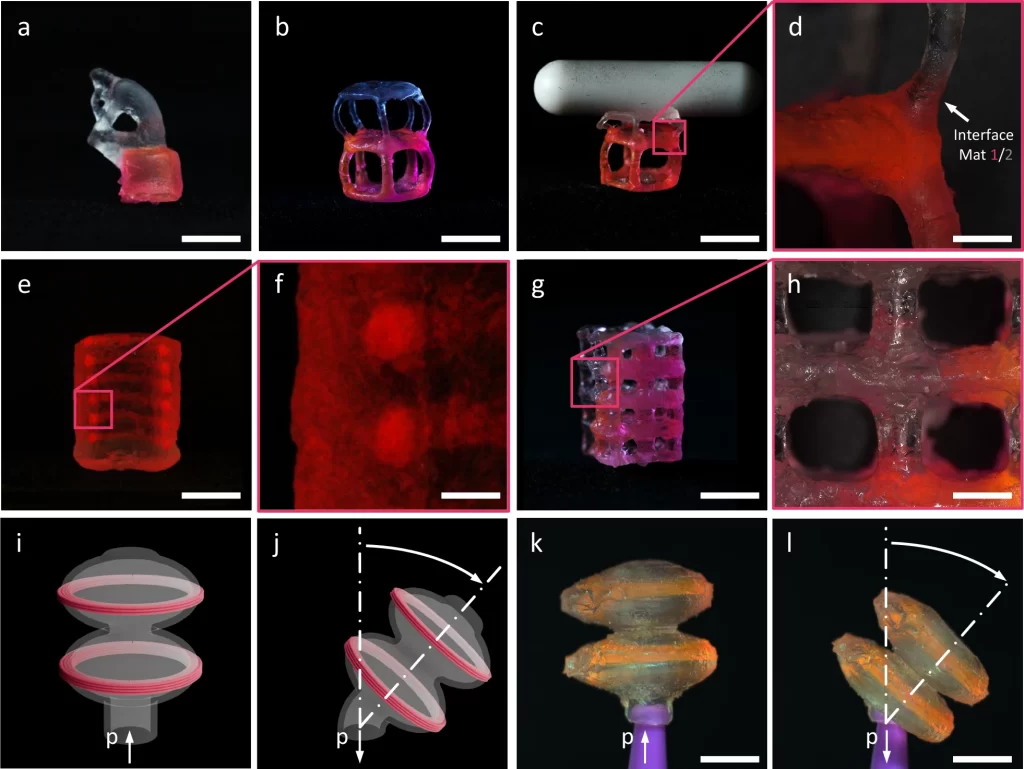
Multi-material parts fabricated via EmVP included stacked dual-hardness spheres, filaments embedded in walls of flexible cylinders, and actuators composed of soft shells reinforced with stiff embedded rings. The embedded filament diameter achieved with EMB3D was 175 µm. One structure featured Rodin’s Thinker sitting atop a rigid platform embedded within a soft resin body, with deformation tests confirming selective mechanical response. The average Hausdorff distance between printed and modeled geometries was 0.23 ± 0.28 mm, as determined via microCT, demonstrating spatial fidelity in volumetric material transitions.
In addition to positive material integration, the researchers used sacrificial inks to form embedded voids. Known as negative EmVP, this process allows direct fabrication of hollow microchannels by flushing out a non-photopolymerizable ink after volumetric curing. Using Pluronic PE3100 as the sacrificial phase, the team printed Y-junction chips and coiled cylindrical designs with internal diameters as small as 119 µm. This resolution surpasses the 500 µm lower limit of the standalone TVAM system, where overcuring and diffusion effects typically constrain negative feature fidelity. Channel diameters were verified by microCT scans using 15 µm voxel resolution.
Compared to sequential multi-material volumetric printing (SMVP), which requires curing one material at a time followed by vat replacement and alignment, EmVP avoids the need for additional support structures, complex mechanical positioning, or dual-wavelength projection systems. In SMVP, any misalignment can result in geometric error or print failure. Freiburg’s EmVP technique, by contrast, performs all curing in a single volumetric step, with the embedded material held in place by the rheological properties of the surrounding bath.

Previous implementations of EmVP were limited to overprinting, where one material was fully encased in another. The present study extends that by enabling exposed, spatially distinct regions composed of different materials. By depositing only the minimal necessary ink volume, the researchers minimized oozing artifacts and reduced EMB3D print duration. This selective deposition was coupled with projection optimization using Object Space Model Optimization (OSMO) refined via Proportional-Integral Histogram Equalization. Projections were computed by voxelizing the 3D model, forward-projecting to simulate light paths, and iteratively adjusting dose distributions to match target geometry.
To scale the process without optical redesign, the team prioritized embedding the higher-absorbing material as the minority phase, allowing projections to cure the entire structure without excessive energy absorption. This setup maintains resolution without reducing pixel size or increasing system complexity. For microchannel production, EmVP decouples channel resolution from pixel density by allowing control via needle diameter during EMB3D, enabling finer internal features than what TVAM alone can deliver.

EmVP expands the range of printable architectures in volumetric systems, supporting both heterogeneous mechanical properties and embedded microfluidic geometries. Applications include soft robotics, functional part prototyping, and lab-on-a-chip devices. The technique operates on conventional LCD-based TVAM hardware without requiring wavelength-selective resins or hardware augmentation. Its dual capability to produce positive and negative features within a single volumetric print step offers a path forward for scalable, multi-material additive manufacturing.
Ready to discover who won the 2024 3D Printing Industry Awards?
Subscribe to the 3D Printing Industry newsletter to stay updated with the latest news and insights.
Featured image shows selection of parts printed with the positive EmVP process. Image via Nature Communications.