3D scanner manufacturer Revopoint has launched the Trackit SR, a wireless, marker-free optical tracking 3D scanner with a stated single-frame accuracy of 0.02 mm. According to the company, the system is designed to address common constraints in traditional metrology workflows, including setup time, cabling, the application of marker points, and limited maneuverability around large or complex parts.
The scanner is positioned for use in aerospace, automotive, and quality control applications. Alongside the single-frame figure, Revopoint specifies volumetric accuracy of up to 0.025 mm + 0.04 mm × L (m). Integrated sensors monitor temperature in real time, which the company says prevents accuracy drift caused by environmental fluctuations. The CMM Edition adds on-site, real-time accuracy verification using a CMM-certified ball plate.
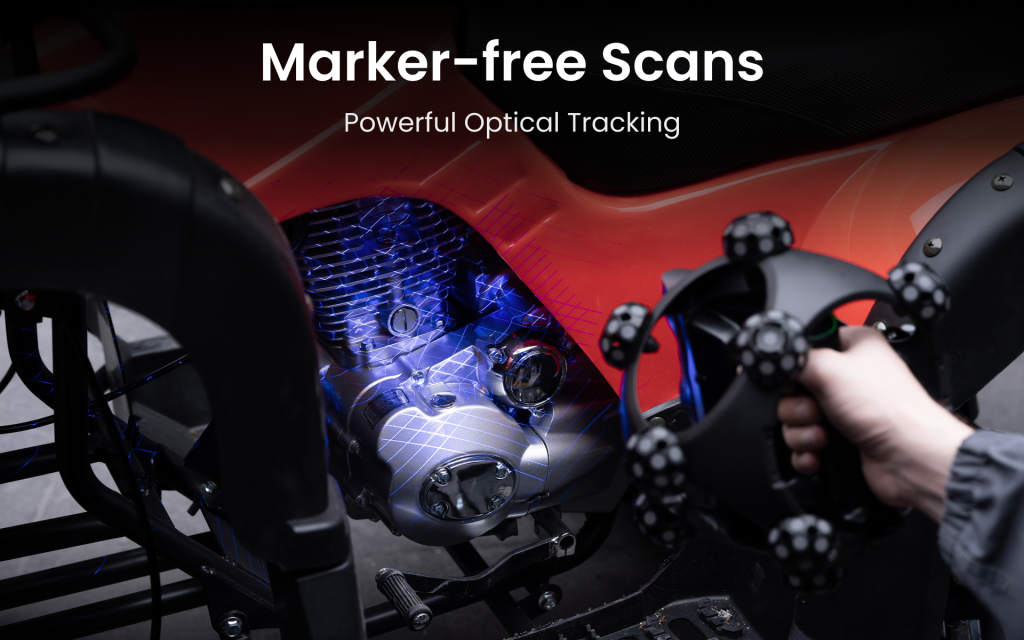
Marker-Free Tracking with Three Scanning Modes
Rather than requiring reference markers on the part’s surface, the Trackit SR uses optical tracking to determine the scanner’s spatial position in real time. The system offers three scanning modes that can be switched between depending on the task: Fine Mode projects 30 blue cross laser lines; Far Mode uses 17 blue parallel laser lines, intended for full-surface capture of larger components such as body panels; and Deep Hole Mode uses a single blue laser line for cavities and deep-hole features.
All three modes are specified to scan dark, reflective, and metallic surfaces directly, without markers or matting sprays.
Both the Scanner and the Tracker connect to a PC over Wi-Fi 6. The Scanner runs on a battery rated for 2.5 hours, and the Tracker can be powered by an optional battery grip. Revopoint states the system tolerates ambient light up to 100,000 lux, allowing operation outdoors as well as indoors, the company cites engineering fieldwork, on-site industrial measurement, and archaeological documentation as intended use cases.
Software Pipeline from Scan to Report
The hardware is supported by a software suite covering “Scan-to-Report” and “Scan-to-CAD” workflows. Revo Track handles real-time capture and registration during scanning; datasets can then move into Revo Measure for GD&T analysis, deviation mapping, and inspection reporting, or into Revo Design for reverse engineering with STEP, IGES, and STL output. The three applications share a common data layer, removing the need to export, convert, and re-import files between separate environments.
Revopoint lists applications including tolerance verification in aerospace and automotive manufacturing, deep-hole capture in molds and castings, and digital preservation in art and heritage through texture mapping with millimeter-level alignment.
At the moment, the Standard Edition is priced at $3,329.00. Further specifications are available on the Revopoint website.

Optical Tracking Scanners Move Down-Market
The Trackit SR continues a strategy Revopoint has pursued across recent releases: offering marker-free optical tracking metrology, a category historically dominated by high-cost industrial systems, at lower price points. The original Trackit established the formula; the SR adds fully wireless operation, a third scanning mode, and outdoor light tolerance.
Other manufacturers are converging on the same formula. Shining 3D introduced its FreeScan Trio at Formnext 2023, a metrology-grade marker-free scanner using a 98-laser-line mode and a triple 5MP camera system, capturing up to 3,010,000 points per second, with marker-assisted precision of up to 0.02 mm and an ISO/IEC 17025-accredited accuracy laboratory behind it.
At the industrial end, Hexagon launched its HYPERSCAN marker-free 3D scanner in February 2026, certified to VDI/VDE 2634-3 and validated by an ISO 17025 accredited laboratory. It handles components up to 7 metres in handheld or robotic configurations and incorporates a Wi-Fi module and integrated battery for untethered use on factory floors and at on-site locations.
Marker-free, wireless operation is becoming a category-wide direction rather than a single vendor’s feature. The differences now lie in certification, scale capacity, and price.
3D Printing Industry is inviting speakers for its 2026 Additive Manufacturing Applications (AMA) series, covering Energy, Healthcare, Automotive and Mobility, Aerospace, Space and Defense, and Software. Each online event focuses on real production deployments, qualification, and supply chain integration. Practitioners interested in contributing can complete the call for speakers form here.
To stay up to date with the latest 3D printing news, don’t forget to subscribe to the 3D Printing Industry newsletter or follow us on LinkedIn.
Explore the full Future of 3D Printing and Executive Survey series from 3D Printing Industry, featuring perspectives from CEOs, engineers, and industry leaders on the industrialization of additive manufacturing, 3D printing industry trends 2026, qualification, supply chains, and additive manufacturing industry analysis.
Featured image shows Revopoint Releases Trackit SR, a Wireless Marker-Free Optical Tracking 3D Scanner. Image via Revopoint.