
Oklahoma State University (OSU) and Mississippi State University are building a 3D printer that deposits continuous fiber and polymer in the same part while using machine learning to check part quality as it prints. The National Science Foundation is funding the work through its Major Research Instrumentation (MRI) program under the title “MRI: Track 1 Development of Machine-Learning Assisted Continuous Fiber Deposition for Multi-Material Additive Manufacturing.”
Most research grants produce findings. This one produces a machine. “This project provides us with opportunities to develop a brand-new 3D printing system that is not currently available on the market,” said Dr. Wenmeng Tian, associate professor in OSU’s School of Industrial Engineering and Management (IEM) and the project’s co-principal investigator. Her team is responsible for the sensing and machine-learning modules that will let the printer analyze and adjust its own process in situ.
Once complete, the system is planned as a regional and national research hub, open to universities and industry groups across engineering and science.
Fiber and polymer in one build
The printer’s defining feature is the ability to lay continuous fiber reinforcement and polymer together within a single part. “The new 3D printing system will enable simultaneous deposition of polymer materials and continuous fibers in multi-material composite structures, providing unique customization of material properties,” Tian said.
Continuous fibers give designers far finer control over mechanical behavior than unreinforced prints allow. By pairing different fibers with different matrix materials, researchers can create composites whose stiffness, strength, or flexibility varies from one region of a part to another.
To make that possible, the machine will carry several print heads, each assigned its own material, and will support more than one printing process on a single platform. Conventional printers typically run one process with a narrow range of materials, which caps what a single build can contain. Lifting that constraint puts new part designs within reach. The team is targeting soft robotics, flexible electronics, functional devices, and smart structures, and Tian also pointed to aerospace structures and bio-integrated devices as fields that could benefit from high-fidelity composite production.

Monitoring quality while the part is built
The second half of the system is data. Sensors will record process information throughout each build, and machine-learning models will use it to judge component quality in real time instead of leaving evaluation until the print is done.
That data serves a research purpose as well. Engineers describe the links between how a part is made, the internal structure that results, and how the part ultimately performs as process-structure-property relationships. In single-material printing these links are hard enough to pin down. In multi-material work, every additional material, fiber path, and deposition method introduces variables that interact unpredictably, so design data alone rarely tells the full story.
Embedding sensing and learning directly in the printer is meant to close that gap. The system is designed to feed what it learns back into both part design and print settings, and to catch defects early enough that they can be fixed before a build is lost.
Students and outside researchers
IEM students will take on sensor selection and placement, experimental design, and the analytics that connect process data to part properties. According to Tian, the work combines hands-on manufacturing with data science, a pairing employers increasingly want as factories move toward in-process monitoring and data-driven quality control.
The instrument’s broader impact will hinge on adoption beyond Oklahoma and Mississippi. If it performs as intended, researchers who lack specialized equipment of their own will gain access to continuous-fiber, multi-material printing with monitoring built in, a combination commercial machines seldom offer. For OSU, the project also fits a wider push to convert research into working tools while preparing the students who will eventually operate them.
Closing the gap between reinforced printing and process insight
The OSU–Mississippi State project addresses a gap on two fronts. Continuous-fiber printing, multi-material deposition, and in-process monitoring have each advanced on their own, but no commercial platform combines them with learning models that tie process data to part performance. Instead of buying equipment, the two universities are building that combination as a shared instrument, so outside groups without comparable hardware can use it.
On the hardware side, recent academic work has attacked pieces of the same problem. Researchers from the Institute of Space Technology in Islamabad, working with the National University of Science and Technology and Ajman University in the UAE, built a production setup for continuous fiber-reinforced polymer filament for FDM printing that embeds continuous E-glass fibers in a PLA matrix while keeping the fibers aligned and encapsulated during extrusion, targeting a process long hampered by fiber breakage, misalignment, and weak matrix adhesion. At MIT, researchers are pursuing multi-material capability instead: their multi-material extrusion platform carries four separate extrusion tools, each built to process a different type or form of feedstock, aimed at producing fully functional electric motors on site in a single step.

Monitoring research has moved in parallel. Argonne National Laboratory and Texas A&M University built a powder bed fusion rig fitted with in-situ infrared cameras and trained machine learning algorithms to predict defects in 3D printed parts from the thermal histories recorded during printing. More recently, the University of Bolton’s Centre for Advanced Manufacturing began deploying Addiguru’s in-situ monitoring and defect detection platform on its metal additive equipment to study defect formation, process stability, and build consistency, within a collaboration that merges optical, thermal, and machine control data through automated and statistical analysis.
These efforts tend to advance either the material system or the monitoring. The OSU–Mississippi State instrument attempts both in one machine, and its real test will be how widely outside researchers use it.
Register now for AMA: Software 2026. Join 3D Printing Industry on 22 October for expert presentations, panel discussions and live audience Q&A exploring the software shaping additive manufacturing. [Register here.]
To stay up to date with the latest 3D printing news, don’t forget to subscribe to the 3D Printing Industry newsletter or follow us on LinkedIn.
Explore the full Future of 3D Printing and Executive Survey series from 3D Printing Industry, featuring perspectives from CEOs, engineers, and industry leaders on the industrialization of additive manufacturing, 3D printing industry trends 2026, qualification, supply chains, and additive manufacturing industry analysis.
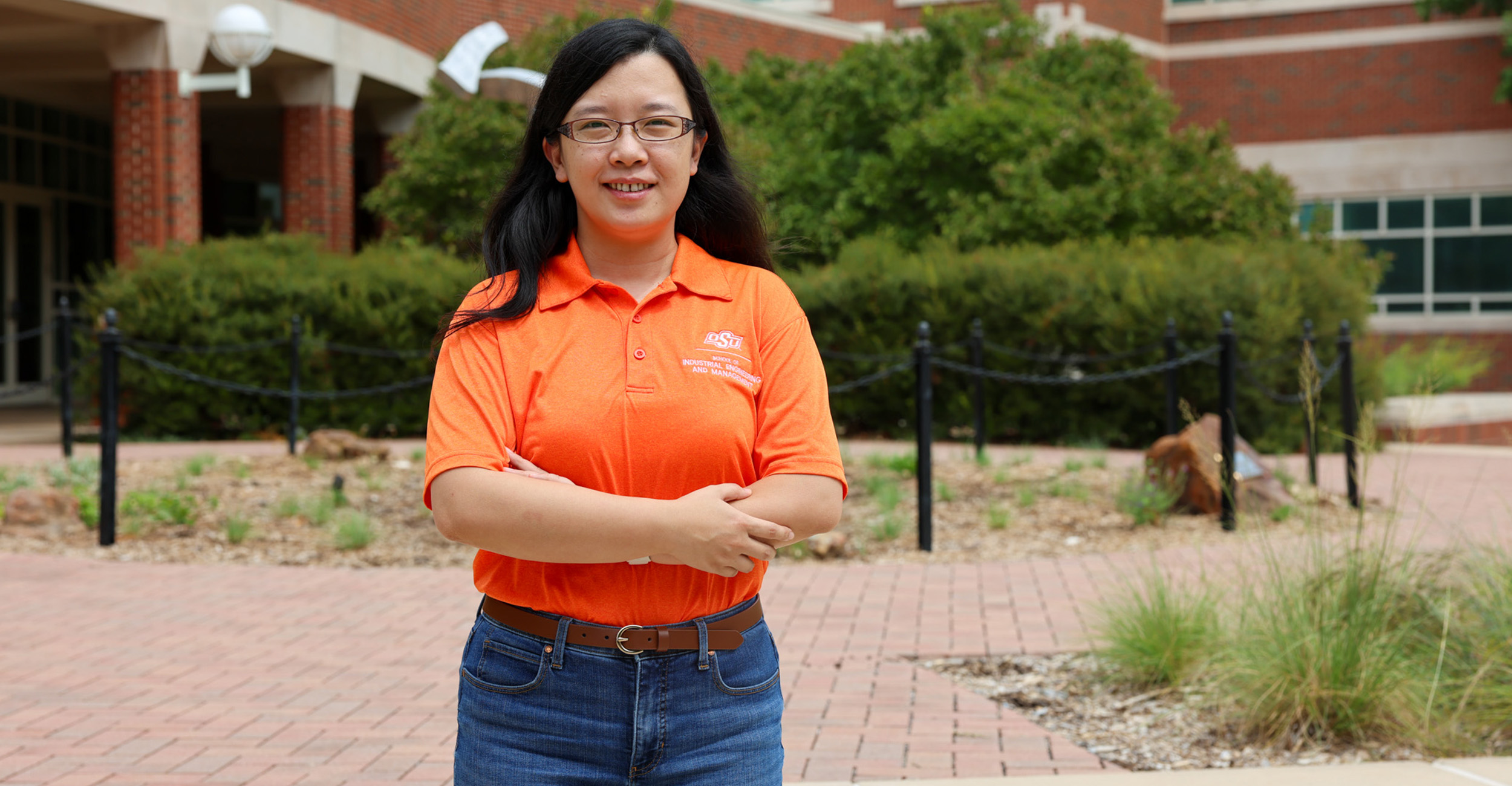
Featured image shows Dr. Wenmeng. Photo via OSU.