ALOFT AeroArchitects and Spectrum Networks LLC are using Markforged’s composite 3D printing systems to manufacture certified aircraft components, Nano Dimension has announced.
Produced for government, VIP and private aircraft worldwide, Spectrum Networks is using Markforged’s FX10 3D printers and Continuous Fiber Reinforcement (CFR) to produce certified cabin items such as lighting housings, replacement fixtures, panels and fittings tailored for VIP and legacy aircraft.
After printing, those parts are handed then to ALOFT AeroArchitects, which installs the components as part of its completion and maintenance work on special-mission and high-end aircraft.
In a statement, the Israeli 3D printer OEM highlighted that Spectrum Networks produced over 10,000 certified flight parts last year, demonstrating the scalability of additive manufacturing for interior and non-structural components.
Speaking about the efficiency, Spectrum Networks President and COO Niel Gunnarson said that the company was “able to pull the part right off the machine and ship it out the door, as is. With Continuous Fiber Reinforcement, we noticed quickly that it gives us structural properties that we never thought were possible,” Gunnarson said. Our customers are able to use that information and propose designs that they need using those benefits.”

Enabling certified parts production
A key to gaining regulatory acceptance has been in-process measurement and traceability. The FX10 platform performs automated laser micrometer inspection during printing and produces a layer-by-layer conformance report for each part.
Those digital records have been used in certification submissions and have helped secure approvals from the Federal Aviation Administration (FAA) and other aviation authorities to use the printed components in certified aircraft installations.
That capability matters most during deep maintenance events. Aircraft undergo C checks every 18 to 24 months, involving detailed inspections and partial disassembly. Meanwhile, D checks are full structural overhauls performed about every 6 to 10 years and often uncover broken or obsolete parts.
When legacy parts are no longer produced, operators can face prolonged grounding while they source replacements. On-demand 3D printing shortens that timeline by producing certified, installation-ready replacements in weeks rather than months.
One concrete example of the approach is the SPN 31 LED retrofit, designed and manufactured with CFR technology to replace halogen lighting fixtures on panels that are two decades old. This 3D printed retrofit is engineered to provide the necessary structural integrity and surface finish so it can be fitted directly into the existing cabin architecture without additional modification.
“ALOFT and Spectrum’s work demonstrates the power of Markforged to meet the highest levels of safety, quality, and performance demanded by the aerospace sector,” said Dave Stehlin, CEO at Nano Dimension.
Together, the integrated workflow of design, CFR printing, inspection, and installation addresses long-standing maintenance challenges such as supply-chain gaps and long lead times, enabling faster returns to service for customized aircraft.
3D printing interior parts in commercial aircrafts
3D printed components are now being produced and installed on operational aircraft, signaling an increase toward mainstream adoption of additive manufacturing in regulated aviation.
Earlier this year, LOT Polish Airlines began installing 3D printed arm caps on its Boeing 737 fleet to improve cabin durability and overcome parts shortages. Developed by Riga-based AM Craft using Stratasys FDM technology and ULTEM 9085 thermoplastic, the single-piece design replaced the original multi-material components that often cracked or detached under frequent use.
Finished with Mankiewicz’s ALEXIT coating and certified under EASA Form 1, the 1,200 redesigned arm caps offer higher strength, flame resistance, and easier maintenance. The shift demonstrated how certified 3D printing enabled low-volume, cost-efficient production of durable cabin parts amid supply chain disruptions.
A few years ago, the UAE’s Etihad Airways showcased what was described as the Middle East’s first 3D printed aircraft interior part, a plastic frame designed to house seat-back monitors, at Abu Dhabi’s Global Manufacturing and Industrialization Summit in 2017.
Produced by Strata Manufacturing using AM, the component demonstrated how on-demand 3D printing could replace conventional mass production and warehousing of spare parts. The process significantly reduced cost, lead time, and storage needs while supporting the airline’s broader goal of digital inventory management. The project marked a key milestone toward deploying 3D printing for certified aerospace applications in the region.
Help choose the 2025 3D Printing Industry Awards winners – sign up for the Expert Committee now!
To stay up to date with the latest 3D printing news, don’t forget to subscribe to the 3D Printing Industry newsletter or follow us on LinkedIn.
While you’re here, why not subscribe to our Youtube channel? Featuring discussion, debriefs, video shorts, and webinar replays.
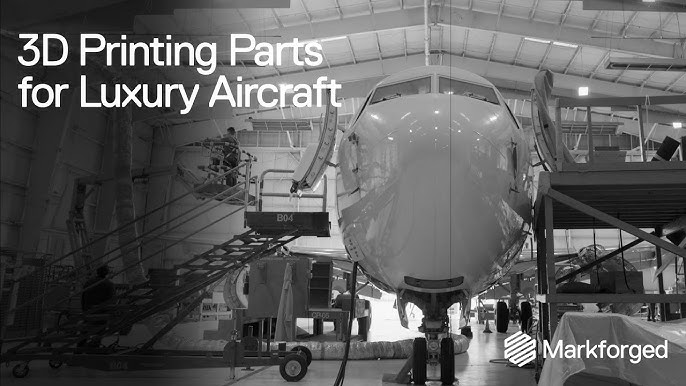
Featured image shows 3D printing parts for luxury aircrafts. Photo via Markforged.