

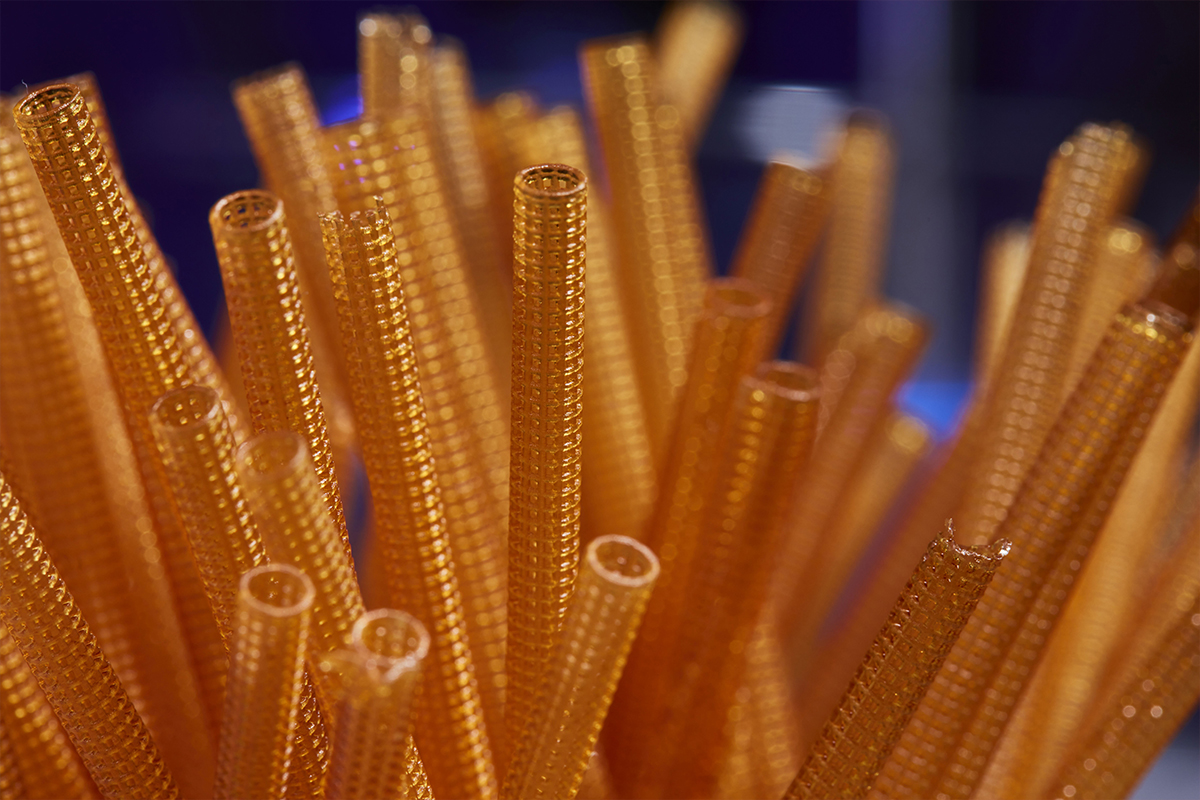
Researchers at Lawrence Livermore National Laboratory (LLNL) have built a 3D printed solid-state bioreactor that converts methane into succinate. Succinate is an industrial chemical used to make polymers, stabilize drugs and enhance food flavor. According to the team, the compact reactor performs more than 10 times better than conventional liquid-state systems and uses less power. The work is published in Scientific Reports.
The system replaces the traditional stirred tank with thin, printed lattice scaffolds. Methane-consuming bacteria are embedded in hydrogel walls inside the lattice, and methane passes directly through and around the structure. The gas no longer has to dissolve in liquid before reaching the microbes. The team says this could make methane bioconversion workable at small landfills and wastewater treatment plants, where much of the gas is currently burned.
Printed lattices replace the stirred tank
Standard gas fermentation takes place in a large vat. Gas is dissolved into water and the mixture is stirred hard so bacteria can reach it. That works poorly for methane, which dissolves badly in water, so the process is slow and expensive in energy and operating costs. This has made large-scale methane bioconversion hard to justify economically.
“Bioproduction using poorly soluble gases has long been limited by slow mass transfer and low efficiency because conventional liquid-phase bioreactors are not well suited for gas fermentation,” said LLNL scientist and corresponding author Fang Qian.
The LLNL design removes the liquid bath. “Rather than have this big tank of a ‘broth’ that you’re putting gas into, we produced these thin structures that we call scaffolds,” said LLNL scientist and author Nathan Ellebracht. “They’re 3D printed. They have a lattice structure, and we put the microorganisms into a hydrogel that fills these really thin walls.”
The hydrogel walls are mechanically robust and resistant to degradation. They behave like a thin, porous sponge with high surface area and good permeability, so methane reaches the embedded cells quickly. The printed scaffolds can also hold many times more bacteria than a vat of the same scale.
The bacteria are methanotrophs, which naturally consume and process methane. They carry out the conversion without the added heat or pressure that a chemical route would usually need, which the researchers say could lower costs.

Design, printing and modeling in one workflow
The team combined material selection, printing methods, geometric design and performance modeling in a single development process. Once the best design parameters were identified, printing let them quickly produce prototypes at different sizes.
“Once the optimal design parameters were identified, 3D printing allowed rapid fabrication of prototypes across different sizes and scales, accelerating the transition from reactor design to testing and scale-up,” said LLNL engineer and author Hawi Gemeda.
The hardest part was designing the scaffold around the biology. The printed structure had to maximize cell density and contact between gas and cells, and it also had to keep the bacteria alive. “It was a combination of figuring out how we could engineer our scaffold to maximize our cell density and gas-cell interaction, but also how we keep the cells alive for more than a few days,” said LLNL scientist and author Natalie Hwee.
The reactor has so far been scaled from two milliliters to one liter. The researchers say further scale-up is needed before real-world deployment.
A small-scale option for waste gas
The team sees the reactor’s small size as a possible commercial advantage. Chemical plants are usually economical only at large scale, which leaves smaller methane producers with few options for recovering value from their gas.
“At smaller landfill or wastewater treatment facilities, there aren’t really good, existing solutions that scale down,” said Ellebracht. “Our approach could be applied at a small plant and allow them to get value out.”
The printed scaffold approach could also extend beyond methane. Qian noted that most industrial bioproduction relies on aerobic sugar fermentation, where getting enough oxygen to the cells is a major bottleneck. Immobilizing the cells in a scaffold would also remove the downstream step of separating them from the reaction products. “We are now actively extending the solid-state bioreactor concept to other bioprocesses,” Qian said.
The project brought together LLNL expertise in biomaterials, additive manufacturing and bioreactor modeling. Collaborators included the National Laboratory of the Rockies, Quasar Energy Group and the University of North Texas. Funding came from a Laboratory Directed Research and Development project, LLNL’s Innovation and Partnerships Office and a U.S. Department of Energy Technology Commercialization Fund.

Printed lattices as a platform for living bioreactors
LLNL sees reactor geometry, not tank size, as the key to making gas fermentation economical. Its printed lattices hold microbes in place and let methane flow straight to them, which yields a compact reactor sized for small landfills and wastewater plants. With DOE commercialization funding and plans to use the scaffold for other bioprocesses, LLNL is treating the design as a platform rather than a one-off demonstrator.
Printed hydrogel lattices have been used to hold live microbes before. At the University of Washington, Alshakim Nelson’s team developed a 3D printed hydrogel lattice infused with yeast, with a material made of about 70% water and 30% yeast-infused polymer, extruded on a printer the team built themselves. Those printed bioreactors reportedly kept producing ethanol for four months without stopping. The researchers suggested that confinement in the hydrogel lattice may stop the yeast cells from reproducing or aging, which is the same cell-immobilization principle LLNL uses for its methanotrophs.
Researchers at ETH Zurich have applied the approach to carbon. A team led by Professor Mark Tibbitt created a 3D printable hydrogel infused with cyanobacteria, which absorb atmospheric carbon dioxide and turn it into biomass and stable carbonate minerals. The polymer network was chosen to carry light, carbon dioxide, water and nutrients through the material while keeping the cells evenly distributed, and 3D printing was used to optimize the structures’ geometry for the bacteria’s longevity and efficiency. As with LLNL’s scaffolds, the printed geometry is what determines how well the microbes can reach the gas.
Printed hydrogel lattices are moving from lab curiosity to process hardware. LLNL’s methane reactor tests whether this approach can scale from liters to landfill sites.
Register now for AMA: Software 2026. Join 3D Printing Industry on 22 October for expert presentations, panel discussions and live audience Q&A exploring the software shaping additive manufacturing. [Register here.]
To stay up to date with the latest 3D printing news, don’t forget to subscribe to the 3D Printing Industry newsletter or follow us on LinkedIn.
Explore the full Future of 3D Printing and Executive Survey series from 3D Printing Industry, featuring perspectives from CEOs, engineers, and industry leaders on the industrialization of additive manufacturing, 3D printing industry trends 2026, qualification, supply chains, and additive manufacturing industry analysis.
Featured image shows The scaffolds hold microorganisms in place, providing an alternative to the traditional liquid-based reaction. Photo via Garry McLeod, LLNL.