


U.S. Air Force and Marine Corps maintainers used on-site additive manufacturing to return an F-15 Eagle to operational service in just hours, months ahead of schedule, underscoring how 3D printing is becoming a frontline capability for sustaining aircraft in contested, forward-deployed environments.
The effort brought together teams from Marine Aircraft Logistics Squadron 36 (MALS-36) and the 18th Maintenance Group (18 MXG), demonstrating how joint AM capabilities can overcome supply chain delays that would otherwise ground high-value assets.

3D Printing Strengthens Air Force Readiness
Additive manufacturing is increasingly viewed as a force multiplier for the Air Force, particularly when traditional procurement routes fail to deliver parts quickly. “In applications where 3D manufactured parts are a viable option and are non-procurable or have a long lead time, using this capability can offer cost and time savings. This capability is critical when items are not available from the supply chain or cannot be purchased from industry when needed,” said Depot Liaison Engineer U.S. Air Force Capt. Diego Carrillo.
At Kadena Air Base in Okinawa, Japan, Air Force maintainers discovered a crack in an F-15’s right-hand cockpit cooling duct during a post-flight inspection. Initial estimates suggested the aircraft would be grounded for three to four months. After considering conventional repair methods, the team instead opted to replace the component using AM, following consultation with a depot liaison engineer.
Early attempts produced two prototype parts that failed to meet technical requirements. Knowing that MALS-36 operated the same AM system, the Air Force team reached out for support. Within 12 hours, Marine maintainers had printed, delivered, and test-fitted two new prototypes.

The collaboration went further. By reviewing the Air Force’s technical data package, the Marines proposed a refined design that cut print time by two hours. “We were skeptical of the first design provided by [the MALS] due to the significant shorter print time compared to our first prints. Our techs learned that the duct’s orientation affects the necessity for the support structures, which allowed the Marines to reduce the duct’s print time without compromising its structural integrity,” he said.
Beyond the single repair, Carrillo sees the impact as systemic.“The duct’s new printing requirements are now part of the Air Force’s AM technical publications and will be used for similar repairs across the F-15 community,” he said. “Cooperative and joint exercises with sister services and other stakeholders can help cross-pollinate ideas and methodologies, strengthen partnerships and increase force effectiveness.”
Air Force Expands AM Efforts
In July, Continuous Composites (CCI), a composite 3D printing technology developer, was awarded a multi-year, multi-million-dollar contract from the U.S. Air Force to advance the development of high-performance composite materials using its proprietary Continuous Fiber 3D (CF3D) technology. The project is structured in two phases, aiming to demonstrate CF3D’s potential for aerospace applications.
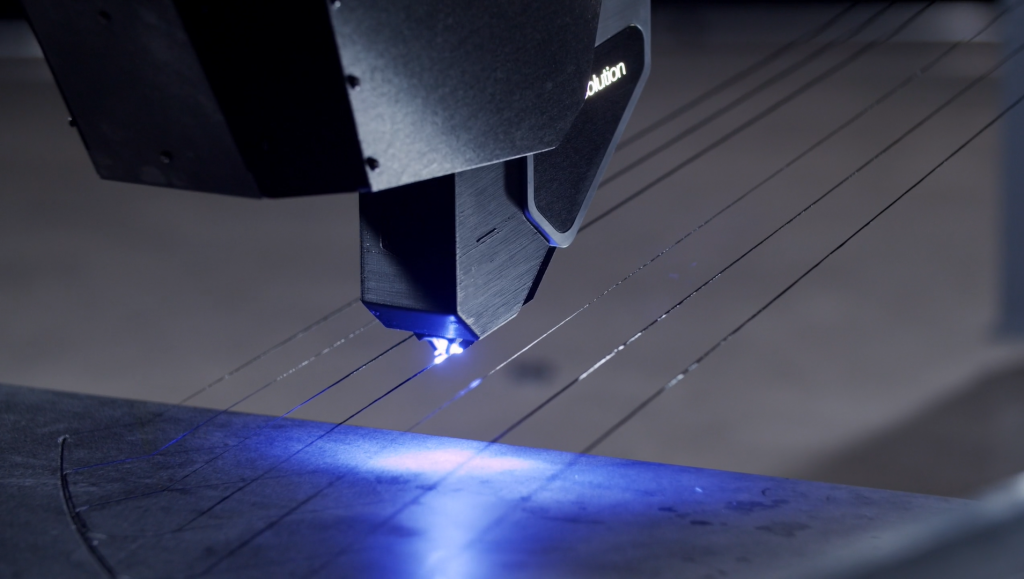
In related developments, Elementum 3D, a developer of advanced metal materials and print parameters for additive manufacturing, was selected as an EWAAC awardee. The company will contribute its expertise in high-performance materials and AM processes to support projects aligned with the Air Force’s digital transformation and armament modernization goals. The company is known for its proprietary Reactive Additive Manufacturing (RAM) technology, which enables printing of advanced materials previously unattainable with conventional methods.
The 3D Printing Industry Awards are back. Make your nominations now.
Do you operate a 3D printing start-up? Reach readers, potential investors, and customers with the 3D Printing Industry Start-up of Year competition.
To stay up to date with the latest 3D printing news, don’t forget to subscribe to the 3D Printing Industry newsletter or follow us on Linkedin.
Featured image shows F-15 Eagle. Photo via NAVAIR.