South Korean motor vehicle manufacturing companies Hyundai Motor and Kia have given a detailed look inside the Additive Manufacturing Solution Center (AMSC), a facility at their shared Namyang Research and Development (R&D) Center in Hwaseong, South Korea, that consolidates polymer and metal 3D printing under a single roof.
The AMSC is the first site Hyundai Motor Group has built specifically for additive manufacturing, established nearly three decades after the Group installed its first industrial 3D printer in 1996.
Four process families, one facility
Rather than standardizing on a single technology, the AMSC runs a spread of processes matched to material, geometry, and performance requirements.
On the polymer side, the center operates vat photopolymerization systems in two forms: Digital Light Processing (DLP), which cures a full resin layer at once using ultraviolet light, and stereolithography (SLA), which traces geometry with a guided laser. Both are aimed at finely detailed parts for design validation and prototype work where dimensional accuracy matters most.

Polymer powder bed fusion covers the second polymer route. Because the surrounding powder bed supports the part as it builds, no support structures are needed, cutting waste and post-processing. Hyundai says vapor smoothing brings the finish close to that of injection-molded parts, making the process viable for customized and development components rather than visual mock-ups alone.
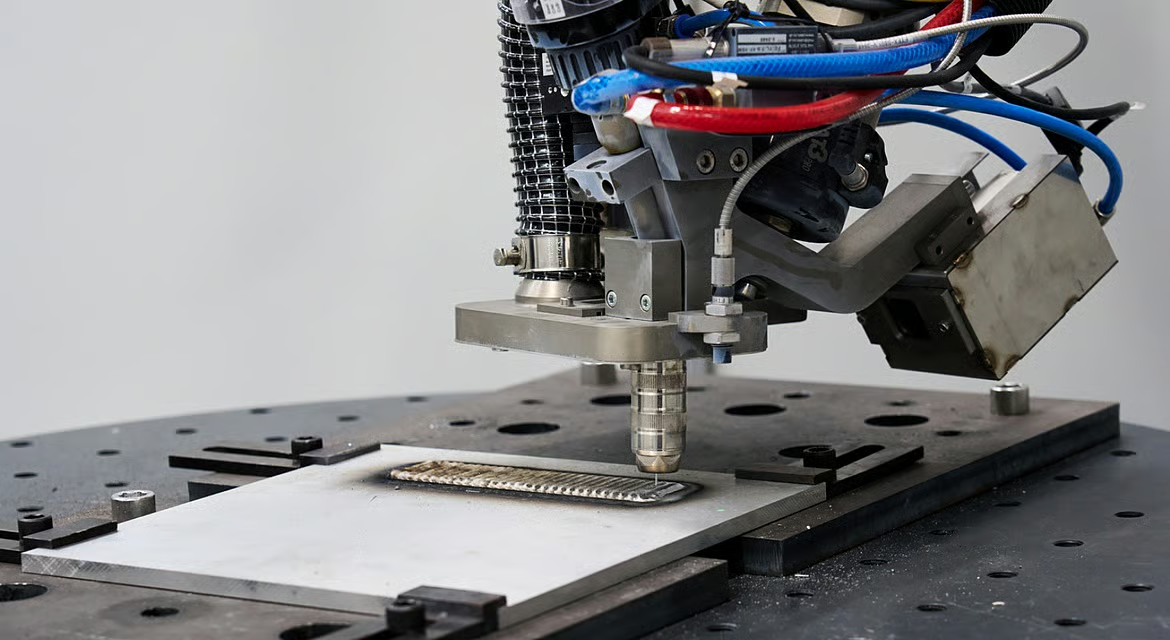
For metals, the AMSC pairs metal powder bed fusion with directed energy deposition. Metal PBF handles complex geometries at the accuracy and mechanical performance needed for vehicle components that would be awkward to cast, stamp, or machine. For larger structures, the center uses DED-Wire Arc Additive Manufacturing (DED-WAAM), depositing metal via welding arc in steel, stainless steel, aluminum, and titanium, the route Hyundai points to for large structural parts that conventional methods struggle to produce as one piece.
Alongside the hardware, the AMSC is building out Design for Additive Manufacturing (DfAM) capability, with engineers reworking components specifically for printing to enable part consolidation, lattice structures, and lightweight geometries.
Validating printed parts against production standards
Every component produced at the center passes through a Quality Inspection Cell, where dimensional measurements, tensile strength, bending stiffness, and impact resistance are checked against production-equivalent benchmarks. In-house material verification and metallurgical analysis sit behind that testing, the mechanism by which Hyundai and Kia argue additively manufactured parts can be held to the same expectations as conventionally produced ones.
From jigs to a Hyundai Pony restoration
The applications now running through the AMSC span four areas. In vehicle development, the center produces prototypes, development components, manufacturing jigs and fixtures, and service parts for discontinued models or urgent replacements where cutting new tooling makes no sense.
Heritage restoration is the second. Engineers rebuild legacy components through 3D scanning and reverse engineering, demonstrated by a Hyundai Pony side-sill part that was digitally reconstructed and reproduced with period-accurate surface finishing.
Motorsport is the third, with anti-roll bar blades, damper brackets, and brake duct rails printed to hit the weight-to-rigidity balance racing demands. The center has also shown a vehicle motor housing displaying both its as-printed DED-WAAM structure and its CNC-machined finish, illustrating how printed metal parts move through post-processing.
Hanwoo On, Senior Manager of the Additive Manufacturing Solutions Team, said the Group is “rapidly internalizing additive manufacturing technologies” across a widening set of applications, adding that use is expanding past vehicle components into equipment consumables and manufacturing tooling.

Automakers are pulling additive manufacturing in-house
The strategic logic is in that word “internalizing.” Hyundai Motor Group is keeping printers, DfAM expertise, and qualification testing inside its own R&D perimeter, betting that additive’s value lies less in any single part than in how fast a design becomes a testable one.
BMW made the same bet. The company’s Additive Manufacturing Campus in Oberschleissheim, north of Munich, has moved from prototyping into what BMW frames as standing industrial production, with the first vehicle components made by Wire Arc Additive Manufacturing scheduled to enter series production in 2027, supported by new metal systems, larger build volumes, and digitally networked process chains. BMW has also worked the sustainability angle from the same site, recycling spent print powder and scrap components into filament and granulate for reuse across its plants.
The legacy-parts case Hyundai is making with the Pony has precedent too. Porsche Classic turned to SLM and SLS to reproduce rare spare parts for collector models including the 959, addressing exactly the problem Hyundai cites: components for which original tooling is gone and demand is too low to justify rebuilding it.
Within Hyundai Motor Group itself, supplier Hyundai Mobis opened a $2.8 million Design Model Workshop combining powder 3D printing with full-size clay modeling, an early move toward the co-located design-and-fabrication model the AMSC now formalizes at Group scale.
What the AMSC changes is where the capability lives. Hyundai and Kia have stopped treating printing as a service they call on and started treating it as infrastructure they own. The next question is how much of it reaches series production.
3D Printing Industry is inviting speakers for its 2026 Additive Manufacturing Applications (AMA) series, covering Energy, Healthcare, Automotive and Mobility, Aerospace, Space and Defense, and Software. Each online event focuses on real production deployments, qualification, and supply chain integration. Practitioners interested in contributing can complete the call for speakers form here.
To stay up to date with the latest 3D printing news, don’t forget to subscribe to the 3D Printing Industry newsletter or follow us on LinkedIn.
Explore the full Future of 3D Printing and Executive Survey series from 3D Printing Industry, featuring perspectives from CEOs, engineers, and industry leaders on the industrialization of additive manufacturing, 3D printing industry trends 2026, qualification, supply chains, and additive manufacturing industry analysis.
Featured image shows A DED-WAAM (Directed Energy Deposition-Wire Arc Additive Manufacturing) system fabricates a metal component by depositing material layer by layer. Photo via Hyundai.