



Suuz is a new Dutch online service for designing personalized jewellery. The company – founded by five former Technical University of Delft students – first launched its site in a beta phase in February, but has now launched the full version of the service. The core idea is simple – Suuz enables users to customize the products – jewellery from different categories – according to their needs and personal tastes and then order the 3D printed products directly to their front door.
The product range from Suuz at this point is not overwhelmingly complex – the categories include two different kind of rings and beads – all with the customization aspect related to the ability to personalize text and applied font style, which in fact form the most of the actual ring/bead’s final design. Other tweakable components include the jewellery’s material – ranging from gold plated and full silver options to plastic in all colors of the rainbow as cheaper options – and naturally the diameter of the ring, with sizes 14 mm to 21mm available. The prices are of course heavily dependant on the chosen material – e.g. a gold plated ring will cost €139, but in nylon can be purchased for €19.
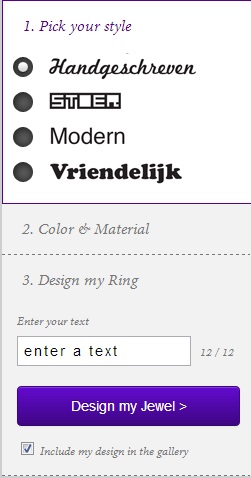 When looking at Suuz at this stage, they seem to have incorporated service elements from two market leading 3DP companies – Thingiverse and Shapeways – into their model. The ease of customization is particularly reminiscent of the first company: e.g. creating the text into the .stl model via closed text boxes and adding the user created designs automatically to the gallery (if not unchecking the respective box) – two functions which are basically what the various customizable ring creators already provide at Thingiverse. Also, with no specific information on the actual manufacturing processes of Suuz available on their website, the latter company – Shapeways, might could well provide the 3D printing fulfillment of the also Dutch-native Suuz jewellery. This would, imo, be a positive due to Shapeways’ proven track record.
Even though Suuz has created a solid foundation for the company, in order to succeed in the long run they could benefit from a stronger and differentiating angle. Whether or not they are even planning to expand their portfolio to cover all relevant jewellery categories, enable the customization engine to affect more than just the text and material i.e. the shape itself is unknown/unpublished – natural for a brand new project – but one thing is for sure – 3D printable jewellery and a simplified online browser-based customization such as this should be a part of most traditional jeweller’s offering as well. It wouldn’t be contradictory to the handcraft aspect nor interfere with the daily business, but could easily be operated on the side with just a few resources. The jewellery sector could very well be the leading example business of how 3D printing and traditional manufacturing can co-exist peacefully together and actually create synergy rather than cannibalize one another if placed on the same roster.
Source: Suuz