

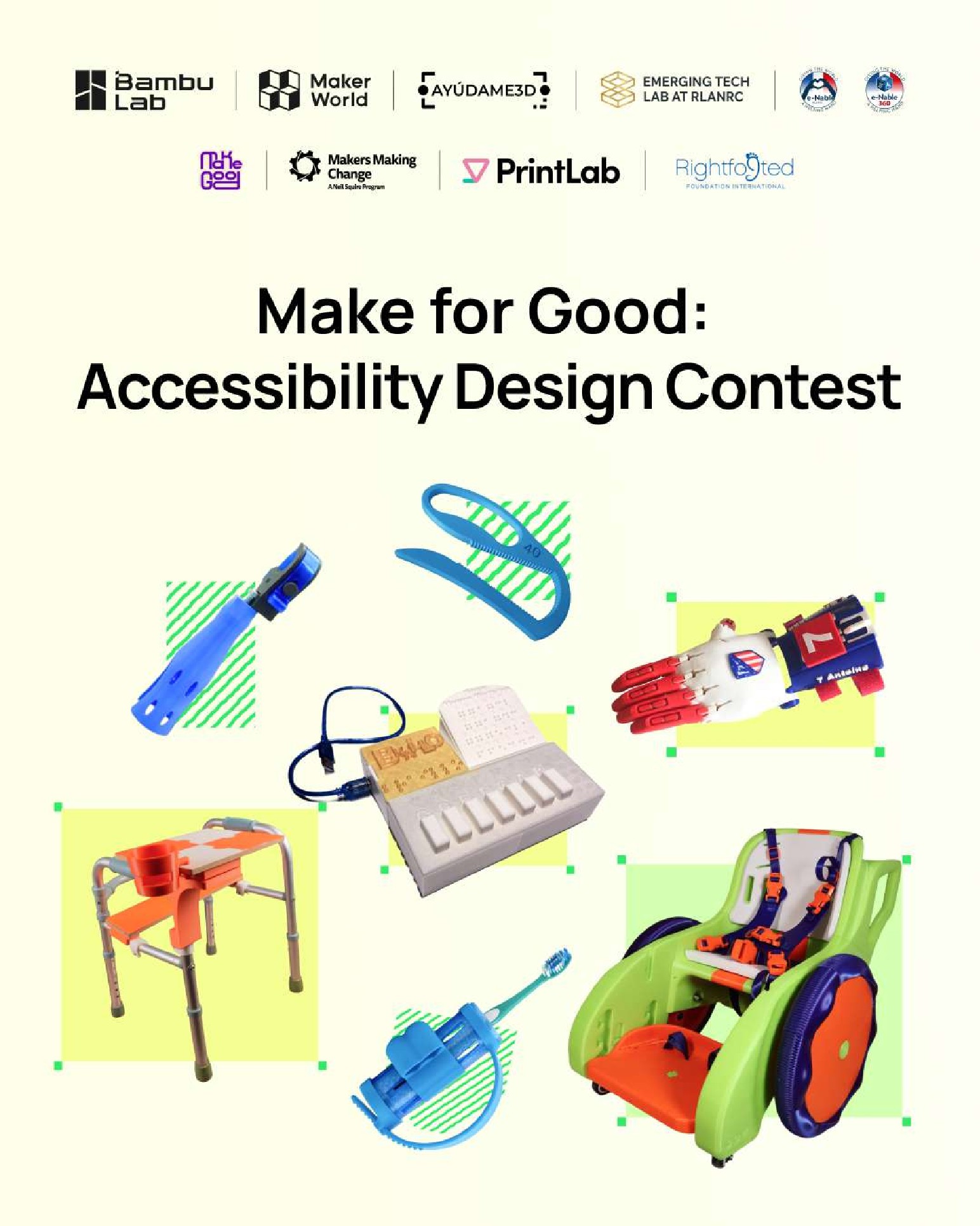
Bambu Lab has partnered with seven accessibility organizations to launch a global 3D printing design challenge on MakerWorld, running from September through December 2026. The contest will roll out 24 design briefs asking participants to create printable objects that solve specific, everyday problems faced by people with disabilities.
The initiative marks the first time MakerWorld has organized its designer community around a coordinated set of needs defined directly by people with disabilities and the organizations that work with them.
Real problems, real users
Each brief traces back to a concrete obstacle someone actually faces. Jessica Cox, founder of Rightfooted Foundation International and born without arms, uses her feet for daily tasks. Putting on a single sock is manageable; a second sock is not, since covering one foot removes the friction needed to pull fabric over the other heel. Walking her service dog presents a similar problem: she can scoop waste with her foot but has no way to carry the bag afterward without holding it under her chin. Fastening a bike helmet means sitting on the floor to align the buckle by feel.

At the Emerging Tech Lab (ETL) at Rancho Los Amigos National Rehabilitation Center, staff work with people with disabilities and rehabilitation professionals to identify and fabricate similar fixes, such as reachers that don’t require a squeezing motion, or storage solutions for wheelchair users who struggle to access phones, wallets, or keys.
The remaining briefs span the kitchen, the bathroom, and hobbies. Ayúdame3D is asking for a toothbrush that doesn’t need to be pinched and a one-handed ponytail tool. E-Nable France wants a one-hand kitchen toolkit. Makers Making Change, a program of the Neil Squire Society, is requesting a knitting-needle support for stroke survivors, a guitar pick that stays put with limited grip, and a marker-cap aid usable by a teacher working alone. PrintLab wants a tabletop game a child with cerebral palsy can play with friends, designed to look like a game, not therapy equipment. MakeGood is requesting a pickleball paddle holder for players with weakened hand and arm strength.
Qianye, Creator Operation at MakerWorld, framed the challenge around specificity rather than abstraction: “These are not hypothetical users.” The goal, as described in the release, is a design precise enough that “that person does not have to ask” a stranger for help.
From submission to someone’s hands
Submissions run for two months. The seven partner organizations then spend a month printing shortlisted designs and testing them directly with the people the briefs were written for, in some cases delivering finished prints to those users as part of the evaluation. That testing feedback will shape the final results.
Winning files will be added to open-source libraries and distributed through volunteer print networks the partner organizations already operate in more than 70 countries.
Bambu Lab framed the challenge’s outcome in small, specific terms rather than aggregate metrics: someone who set aside a board game because the pieces were too small sitting down to play again, a ponytail tied without assistance, a second sock going on without a fight. The release states that a dozen such moments by December would count as the challenge doing “what it set out to do.

Closing a Gap the Maker Community Already Sensed
Bambu Lab’s strategy with this challenge is to redirect the size of its own community toward a problem 3D printing has always been suited to but rarely organized around at scale: assistive devices tailored to a single person’s body and routine.
That gap has shown up in smaller, disconnected efforts for years. MakeGood built the Toddler Mobility Trainer, a fully 3D printed wheelchair for young children, part of a broader wave of 3D printed and wearable assistive technologies aimed at improving independence.
Further back, B9Creations partnered with Black Hills Works to print custom devices, eating utensils, wheelchair grips, wearable medical tools, for more than 600 disabled individuals, pairing a printer manufacturer’s hardware with an organization that already understood the users’ needs.
The pattern goes back a decade: MakerBot’s Thingiverse ran an Assistive Technology Challenge in 2015 after a Bay Area Makeathon produced prototypes like a mouth-operated grabber, proving the community could build this way when given a real person’s problem. What Bambu Lab is attempting now is to make that occasional pairing a standing structure, nonprofits supplying the need, MakerWorld supplying the reach.
Register now for AMA: Software 2026. Join 3D Printing Industry on 22 October for expert presentations, panel discussions and live audience Q&A exploring the software shaping additive manufacturing. Register here.
To stay up to date with the latest 3D printing news, don’t forget to subscribe to the 3D Printing Industry newsletter or follow us on LinkedIn.
Explore the full Future of 3D Printing and Executive Survey series from 3D Printing Industry, featuring perspectives from CEOs, engineers, and industry leaders on the industrialization of additive manufacturing, 3D printing industry trends 2026, qualification, supply chains, and additive manufacturing industry analysis.
Featured image shows Bambu Lab Launches Global 3D Printing Challenge for Assistive Devices. Image via Bambu Lab.







