

Where can AI actually help your print workflow? Find out at AMA Software, online on October 22nd.
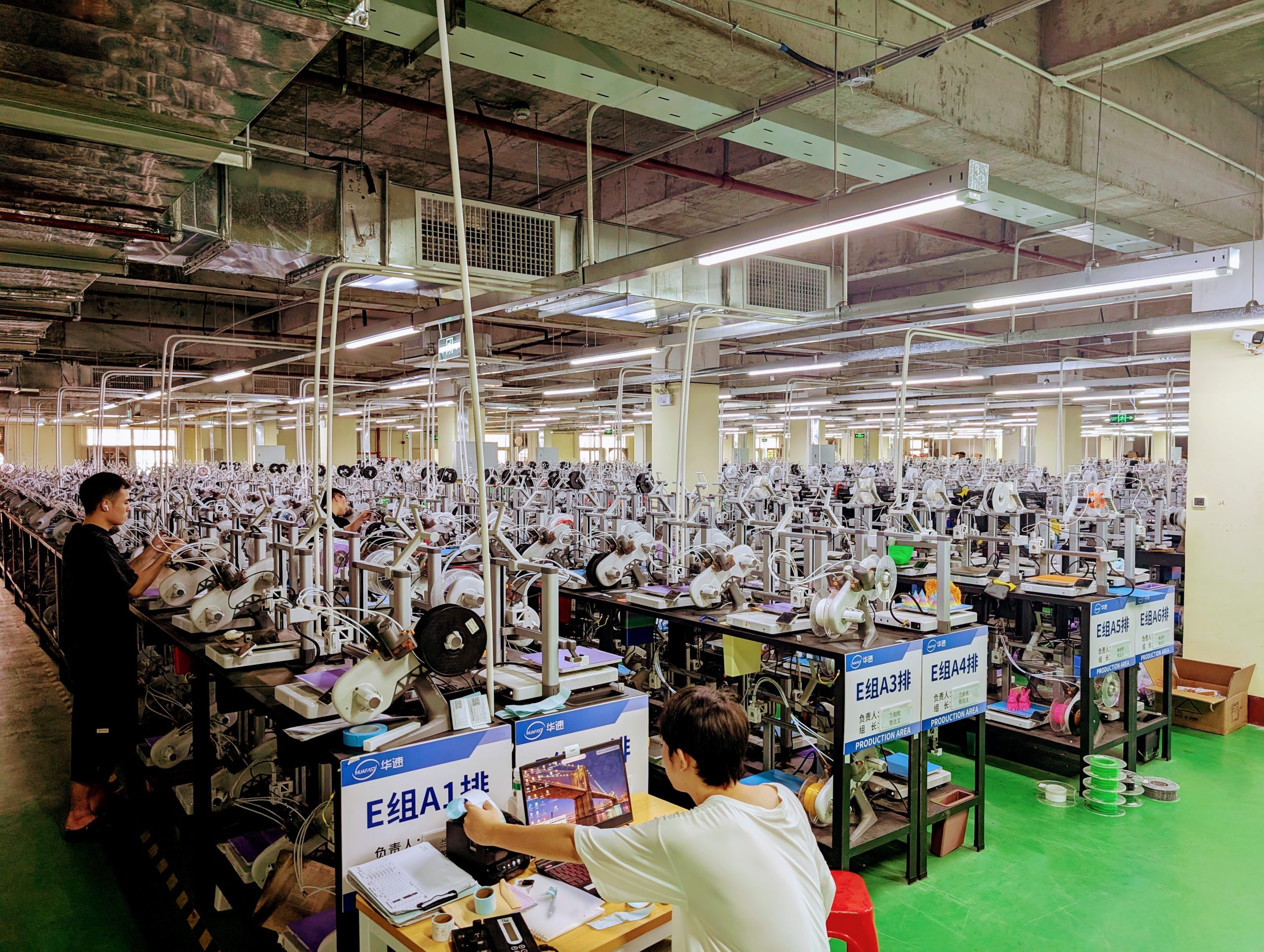
At Huafast’s 3D printing operation in Shenzhen, thousands of desktop machines manufacture toys and other products. On some of the equipment, getting a design into production still involves carrying an SD card to the printer. Wireless interference makes sending files across the factory unreliable. Cheap machines have arrived faster than the infrastructure to manage them.
The scale would once have surprised Timo Führer, a partner at AMPOWER, the additive manufacturing consultancy. Having visited Huafast himself, he recalls doubting whether filament extrusion could support such large operations. He was similarly sceptical about Zellerfeld’s plans to manufacture shoes using the process. “When I first heard about Zellerfeld, for example, I was really skeptical,” he says.
AMPOWER’s latest desktop printing study, published with the Manufacturing Technology Deployment Group, estimates that 5.2 million desktop printers were sold worldwide in 2025, up 34% from 3.88 million in 2024. Sales have grown at a compound annual rate of 22.4% since 2020. Filament consumption reached approximately 60,000 tonnes in 2025, an increase of almost 43%.

China manufactures 94% of desktop printers, according to the study. Four of the five largest suppliers by unit volume are based in the Shenzhen region. The five together account for 86% of sales. Nearby materials producers, component suppliers and equipment manufacturers have helped turn the region into a centre of rapid product development.
Führer attributes part of that success to the ambitions with which newer manufacturers entered the market. “They went to the market and were looking for an opportunity to sell millions and millions of printers,” he says. They approached desktop printing as a consumer-electronics business. Recent reporting showing Bambu Lab has expanded its presence at authorised Apple stores across China supports this premise. From an initial roll-out in sixty Apple stores, Bambu Lab 3D printer can now be purchased at 262 stores as of the end of September 2026.
Bambu Lab’s arrival in 2022 accelerated competition over speed, reliability and ease of use. Its rivals were caught off guard, Führer says; one described how Bambu’s arrival undermined a product launch of its own. AMPOWER’s report charts a market in which buyers have gained substantially more capable equipment without a corresponding increase in price.
The pressure extends beyond inexpensive hobby machines. Führer argues that Bambu is eroding the position of suppliers selling equipment in the €5,000–€10,000 range. He expects the market eventually to be dominated by five to ten companies, with room for specialists. European suppliers, in his view, have opportunities among customers concerned about data security and in regulated industries such as defence, albeit at smaller volumes than the consumer market offers.
For manufacturers of finished products, machines costing €500–€1,000 allow capacity to be added in small increments. A business can test a design, take orders and buy further printers as demand develops. AMPOWER identifies companies using desktop fleets to make lighting, footwear, insoles, accessories and collectible toys. China’s Jinqi Toys and America’s Wigglitz illustrate how quickly such businesses can assemble fleets numbering in the thousands.
The most striking financial claim concerns a European producer of furniture and lighting elements. It told AMPOWER that a Bambu Lab A1 could repay its purchase cost within 24 hours. Earlier equipment had required attention every few days, Führer says. More reliable machines reduced that burden. The business already had customers and sold into the premium furniture market. Its claim concerns additional equipment serving established demand. A low purchase price makes rapid payback possible, but the selling price of the product and the ability to find buyers remain decisive.
Filament demand offers another indication of expanding activity. PLA remains the dominant material, while the report highlights growth in flexible TPU, used by footwear producers including Zellerfeld and Koobz. Rising material consumption does not, by itself, establish greater utilisation per machine: the installed fleet is also expanding.

Despite the visibility of large print farms, individual buyers remain the core market for desktop manufacturers. “They are focusing on their community rather than on industrial users,” Führer says.
That helps explain the uneven development inside factories. At Huafast, he saw software providing an overview of jobs and machine activity, but little automation of the surrounding physical work. The report identifies filament changes, part removal, inspection and packaging among the tasks still commonly performed by hand. An inexpensive printer can be bought off the shelf; integrating hundreds of them into an efficient production operation requires further investment – in the case of the China 3D printing farms that often means people, rather automation.
Führer expects AI-assisted design to broaden the consumer market by helping people create objects without learning conventional CAD software. His argument centres on easier access to design and the possibility of incorporating those capabilities into widely used AI assistants.

The report’s moderate scenario assumes roughly 30% annual growth in equipment sales. Sustained from the 2025 base, that would produce approximately 19.3 million annual sales by 2030, a calculation rather than an explicit numerical forecast in the study. Führer considers that scale conceivable, while expecting growth rates to ease after perhaps another two or three years of rapid expansion.
For the factories already operating these machines, less speculative improvements are available. At Huafast, the ability to send a file reliably across the room would remove one reason for an operator to walk between printers. Finished parts would still need collecting, checking and packing.
Register now for AMA: Software 2026. Join 3D Printing Industry on 22 October for expert presentations, panel discussions and live audience Q&A exploring the software shaping additive manufacturing. Register here.
To stay up to date with the latest 3D printing news, don’t forget to subscribe to the 3D Printing Industry newsletter or follow us on LinkedIn.
Explore the full Future of 3D Printing and Executive Survey series from 3D Printing Industry, featuring perspectives from CEOs, engineers, and industry leaders on the industrialization of additive manufacturing, 3D printing industry trends 2026, qualification, supply chains, and additive manufacturing industry analysis.
Featured image shows Rows of Bambu Lab desktop 3D printers operating at Huafast in Guangming. Photo by Michael Petch.







