

Researchers at the Université de Lorraine in France have examined strategies to simplify plastic recycling by reducing the need for pre-sorting, helping to advance Distributed Recycling Additive Manufacturing (DRAM) as a framework for more localized and circular production systems.
This approach is significant because sorting mixed plastic waste remains one of the most costly and energy-intensive stages in recycling, often limiting material recovery rates and economic viability. Enabling direct processing of mixed streams could lower operational barriers, reduce waste, and make decentralized recycling models more practical.
The study was conducted in collaboration with the ERPI and LRGP laboratories at Université de Lorraine, alongside the Department of Electrical and Computer Engineering at Western University in Canada.
To assess feasibility, the team worked with recycled polyethylene terephthalate (rPET) and recycled high-density polyethylene (rHDPE) obtained from discarded water bottles. They compared conventional processing methods with fused granular fabrication (FGF) 3D printing, blending rPET and rHDPE at a 90/10 weight ratio. The objective was to determine whether directly printing mixed recycled plastics could deliver mechanical performance comparable to that achieved through traditional extrusion and injection molding routes.
Processing Methods and Mechanical Performance
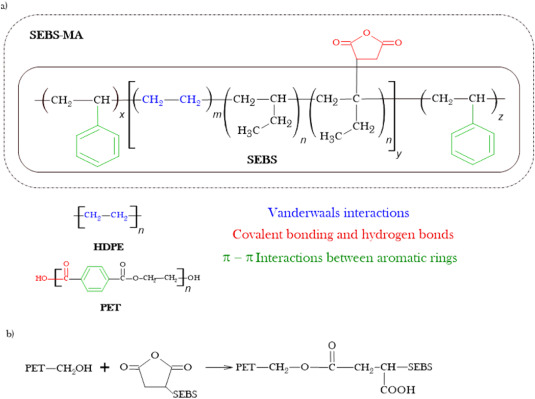
To enhance compatibility between mixed polymers, the study incorporated three styrene-based compatibilizers at 10% by weight: two non-reactive grades (G1650 and G1652) and a reactive maleated SEBS, cirKular+ C1010. According to lead researcher Cécile Nouvel of Université de Lorraine’s CNRS laboratory, the research sought to address “the high costs and inherent inefficiencies of conventional processes” by minimizing sorting steps in recycling streams.
Mechanical testing revealed notable differences between manufacturing methods. Parts produced through twin-screw extrusion and injection molding demonstrated roughly 50% higher tensile strength and 34% greater impact resistance compared to those fabricated via FGF 3D printing. Conventionally processed samples were fully dense, while printed components contained internal voids resulting from the layer-by-layer deposition process.

However, the additively manufactured samples exhibited advantages in other areas. They showed reduced thermal degradation and displayed more structured crystalline organization at elevated temperatures.
Compatibilizer addition improved elongation at break by around 40% in conventionally processed materials. Rheological analysis indicated that G1652 lowered the melt flow index by approximately 10%, while G1650 reduced it by 47%, both reflecting increased viscosity. In contrast, the reactive C1010 slightly increased melt flow index by 6%.
Processing Limitations and Future Directions
For the additive trials, researchers employed a modified Gigabot XL system equipped with a single-screw extruder and a residence time of 2.2 minutes. The team observed that “a single mixing point often results in non-uniform shear distribution, which can hinder the effective breakdown of polymer domains,” highlighting a limitation in current large-format FGF setups.
Based on these findings, the researchers suggested integrating twin-screw or planetary roller extrusion systems directly into 3D printers to achieve more uniform blending and improved material performance.

Circular AM Expands — But Feedstock Remains Controlled
Circularity initiatives in additive manufacturing have grown, but they mostly rely on controlled, homogeneous waste streams. Building on this trajectory, the Université de Lorraine study explores directly printing mixed post-consumer plastics (PET and HDPE) without prior sorting, tackling a key bottleneck in distributed recycling.
Other initiatives illustrate the current landscape: University of Colorado Boulder, engineers launched a campus program to collect and remanufacture PLA print waste into reusable filament, showing how localized recycling can reduce landfill disposal in educational environments.
Pellet-based systems such as WASP’s CUBO HDP process shredded plastics directly on-site, enabling decentralized reuse without relying on filament supply chains. The printer tolerates some variability in particle size, but guaranteed performance is only achieved with a list of tested polymers, meaning the feedstock is still effectively controlled.
In industry, Filamentive’s recycling service demonstrates a similar pattern: post-consumer filament is collected, reprocessed, and returned as high-quality feedstock, but the scheme is only available for PLA waste.
The 3D Printing Industry Awards are back. Make your nominations now.
Do you operate a 3D printing start-up? Reach readers, potential investors, and customers with the 3D Printing Industry Start-up of Year competition.
To stay up to date with the latest 3D printing news, don’t forget to subscribe to the 3D Printing Industry newsletter or follow us on Linkedin.
Featured image shows A) Chemical structure of SEBS, SEBS-MA, PET and HDPE with possible interaction b) reaction of the terminal hydroxyl group of PET with maleic anhydride of the SEBS. Image via Université de Lorraine.







