

Camtek Ltd. (CAMT) is launching the first commercial 3D printer for the PCB (Printed Circuit Board) industry this year. The company announced this development in a press release stating: “As a future growth engine, in addition to the existing products lines, the Company will focus its activity in the field of digital 3D printing for the printed circuit board industry.” As discussed in last month’s 2013 year-end conference call, Camtek’s new $300,000 “GreenJet” inkjet-based 3D printer has been delivered to the first customer and is in the final stage of testing with full commercialization anticipated in the second half of this year. With the competitive advantages the printer delivers, the launch could be a game-changer for the company as well as the PCB industry.
Camtek Ltd manufactures and markets computerized systems that optically inspect electronic components for defects caused during manufacturing. The $120 million market cap company has 480 employees, a balance sheet with $ 22.5 million cash and equivalents, and a current ratio of 3. Camtek Ltd. is based in Israel, with offices in the U.S. and Europe in addition to a strong presence throughout the Asia-Pacific region.
Highlights of the Full Year 2013
- Revenues of $85.4 million
- Gross margins 45%
- Non-GAAP operating income of $3.2 million; GAAP operating income of $1.1 million
- Non-GAAP net income of $2.1 million; GAAP net income of $7 thousand
- Positive operating cash flow of $4.7 million; Cash and equivalents of $22.5 million as of December 31, 2013
Highlights of Fourth Quarter 2013
- Revenues of $23.3 million (a 32% increase over Q4 2012)
- Net income (GAAP basis) of $0.02/share vs. loss of $0.11/share in Q4 2012
- Positive operating cash flow of $2.6 million
- 3D Printing System for PCB market installed at customer site for testing
- Camtek is forecasting Q1 2014 revenue growth of greater than 20%
Sources: Form 20-F, press release
Analyst Earnings Estimate .40/share Next Year
Due to the launch of its new 3D printer for the PCB industry, Chardan Capital Markets upgraded Camtek to a “Buy” based on the company’s “3D Printing Opportunity.” Chardan Capital Markets now estimates earnings of .10/share for 2014, and an impressive .40/share next year.
Launching GreenJet 3D Printer For Solder Mask Deposition
Camtek’s $300,000 GreenJet printer is an inkjet-based 3D printer designed for the deposition of solder mask on PCBs and offers manufacturers a high-performance solution with a wide range of cost-effective and technological benefits. The GreenJet printer is reported to deliver savings in labour, cycle time, electrical costs and space.
Moreover, GreenJet printers directly address a critical, costly and frequent complication during PCB manufacturing process: misalignment. As PCBs become increasingly crowded in order to fit more electrical components with more links on smaller boards, perfect alignment is essential. I believe the ability of the GreenJet printer to minimize alignment issues and reduce the 4-step solder mask deposition process to a 1-step process in addition to cost savings and shorter cycle times will result in strong demand from PCB manufacturers.
Early Mover Advantage In $93.9 Billion Market
The PCB industry is forecast at an 8% compound annual growth rate, and to reach $93.9 billion by 2017. This enormous market is highly competitive and Camtek’s GreenJet printer is entering the space with a novel product that delivers PCB manufacturers the competitive advantages noted above.
In addition to machine sales Camtek will generate recurring revenue with their proprietary hybrid ink, tailored to meet the demanding requirements of the PCB industry.
Technical Indicators
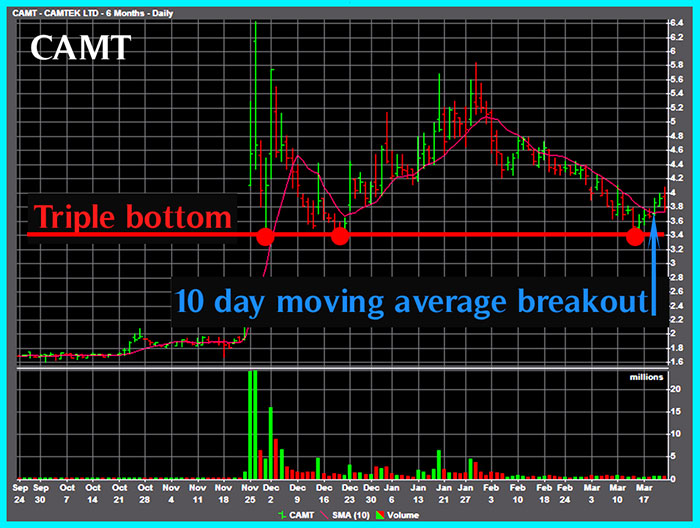
Two strongly bullish technical indicators were put into place last week:
• CAMT is coming off a triple bottom formation with lows on 11/29, 12/18, and 3/14
• CAMT broke above the 10 day moving average on 3/19. On Friday, 3/21, (a red day for the market in general), shares bounced off the 10 dma of 3.73 (low of day was 3.74)
Triple bottom reversals and 10 day moving average breaks are two of the more frequently used bullish technical indicators, and that’s in no small part because they are typically reliable.
Many experts agree that stock trading in specific companies and in the stock market overall tends to be forward-looking by about 6 months. Taking that time frame into consideration with Camtek’s scheduled commercialization of GreenJet printers in the second half of this year, I believe the lows of 2014 have been put into place and that the stock will trade higher from here.
Conclusion
With a strong balance sheet, strong revenue growth forecast, positive cash flow from operations and the commercial launch of the GreenJet printer this year, I believe shares are heavily undervalued at present. Analyst estimates for .10/share in earnings this year, jumping to .40/share next year appear well within reason and should drive CAMT shares higher.
Disclosure: I am long shares of Camtek Ltd. I have not been paid by any company or third-party for this article.