

ORD Solutions has undertaken a Kickstarter campaign to fund its most recent project, a multi-coloured 3D printer, and has surpassed its fundraising goals. The eagerness from supporters establishes the belief people have in ORD and the expectations for ORD products. With five extrusion nozzles and a larger build area, the MH3000 looks to challenge other multi-coloured 3D printers. In fact, one of the selling points for the fundraiser is the comparatively low-cost projected by ORD Solutions. They plan to use a similar model to their BTO1001 R2 3D printer with some slight modifications.
ORD plans to make the hot-end all metal so it can print at temperatures greater than 350˚C allowing users to print with materials like polycarbonate, ABS, PLA and Vinyl. The Y bed promises to be lighter, sturdier and flatter. The volume goal is 11.1”(X) by 10.65”(Y) by 6.5”(Z), yet ought to be able to fit on a standard printer platform and heat in less than one minute. All of these goals are exciting and help explain the quick level of donation.
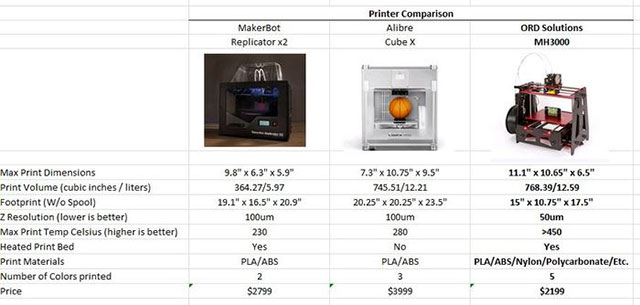
When compared with the Replicator 2 and Cube X respectively, all the numbers sway in favour of the proposed ORD MH3000. The second video shows the prototype in action printing dice. As the video explains, the printing speed had required adjustment based on the design and specifications of the object. The tubes carrying the filament recall the experiments of scientists mixing solutions with anticipation as their concoction blooms to fruition. With outlets like Kickstarter, ORD creates a symbiotic relationship with its customer base and those wanting more affordable and effective 3D printers in the third wave of 3D printing.
Source: Kickstarter