


Researchers Masaru Mukai, Shoji Maruo, and colleagues at Yokohama National University have introduced a photocurable resin that can be printed, melted down, and printed again, more than ten times over, without adding a single chemical along the way. The material,…
Research
- 3D Platforms
- 3D Printers
- 3D Printing
- 3D Printing News Digest
- 3D Scanners
- 3D Software
- 3DP Applications
- Aerospace
- Applications
- Archive
- Art & Sculpture
- Automotive
- bodyTop
- Business
- Case Studies
- Construction
- Consumer Products
- Crowd Funding
- Defense
- Design
- DontAppear
- Education
- Electronics
- Energy
- Entertainment
- Event
- Executive Interview Series
- Fashion
- Food
- Insights
- Jewellery
- Jobs
- Kickstarter, etc
- Laser Cutters
- Legal and Regulatory
- Magazine
- Makers
- Market Insights
- Materials
- Medical & Dental
- On demand manufacturing
- Open source
- Post Processing
- Research
- Reviews
- Stock Market
- Transport
- Uncategorized
- Videos
- More
NSF Backs UNF Research to Stamp Out Defects in Metal 3D Printing
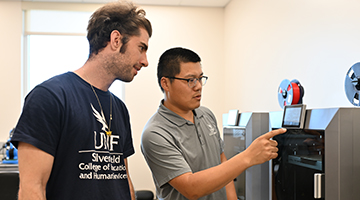
Backed by a newly awarded National Science Foundation grant, researchers at the University of North Florida are developing an automated monitoring system that detects and corrects defects in metal 3D printing layer by layer, in real time. Dr. Longfei Zhou,…

TU Delft researchers 3D print living mycelium materials with growth-driven functionalization
Researchers at Delft University of Technology (TU Delft) have developed a 3D printing approach for shaping living mycelium materials that can self-assemble functional particles during growth. Published in Advanced Functional Materials, the study demonstrates how fungal networks can be printed,…

CU Boulder and Columbia researchers develop bio-inspired 3D printed earth material
Researchers from the University of Colorado Boulder and Columbia University have developed a bio-inspired approach to improve the 3D printing of earthen construction materials. Published in Nature Communications, the study introduces a multiscale optimization framework that uses biopolymers to improve…

University of Illinois Team Is Engineering the Fix for the AI Heat Crisis
Mechanical engineers at the University of Illinois Urbana-Champaign have developed a new approach to cooling computer chips that could reduce the share of energy data centers spend on thermal management. The method, published in Cell Reports Physical Science, pairs a…

Imperial College London researchers develop topology optimization framework for nonlinear mechanical metamaterials
Researchers at Imperial College London have developed a computational framework for the inverse design of nonlinear mechanical metamaterials, using topology optimization to generate microscale unit cells from prescribed homogenized stress–strain targets. Published in Advanced Engineering Materials, the study was authored…

AM mold inserts show promise for short-run injection molding, systematic review finds
Researchers from the University of Navarra, IKOR Technology Centre, GAIKER Technology Centre, and Valencian International University have published a systematic review examining how additive manufacturing can be used to produce mold inserts for plastic injection molding. Published in Rapid Prototyping…

New Study: Architecture Targets the Core Bottleneck in Battery Manufacturing
A study published in Materials Science & Engineering R argues that 3D printing is ready to move from laboratory prototyping to mainstream lithium battery manufacturing, provided several unresolved material and process problems are brought under control. The central argument is…

Cellulose modifications could support more sustainable FDM 3D printing filaments, review finds
Researchers have reviewed how chemically modified cellulose could improve the performance and sustainability of fused deposition modeling (FDM) 3D printing filaments. Published in Carbohydrate Polymers, the review examines functionalization strategies designed to make cellulose more compatible with thermoplastic polymer matrices…
Singapore researchers outline advances shaping biofabrication and biomanufacturing
Researchers in Singapore have published a review mapping the country’s recent contributions to biofabrication and biomanufacturing, from waste-derived biomaterials and 3D bioprinting to cultivated food, regenerative medicine, microneedles, and bioelectronics. Published in Bio-Design and Manufacturing, the review examines work led…
