Discover exclusive software insights at AMA: Software 2026, on October 22. Register for free!
Munich-based footwear startup Sneakprint has launched ShoeFactory, a web platform that sells custom-fitted footwear as a digital file instead of a finished product. Customers scan their feet with a smartphone, adjust a parametric design in the browser and receive STL files to print on their own 3D printer. The first and only model at launch is the Easy Slide, a flip-flop priced at EUR 64.99.
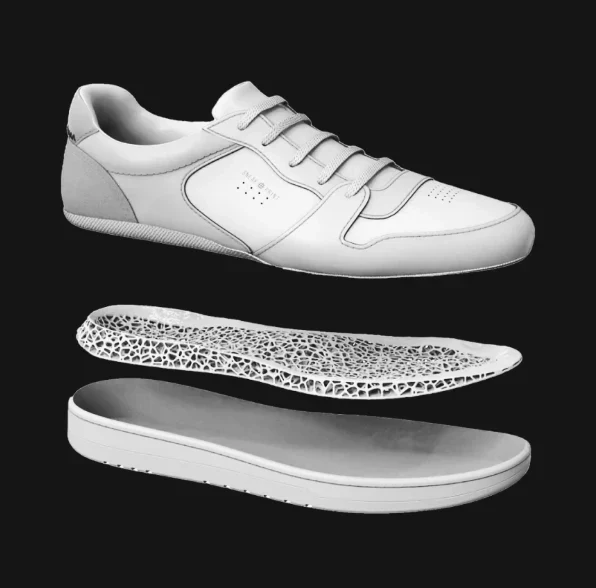
The launch reverses Sneakprint’s current business model. Since May 2023, the company has sold made-to-order leather sneakers, currently the B2 line at EUR 249, built on a fitting approach it calls MeSize. Sneakprint captures each customer’s feet by smartphone or with a mailed impression kit. It then 3D prints footbeds whose lattice structure is tuned to the wearer’s plantar pressure and pairs them with a last chosen from a range of widths. ShoeFactory keeps that scan-to-geometry pipeline but moves manufacturing, and the cost of the printer, to the customer.

From smartphone scan to printable file
ShoeFactory won’t sell anything without foot data. An order can only be placed once a scan is attached to the cart, and every later version of the design is built from that scan.
Each Easy Slide is generated as two separate parts, one per foot, because left and right feet rarely match. The geometry comes from Volumental, a Swedish fit-technology company whose scanning is more often used in shoe stores to suggest a size from a standard range. Here, its length, width and shape measurements, accurate to the millimeter, drive a parametric model instead. Customers run the scan in their phone’s browser without installing an app, photographing each foot on an ordinary sheet of paper that the software uses to judge scale. Volumental says its AI engine was trained on 66 million real-world scans.
In the browser configurator, buyers can adjust sole thickness, width, height, lattice density and strap text, and they have up to 90 days to finish. Approving the design triggers the export, and the customer receives an archive of print-ready STL files by email within one to two minutes. The files stay with the buyer, so a worn-out pair can be printed again without another purchase. The launch does not include guidance on materials or printer requirements, which matters because wearable printed footwear usually depends on flexible filaments and well-tuned printer settings.
Opening the platform to designers and hardware makers
Sneakprint doesn’t plan to stay the only designer on ShoeFactory. Under a partner program, independent footwear designers will be able to list their own styles while Sneakprint provides the platform behind them. It will convert each design into a parametric model, tie it to the buyer’s foot scan, and run the configurator and checkout. That would make Sneakprint’s fitting technology infrastructure for other designers rather than a feature limited to its own products.
The second program targets makers of 3D printers, filaments and accessories, who will be able to present their products in a marketplace whose visitors are already shopping for printable files. Those brands could also fill the Easy Slide’s materials gap by recommending tested settings for printing a flexible sole. Details of both programs are available on request. Sneakprint’s own catalog is growing too, with the Chick Loafer in development as the next model.
Selling the fit, not the shoe
ShoeFactory keeps the fit layer, meaning the scan, the parametric model and the configurator, and hands manufacturing to the customer. That removes inventory, shipping and production limits from Sneakprint’s side, much as its sneakers are already produced only on demand.
In January, Bambu Lab and SCRY, through its FORMISM studio, began offering 3D printed shoes that users can print and customize at home. The model skips molds, inventory and distribution, but it requires a capable desktop 3D printer, experience with flexible TPU and time for long print cycles.
On the scanning side, Zellerfeld partnered with Volumental to connect foot scanning to 3D printed shoes, feeding in-store and mobile scans into its printing pipeline so each shoe is printed to an individual customer’s foot. Zellerfeld still prints the shoes in its own facilities, much like Superfeet with its iPhone-scanned custom 3D printed insoles.
Sneakprint combines both approaches, using scan-driven fit while home users do the printing. Its success will depend on how reliably those users can produce a wearable sole.
Register now for AMA: Software 2026. Join 3D Printing Industry on 22 October for expert presentations, panel discussions and live audience Q&A exploring the software shaping additive manufacturing. Register here.
To stay up to date with the latest 3D printing news, don’t forget to subscribe to the 3D Printing Industry newsletter or follow us on LinkedIn.
Explore the full Future of 3D Printing and Executive Survey series from 3D Printing Industry, featuring perspectives from CEOs, engineers, and industry leaders on the industrialization of additive manufacturing, 3D printing industry trends 2026, qualification, supply chains, and additive manufacturing industry analysis.
Featured image shows the production of personalized sneakers. Image via Sneakprint.