Discover exclusive software insights at AMA: Software 2026, on October 22. Register for free!
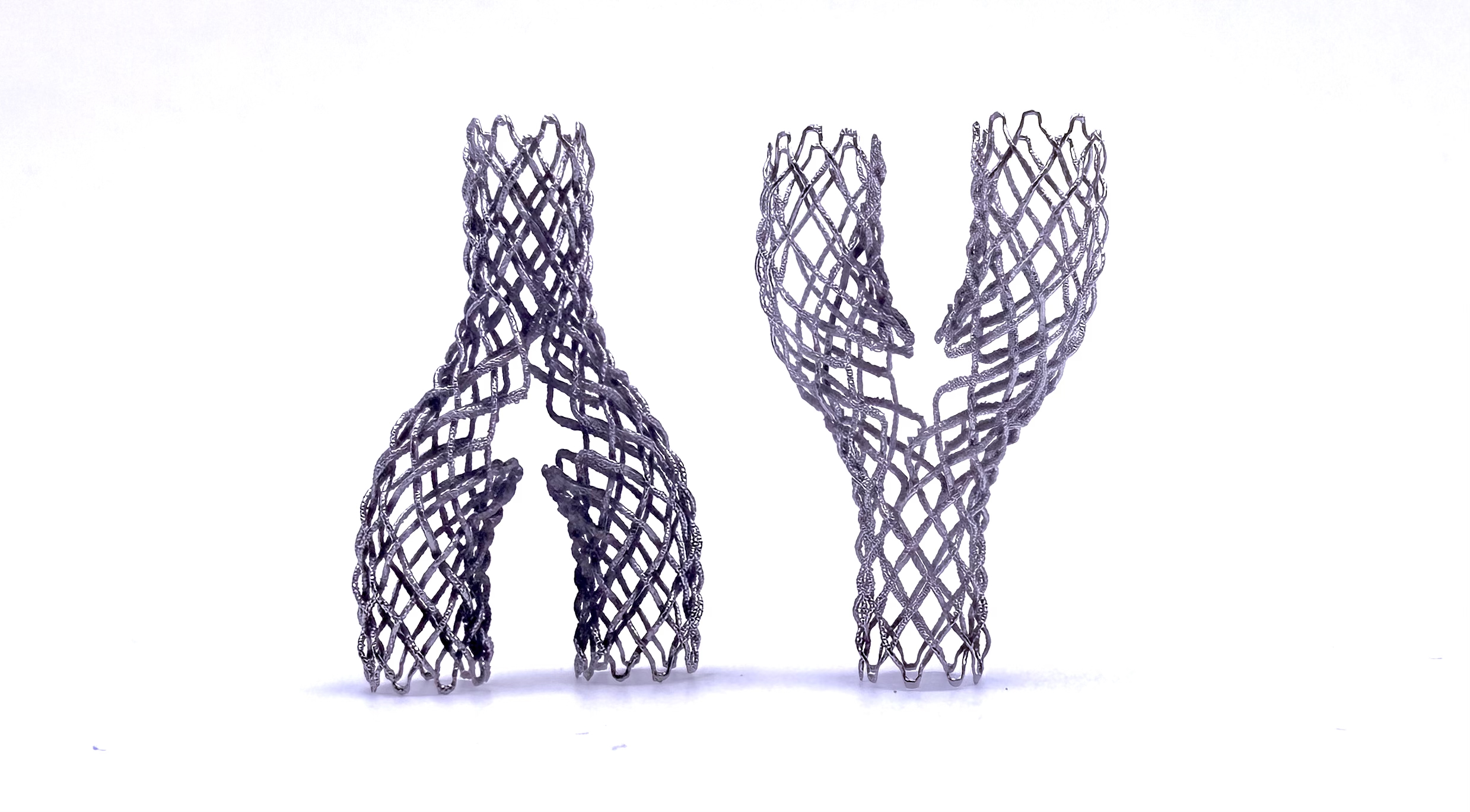
Braided vascular structures 3D printed from nitinol can be squeezed to half their diameter and still regain more than 90% of their shape. That result comes from an international team led by IMDEA Materials Institute and Universidad Politécnica de Madrid (UPM). The group has patented a process that prints the superelastic braids in one step. It reported the work in npj Metamaterials, a Nature Portfolio journal, positioning the method as a path to personalized implants that fold into a catheter and open inside the vessel.
The printed braids also press on vessel walls far more gently than current alternatives. Their chronic outward force (COF), the sustained pressure an implant exerts after deployment, measured up to five times lower than that of additively manufactured lattice structures. Lower COF reduces the likelihood of damaging the vessel or triggering clots. Scientists from the Massachusetts Institute of Technology (MIT) and the University of Galway took part in the study, and the technology has earned a National James Dyson Award.
How the Printed Braids Perform
The team’s design borrows from textiles. In a braid, interlaced filaments slide past one another and change angle under load, so the structure can collapse and reopen without stressing any single element. The braided stents already used in medicine work the same way. Printing the braid directly in nitinol, a nickel-titanium alloy known for superelasticity, avoids weaving the structure from individual wires.
“Braided architectures, on the other hand, can readily accommodate the large deformations required while maintaining both structural integrity and elastic recovery,” said Dr. Carlos Aguilar Vega, one of the study’s authors.
As-printed parts are too rough to implant, so the researchers finished them with chemical etching followed by electropolishing. That treatment made each fiber 47.7% thinner and shrank its cross-sectional area by 71.1%. In the finished state, the stents tolerated compression down to 50% of their starting diameter and kept elastic recovery above 90%.
The team checked several prototypes against standard mechanical benchmarks for such devices. A key test put each one through a single compress-and-release cycle that mirrors the device being loaded into a catheter and then released at the treatment site.

Why Conventional Printed Lattices Fall Short
Transcatheter implants must compress into a thin tube, travel through blood vessels and reopen without lasting damage, often in shapes fitted to a specific patient. Most additively manufactured metal implants use lattices, grids of stiff struts that flex by bending. The study found they stiffen sharply under compression, press hard on artery walls and risk breaking as strain nears 25%.
“Lattice structures manufactured using conventional additive manufacturing techniques are unable to achieve the high degree of reversible deformation required for transcatheter applications,” Aguilar Vega said. He noted that nitinol devices are widely used, yet “current manufacturing methods impose fundamental geometric limitations that restrict their optimisation and personalisation.”
Next Steps: Lab Safety Tests, Then the Brain
The devices have not yet been tested in living tissue. Before any patient trial, the braids must pass in vitro biocompatibility testing and then animal studies.
Beyond cardiovascular use, the researchers see neurovascular implants as the next major target. Such implants would reach diseased areas deep in the brain that current devices struggle to access. That will mean shrinking intricate nickel-titanium structures much further. The group points to two-photon polymerization with metallic suspensions, an ultra-high-precision printing approach, as one option. It also proposes giving devices magnetic properties so they could be guided remotely with magnetic fields.

Closing the Personalization Gap in Superelastic Implants
The braided-stent study extends a research line at IMDEA Materials and UPM aimed at making printed nitinol behave like the conventionally processed alloy, which offers greater elasticity and recoverable strain. In February 2026, the IMDEA Materials and UPM reported an algorithmic design framework for laser powder bed fusion (LPBF) nitinol in Virtual and Physical Prototyping. That earlier paper produced tubular lattices and cylindrical woven architectures whose stiffness, load-bearing capacity, energy absorption and toughness could be tuned through geometry alone. That work, backed by the iMPLANTS-CM initiative funded by the Comunidad de Madrid, introduced the woven concept. The new study turns it into a stent-like device with implant-grade finishing and catheter-loading tests.
Other groups have pursued custom stents with different materials. At Northwestern University, engineers Guillermo Ameer and Cheng Sun used micro continuous liquid interface production (microCLIP) to print biodegradable stents from a citrus-based polymer. The process produced up to 100 parts in under four minutes, and the stents could potentially carry an anticoagulant. Their goal was to replace standard-size metal stents, which force physicians to estimate the best fit for each patient.
Eindhoven University of Technology took a similar polymer route for children. Its researchers developed self-expanding, biodegradable stents for narrow or weak heart arteries, choosing a flexible thermoplastic co-polyester over nitinol. Guided by simulated crush tests, the team printed 10 mm stents on a desktop FDM system and planned animal studies to track degradation.
Where those efforts replaced metal with degradable polymers, IMDEA and UPM are betting on nitinol itself. Their braids suggest the alloy can be printed into patient-specific shapes without losing the flexibility that made it the clinical standard.
Register now for AMA: Software 2026. Join 3D Printing Industry on 22 October for expert presentations, panel discussions and live audience Q&A exploring the software shaping additive manufacturing. Register here.
To stay up to date with the latest 3D printing news, don’t forget to subscribe to the 3D Printing Industry newsletter or follow us on LinkedIn.
Explore the full Future of 3D Printing and Executive Survey series from 3D Printing Industry, featuring perspectives from CEOs, engineers, and industry leaders on the industrialization of additive manufacturing, 3D printing industry trends 2026, qualification, supply chains, and additive manufacturing industry analysis.
Featured image shows a 3D printed Nitinol aortic valve. Photo via IMDEA.