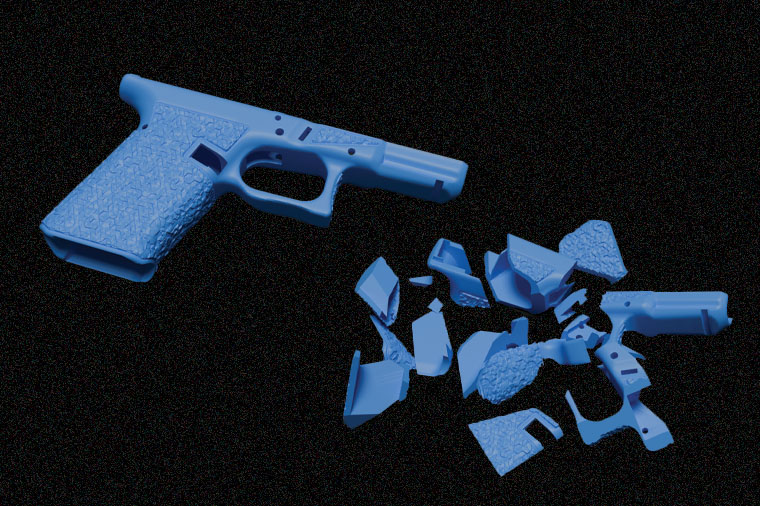
At Washington University in St. Louis, Netanel Raviv, assistant professor of computer science & engineering in the McKelvey School of Engineering, is leading a cross-disciplinary team from computer science and biomedical engineering to address the misuse of 3D printing for untraceable firearms, or ghost guns. The group has developed a technique to embed digital fingerprints directly into 3D printed parts that remain identifiable even if the object is broken. These embedded markers could give investigators critical details such as the printer used, its owner, and the time and location of printing.
“This work opens up new venues for protecting the public from the harmful aspects of 3D printing via a combination of mathematical contributions and new security mechanisms,” Raviv said. “While our project has limitations in defending against resourceful attackers with strong expertise in 3D printing, it significantly raises the level of sophistication, prior knowledge and expertise required from the adversary to remain undetected after committing the crime.”
Introducing SIDE: Secure Information Embedding and Extraction
Although several methods exist for creating fingerprints, none have examined how well these identifiers hold up if the object is tampered with or broken into pieces.
The new framework, called Secure Information Embedding and Extraction (SIDE), uses break-resilient and loss-tolerant fingerprinting methods that withstand tampering and fragmentation. By combining mathematical techniques with security protocols, SIDE compels 3D printers to embed unique, traceable codes into every printed object.
The work expands on Raviv’s earlier research presented at the IEEE International Symposium on Information Theory in July 2024, which focused on recovering data from fragments of compromised 3D printed parts.

The research paper, Secure Information Embedding in Forensic 3D Fingerprinting, was authored by Wang C, Wang J, Zhou M, Pham V, Hao S, Zhou C, Zhang N, and Raviv N. The project was supported by the National Science Foundation (CNS-2223032, CNS-2038995, CNS-223863) and the Army Research Office (W911NF-24-1-0155).
Government Initiatives and Industry Responses to the Rise of 3D Printed Guns
In light of the growing availability of downloadable 3D printed gun designs, both governments and private companies have introduced measures to curb their spread. In May, Bragg, together with New York State Senator Brad Hoylman-Sigal and Assemblymember Linda Rosenthal, introduced updated legislation (S227A/A1777A) aimed at curbing the spread of 3D printed guns and auto sears—small, inexpensive devices capable of converting semi-automatic firearms into fully automatic weapons.
French 3D printer manufacturer Dagoma partnered with international ad agency TBWA\Paris to disrupt access to weapon blueprints by releasing fake, non-functional files of 3D printable guns—frustrating attempts to download usable versions.
At the platform level, Facebook has banned content that shares instructions for manufacturing 3D printed guns, citing violations of its Community Standards. However, groups like the Firearms Policy Coalition have created a call to action asking Facebook to lift the ban on one affected site, CodeIsFreeSpeech.com that advocates: “Information is code. Code is free speech. Free speech is freedom.”
Limited spaces remain for AMA:Energy 2025. Register now to join the conversation on the future of energy and additive manufacturing.
Ready to discover who won the 2024 3D Printing Industry Awards?
Subscribe to the 3D Printing Industry newsletter and follow us on LinkedIn to stay updated with the latest news and insights.
Featured photo shows An example of a broken ghost gun. Image via Raviv lab.