Spend less time fixing files. Discover smarter workflows at AMA: Software 2026.
Two open-source CAD applications written entirely in Rust are testing how far AI-assisted development can take engineering software. SolidCraft, a parametric 3D modeller from GitHub developer bherbruck, and CADCraft, an AutoCAD-style drafting tool from the ArtCraft team behind the recent Adobe and Microsoft Office suites vibecoded projects, were both built around AI coding agents, and both expose their own tools to agents through the Model Context Protocol (MCP). Neither claims to replace commercial CAD, and both publish detailed accounts of what is still missing.
At the time of writing, CADCraft has around 4.3k stars and 2,000 forks on GitHub. SolidCraft has around 2.9k stars, 305 forks and nearly 1,300 commits. Both projects’ roadmaps are dated October 2026.

What the two applications deliver
SolidCraft describes itself as an open-source parametric 3D CAD application that runs on the desktop or in a browser, with AI agents able to model through a built-in MCP server. Its parametric timeline includes extrude, revolve, sweep, loft, fillet/chamfer, shell, draft, holes, threads, patterns and mirror. It also offers assemblies with joints, sheet metal and a plastic enclosure subset. It exports STEP AP242, IGES, 3MF, STL and OBJ. STEP and IGES solids can be imported as a base feature that later features build on, and mesh formats such as STL and 3MF come in as mesh bodies. The project explicitly addresses Autodesk Fusion users, describing its workflows as familiar parametric CAD conventions.
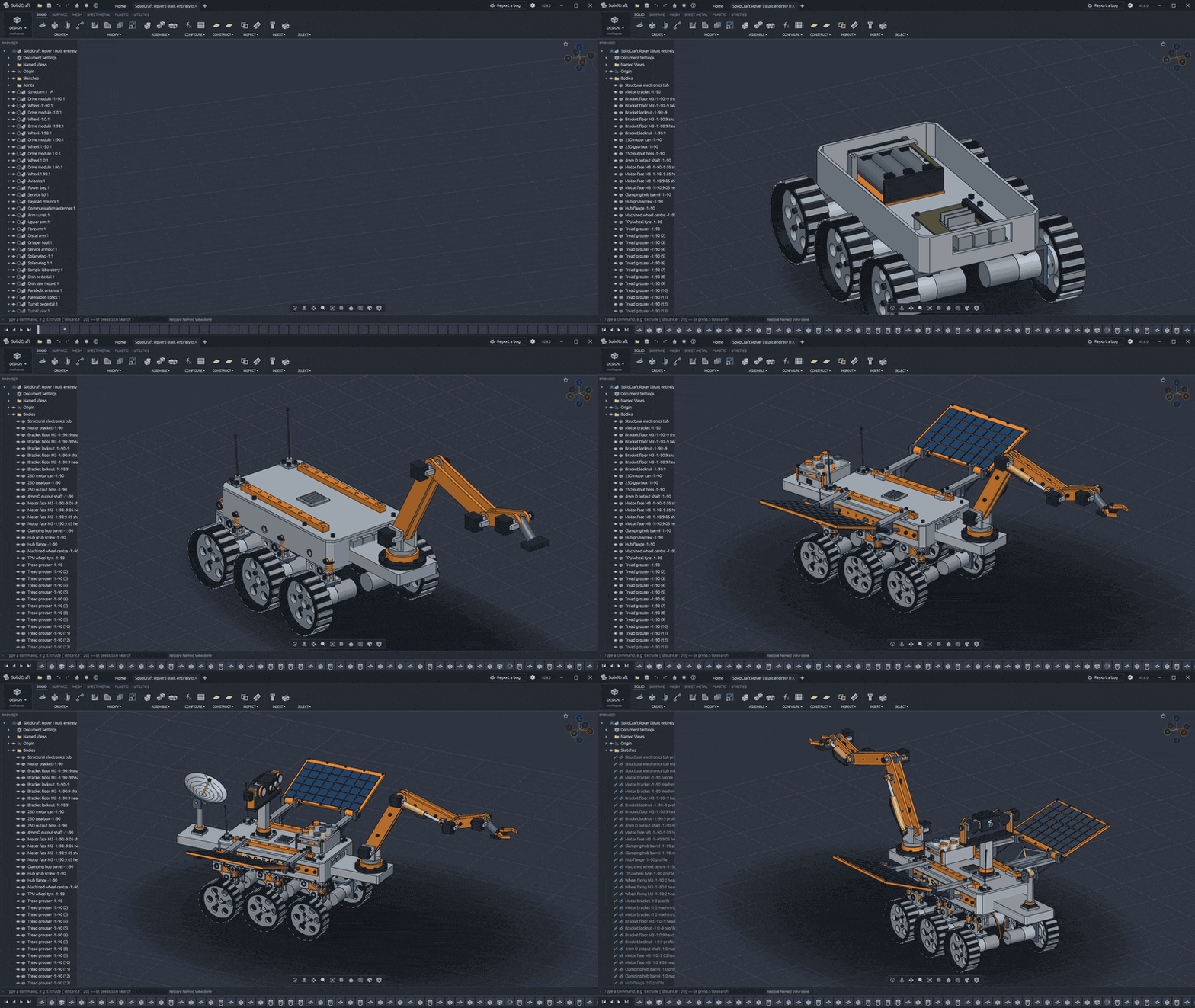
The project’s own status assessment is restrained: early but usable for simple parts. It reports that 75 of 76 public reference parts match analytic or FreeCAD-computed volume, area, centre of mass and bounding box. It also notes that these checks do not establish complete geometric or workflow equivalence. Mesh modelling, T-splines, extended surfacing, PCB, simulation, CAM and 2D drawings are all deferred. One community example hints at what agent-driven modelling can produce: a rover modelled entirely through SolidCraft’s MCP server, made of 3,323 editable timeline steps that rebuild without errors.
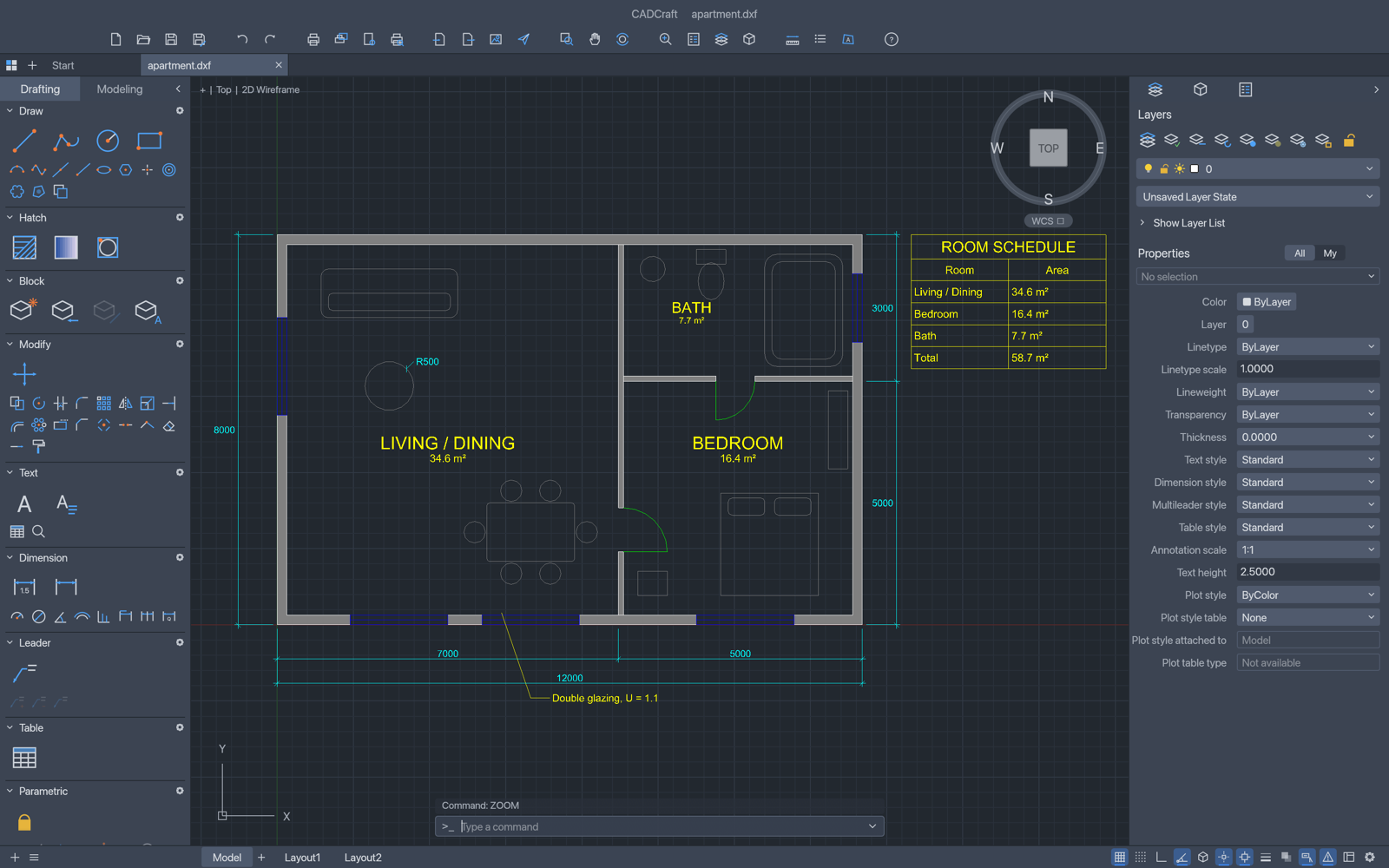
CADCraft focuses on 2D drafting. It calls itself a clean-room reimplementation of Autodesk AutoCAD rebuilt in pure Rust. DXF files from R12 through 2018 can be opened and are saved as R2000. DWG files are read through the open-source acadrust library and are also written as R2000. Entities CADCraft does not yet model are not kept on save. The roadmap puts weighted AutoCAD parity at about 29% overall and 55% for 2D drafting. 3D modelling, including solids, surfaces, meshes and rendering, stands at 0%. Whether CADCraft files open correctly in AutoCAD itself is listed as not yet confirmed.
How AI shaped development
Neither project publishes a figure for how much code was AI-generated, but both repositories make the role of agents explicit. Each contains a CLAUDE.md file framed as instructions for agents. These direct agents to follow an autonomous operation protocol and to stop and ask only when a decision is reserved for the owner. CADCraft’s roadmap measures remaining work in model time. It estimates roughly 50 Opus 5.5 wall-clock hours to an alpha release, or 15 to 20 elapsed hours with three to four agents working in parallel. SolidCraft estimates about 82 agent hours to a useful alpha.
Quality control relies on automated gates. Both projects ban panics in production code and require every crash fix to ship with a regression test. In SolidCraft, Fusion may only be observed as a black box, and agents are barred from reading GPL-licensed code including OpenCASCADE, FreeCAD and SolveSpace. CADCraft applies a matching policy: AutoCAD can only be observed black-box on the development machine, and file formats must come from public specifications. The two projects are closely linked. SolidCraft’s agent instructions name CADCraft as its closest relative among sibling apps that follow the same conventions.
Open kernels lower the barrier
The geometry kernel has long been the most difficult and costly layer of a CAD system to build. SolidCraft currently runs on the Apache-2.0 truck kernel, with its own blend operations and boolean retry and validation layered on top.
The same developer’s companion project, solidcore, points to a possible next step. It is a Rust port of NVIDIA’s SMLib boundary-representation kernel, taken from NVIDIA’s Apache-2.0 USD BRep project, and it names SolidCraft as its first consumer. The port covers NURBS math, B-rep topology, intersections, booleans, fillets and chamfers, offset and shell, sweeps, healing and mass properties. It leaves out the upstream OpenCASCADE translators, USD integration and Python bindings. It aims to match the original C++ to within 1e-9 relative with identical topology, checked unit by unit through a side-by-side test harness. Its status is early, with algorithm modules still being ported one unit at a time.
Together, the projects suggest that permissively licensed kernels combined with agent-driven development could shrink the cost of building CAD software. Whether that produces dependable, manufacturing-ready tools depends on capabilities neither project yet claims, from robust booleans on complex geometry to verified round-trips with the commercial formats engineers rely on.
Open kernels and agent-ready CAD
Open-source infrastructure for this kind of tooling is expanding quickly. NVIDIA has released USD BRep, an open-source CAD modelling kernel built around SMLib, under the Apache 2.0 license. Its Python interface lets developers create and modify geometry through code, although the library itself has no AI that can interpret design instructions. Independent developers are already filling that gap: the smlibpy project pairs a Python modelling interface on SMLib with an MCP server that lets AI agents run geometric modelling scripts.
Agents are also reaching further down the additive manufacturing workflow. German developer Synera has introduced AI agents for engineering workflows, and its integration with Materialise’s Magics SDK gives them access to file repair, part modification and support generation. Taking a different route, LEAP 71’s code-driven engineering system combines its open-source, voxel-based PicoGK kernel with the proprietary Noyron engineering model.
The barrier to entry is shifting from the kernel to the evidence. Open geometry and agent interfaces make CAD easier to build, but proving it produces reliable, manufacturable parts is still the hard part.
Register now for AMA: Software 2026. Join 3D Printing Industry on 22 October for expert presentations, panel discussions and live audience Q&A exploring the software shaping additive manufacturing. Register here.
To stay up to date with the latest 3D printing news, don’t forget to subscribe to the 3D Printing Industry newsletter or follow us on LinkedIn.
Explore the full Future of 3D Printing and Executive Survey series from 3D Printing Industry, featuring perspectives from CEOs, engineers, and industry leaders on the industrialization of additive manufacturing, 3D printing industry trends 2026, qualification, supply chains, and additive manufacturing industry analysis.
Featured image shows Apartment plan. Image via Github.