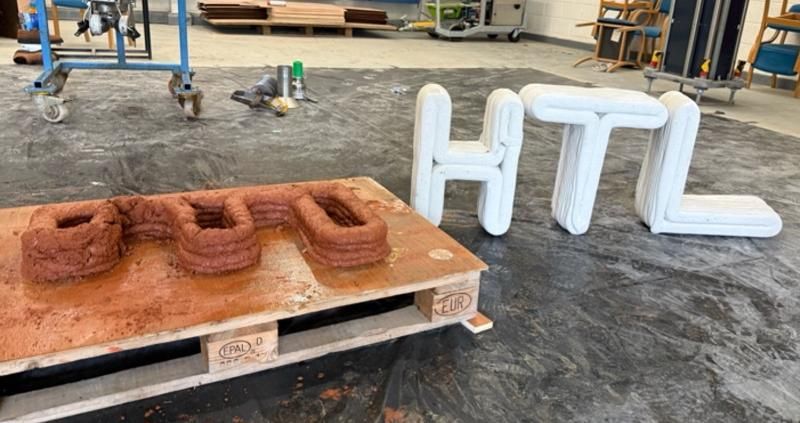
Researchers at Trinity College Dublin‘s School of Engineering have 3D printed what they say is Ireland’s first cement-free geopolymer, a red-brown construction material made largely from industrial waste that contains no Portland cement and, by their preliminary estimate, carries around 70% less embodied carbon than conventional concrete.
The material was put through a full industrial-scale trial at the facility of Harcourt Technologies (HTL.tech), where the team showed it could be mixed, pumped, extruded and printed, the four steps that decide whether a novel mix is a laboratory curiosity or something a construction printer can actually run. More than 30% of its cement-like binder content came from local industrial by-product that would otherwise face treatment, long-term storage or landfill.
A binder built from red mud
The waste at the centre of the mix is bauxite refining residue, better known as red mud: the highly alkaline sludge left over when alumina is extracted from bauxite ore. It is produced globally in vast quantities and, lacking a high-value use, is usually stored in vast impoundment ponds or sent to landfill. Turning it into a structural binder attacks a disposal problem and a carbon problem at the same time.
That dual payoff is the point Prof Sara Pavia stressed after the trial. The material and its production route “essentially deliver two environmental benefits,” she said: they cut reliance on carbon-intensive clinker cements while creating “a high-value use for industrial residues.” The residue does the work through geopolymer chemistry, alkali-activating aluminosilicate waste into a hardened binder, rather than the energy-hungry, high-temperature clinker process behind ordinary cement.
Pavia’s group has been building toward this for years, with published work on red-mud, spent-catalyst and biomass-ash binders and European patent filings on low-carbon binding compositions. The new demonstration extends that lab research into a printable, industrially handled form, co-developed by Dr Zehao Lei alongside team members Liam Whittle, Ivan Sorokivskyi and Vasyl Pylypiv, with HTL’s Jandré Oosthuizen on the materials and operations side.

Why cement-free matters
Cement is one of the largest single industrial sources of carbon dioxide, responsible for roughly 8% of global emissions, most of it baked into clinker production. Because Trinity’s geopolymer sidesteps clinker entirely, Pavia’s team puts the embodied-carbon saving at “approximately 70% compared to conventional Portland cement (PC) concretes,” a figure they are careful to frame as preliminary.
Printing the material layered on the process advantages that already make construction 3D printing attractive: no moulds or formwork, less on-site waste, high automation and lower labour, and the freedom to print complex curves that are difficult or costly to cast. Pavia argued the significance runs deeper than swapping one binder for another. The result, she said, is “a flexible binder platform whose composition, rheology, setting behaviour and early-age performance can be tailored” to different processes and applications, a tunable base recipe rather than a single fixed product.
From lab batch to building site
The study sits inside a broader programme funded by Research Ireland and led on the industry side by SISK, with FLI Precast Solutions, McGrath Quarries, Techcrete and Roadstone contributing expertise across material development, concrete production, precast manufacturing, construction delivery and digital fabrication. The intent is to steer low-carbon binders toward real use, with development guided from the outset by manufacturability, quality assurance, scale-up and market adoption.
The hard part comes next: moving from laboratory batches to the volumes and batch-to-batch consistency that industrial equipment demands, which introduces fresh variables. The team’s stated priorities from here are mechanical performance, durability, reinforcement, long-term stability, process control and regulatory compliance, the checklist any structural material must clear before it can carry load in a certified building.
Making the waste stream the feedstock
Trinity’s strategy is a circular-construction one: rather than treat industrial residue as a disposal cost, the consortium reframes it as the raw material for the binder itself, and structures the project so that manufacturability and certification are designed in rather than bolted on. The aim is to shorten the usual gap between a promising lab result and a specified, buildable product, turning a local waste liability into a supply-chain asset.
That bet is shared across construction 3D printing. In February 2026, Mexican-German studio MANUFACTURA unveiled CORNCRETL, a lime- and bio-based printable material blending recycled agricultural and stone waste that it says trims carbon by up to 70%, the same headline figure Trinity is targeting, reached by a different route.
The impulse to route waste into the mix runs back further. RMIT University developed an eco-friendly printable concrete that swaps scarce river sand for recycled glass aggregate, while a Swinburne–Hebei team turned demolition waste, recycled concrete aggregate, ceramsite and desert sand, into a low-cost extrudable building material. Each treats the feedstock, not just the printer, as where construction’s sustainability gains are won.
What unites them is also what still holds them back. Structural certification, long-term durability and consistent performance at scale remain unproven for most waste-based mixes. Trinity’s contribution is to push a cement-free binder to a full print trial, and to line up the industrial partners needed to answer those questions next.
3D Printing Industry is inviting speakers for its 2026 Additive Manufacturing Applications (AMA) series, covering Energy, Healthcare, Automotive and Mobility, Aerospace, Space and Defense, and Software. Each online event focuses on real production deployments, qualification, and supply chain integration. Practitioners interested in contributing can complete the call for speakers form here.
To stay up to date with the latest 3D printing news, don’t forget to subscribe to the 3D Printing Industry newsletter or follow us on LinkedIn.
Explore the full Future of 3D Printing and Executive Survey series from 3D Printing Industry, featuring perspectives from CEOs, engineers, and industry leaders on the industrialization of additive manufacturing, 3D printing industry trends 2026, qualification, supply chains, and additive manufacturing industry analysis.
Featured image shows Ireland’s first cement-free geopolymer. Photo via Trinity College Dublin.