
A nearly 300-year-old gingko tree, believed to be the first of its kind cultivated outside Asia, is about to inspire one of the most architecturally distinctive student housing projects in the Netherlands.
Rotterdam-based Studio RAP has been commissioned to design and 3D print hundreds of custom ceramic tiles for the Gingko Complex in Utrecht, cladding three monumental columns in a leaf-inspired pattern finished in warm golden glaze. The project, developed by Klunder Architecten and built by Heijmans for SSH Student Housing, is expected to open in 2029 and will house 483 students.

The Project
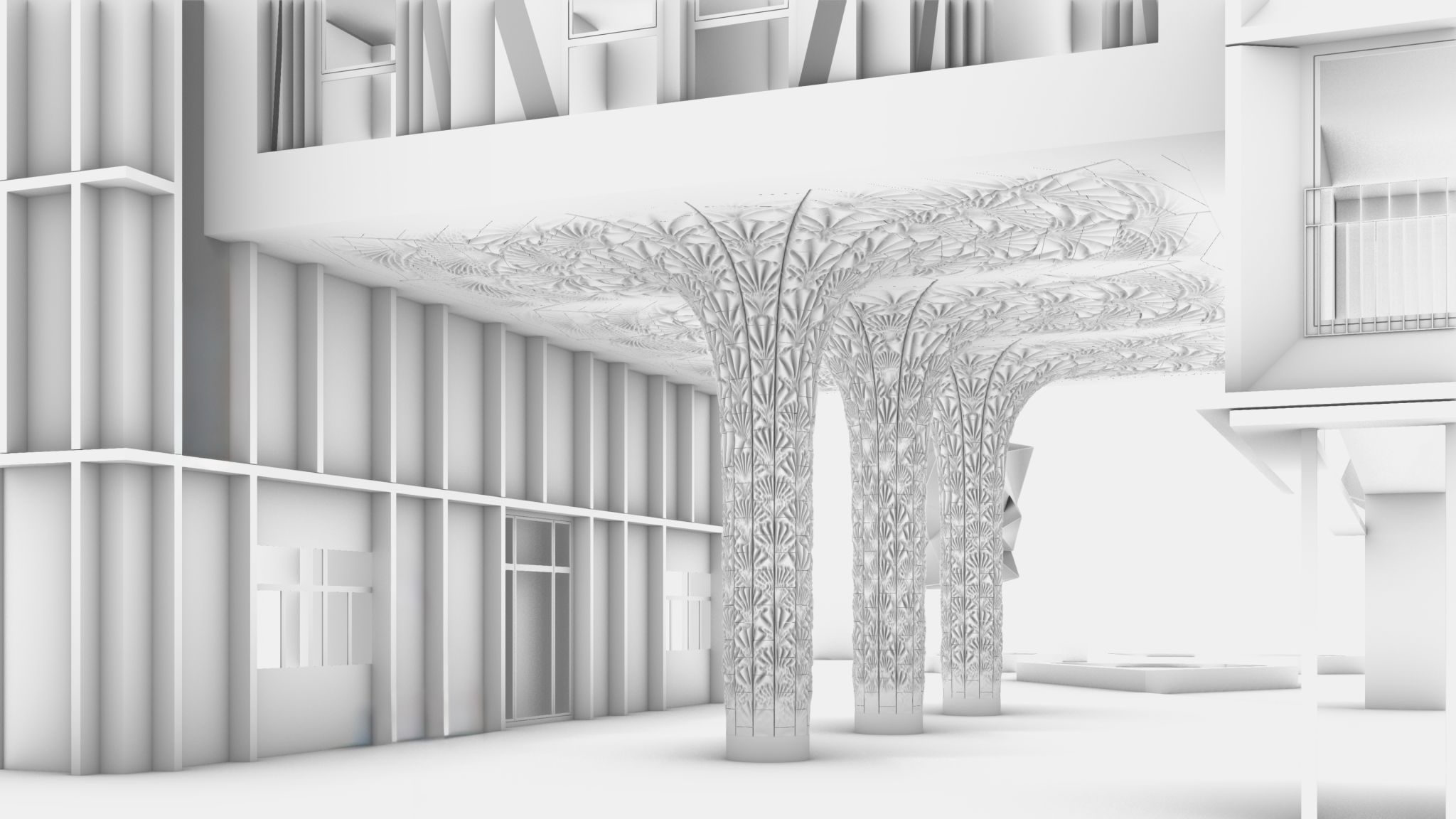
At the heart of the complex is a central public passageway leading to a shared courtyard, an architectural moment anchored by three columns that appear to support a five-story structure above. It is these columns, along with the passageway ceiling, that Studio RAP has been commissioned to transform through ceramic 3D printing.
Producing hundreds of individually unique tiles at the quality and consistency required for a permanent architectural installation demands a manufacturing process that conventional ceramics cannot provide. Studio RAP’s approach combines proprietary computational design algorithms with a custom clay extrusion printer mounted on a Kuka robotic arm, a system the studio has developed and refined across a series of high-profile commissions.
The tile design draws directly from the form of the gingko leaf. The assembled tiles will create a continuous, immersive pattern finished in a warm golden transparent glaze, evoking the appearance of a gingko tree in autumn, when its distinctive fan-shaped leaves turn a deep, luminous gold. The tactile glaze is designed to catch light differently at every hour of the day, ensuring the passageway reads as a living surface rather than a static one.

3D Printing and the New Building Aesthetic
The Gingko Complex reflects how architects and designers are now approaching the built environment: moving away from uniform, mass-produced surfaces toward buildings that carry meaning and tell stories.
Several projects illustrate how this approach is gaining ground. Studio RAP itself set the precedent with its earlier Amsterdam commission, where the studio used computational design, robotics, and ceramic craftsmanship to clad a three-story townhouse with custom 3D printed tiles inspired by textile weaves, a rippled facade that reads as both contemporary and rooted in the Netherlands’ tile-making heritage.
At the 2025 Venice Biennale of Architecture, London-based studio OZRUH, in collaboration with ETH Zurich researchers, presented Anti-Ruin, a modular installation of 12 large blocks 3D printed from marble dust using binder jetting technology, exploring adaptive architecture through reconfigurable stone. What these projects share is the recognition that 3D printing is not just a construction tool, it is the first fabrication technology that makes architectural individuality as achievable as uniformity.
3D Printing Industry is inviting speakers for its 2026 Additive Manufacturing Applications (AMA) series, covering Energy, Healthcare, Automotive and Mobility, Aerospace, Space and Defense, and Software. Each online event focuses on real production deployments, qualification, and supply chain integration. Practitioners interested in contributing can complete the call for speakers form here.
To stay up to date with the latest 3D printing news, don’t forget to subscribe to the 3D Printing Industry newsletter or follow us on LinkedIn.
Explore the full Future of 3D Printing and Executive Survey series from 3D Printing Industry, featuring perspectives from CEOs, engineers, and industry leaders on the industrialization of additive manufacturing, 3D printing industry trends 2026, qualification, supply chains, and additive manufacturing industry analysis.
Featured image shows Gingko-Inspired Ceramic Columns. Image via Studio RAP.