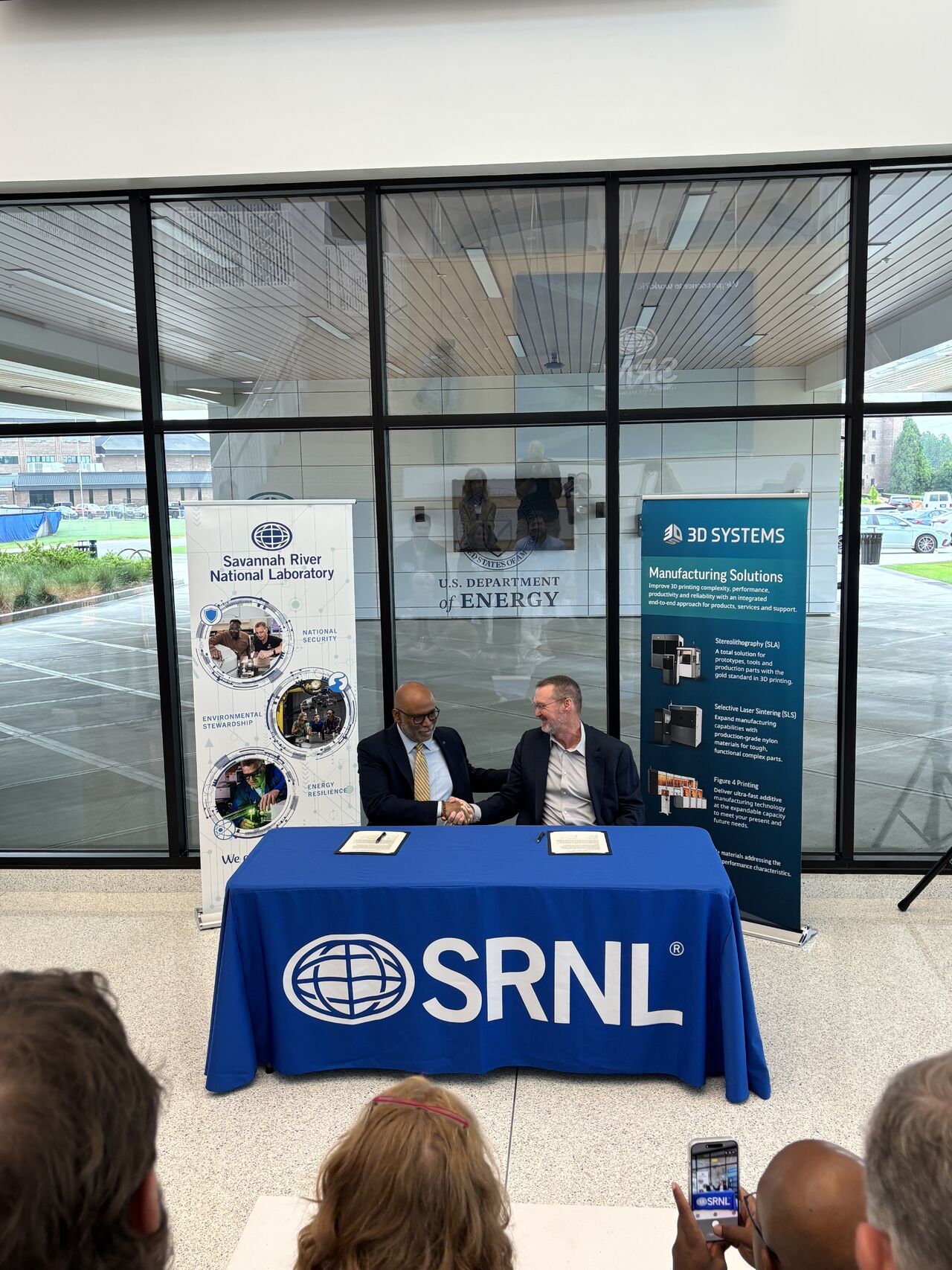
U.S.-based 3D printer manufacturer 3D Systems has entered a Cooperative Research and Development Agreement (CRADA) with Savannah River National Laboratory (SRNL) to advance additive manufacturing for nuclear energy, broader energy infrastructure, and national security applications.
The agreement centers on SRNL’s Advanced Manufacturing Collaborative (AMC), the only national laboratory-operated facility in South Carolina located on a public university campus, and covers joint work spanning materials development, equipment enhancements, AI/ML-driven process optimization, manufacturing systems, cybersecurity, and workforce training.
Printing Parts Conventional Methods Struggle to Make
The partnership’s central focus is applying additive manufacturing to components that advanced nuclear systems need but traditional manufacturing struggles to produce. That includes high-temperature nickel-based superalloys and other radiation-tolerant materials, formed into heat exchangers with internal cooling channels, reactor internals, pumps, valves, and other high-performance parts. The entities invloved pitch several benefits that they say apply to fusion energy technology and power generation equipment as well as nuclear reactors: better performance under extreme conditions, less material waste, more design freedom, and a more resilient supply chain.
Jeff Graves, President and CEO of 3D Systems, tied the deal to both technology and workforce goal “We look forward to partnering with SRNL at the Advanced Manufacturing Collaborative and deploying 3D Systems’ leading AM technologies.” He added that the agreement demonstrates the importance of high-quality 3D printing materials and technologies “on key industrial markets, particularly energy and national security, and on developing the skilled workforce those markets require.”
The timing lines up with a broader buildout in U.S. nuclear capacity. Advanced reactor designs and small modular reactors (SMRs) are pushing demand for manufacturing that can shorten development cycles, cut costs, and build up domestic production. The International Energy Agency (IEA) projects SMR capacity could reach roughly 40 gigawatts by 2050 under current policy, or as much as 120 gigawatts under more aggressive deployment scenarios, demand driven partly by data centers, industrial heat, and grid stability needs.

From Lab Research to Commercial Production
SRNL frames the CRADA as more than a research exercise. Roderick Jackson, associate laboratory director for science, energy and innovation at SRNL, said the collaboration “positions SRNL and 3D Systems to deliver groundbreaking additive manufacturing technologies, strengthen U.S. manufacturing competitiveness, and drive forward the next era of AM innovation.” 3D Systems equipment is already installed at the AMC, backed by facility upgrades and resident additive manufacturing experts, infrastructure meant to support both research and the demonstration of production-ready processes.
Beyond the technology itself, the partnership includes training programs aimed at building the next generation of additive manufacturing scientists, engineers, and technicians, part of a stated goal to strengthen the regional and national AM workforce alongside the nuclear and defense applications the CRADA targets.
Nuclear’s Manufacturing Bottleneck Is Drawing a Crowd
3D Systems’ strategy is about credibility as much as capability: pairing with a national laboratory gives its commercial AM platforms a route into a sector, nuclear energy, where qualification and regulatory trust matter more than speed to market. As SMR and advanced reactor programs ramp up, the gap is proving AM parts can be trusted in a reactor.
Other U.S. national labs are chasing a similar gap. Just this month, Oak Ridge National Laboratory and A.J. Tuck Company developed a hybrid process combining 3D printing, electroforming, and hot isostatic pressing to produce leak-free nuclear components, aimed at easing a U.S. forging capacity shortage for parts like pressure vessels and valves as demand for advanced and small modular reactors grows.

Oak Ridge and Idaho National Laboratory are applying AI-guided 3D printing to real-time defect detection on reactor pressure vessels, building the qualification evidence regulators will need before printed nuclear parts see wide deployment.
The common driver behind the 3D Systems-SRNL deal is that domestic forging and casting capacity can’t keep pace with the next generation of reactors, and additive manufacturing, backed by national lab credibility, is being pulled in to address that challenge.
3D Printing Industry is inviting speakers for its 2026 Additive Manufacturing Applications (AMA) series, covering Energy, Healthcare, Automotive and Mobility, Aerospace, Space and Defense, and Software. Each online event focuses on real production deployments, qualification, and supply chain integration. Practitioners interested in contributing can complete the call for speakers form here.
To stay up to date with the latest 3D printing news, don’t forget to subscribe to the 3D Printing Industry newsletter or follow us on LinkedIn.
Explore the full Future of 3D Printing and Executive Survey series from 3D Printing Industry, featuring perspectives from CEOs, engineers, and industry leaders on the industrialization of additive manufacturing, 3D printing industry trends 2026, qualification, supply chains, and additive manufacturing industry analysis.
Featured image shows 3D Systems enters into a Cooperative Research and Development Agreement (CRADA) with Savannah River National Laboratory (SRNL). Photo via 3D Systems.