Discover exclusive software insights at AMA: Software 2026, on October 22. Register for free!
Dental 3D printing company SprintRay is moving beyond printers. At its 3DNext 2026 event in Miami Beach, the firm introduced Foundation, its first intraoral scanner, along with a compact chairside print, wash and cure system called the Nano Series and a new restorative resin developed with Japanese dental materials maker GC Corporation. Together, the launches give SprintRay products covering each stage of a chairside case, from capturing a patient’s mouth to finishing a printed restoration.
Foundation and the Nano Series are both set to start shipping in November 2026. The scanner will launch first in the United States, while the Nano Series will roll out across the United States, Canada, Australia, New Zealand and the European Union, subject to regional regulatory requirements.
Scanning becomes part of the SprintRay workflow
Foundation is a wireless, full-color intraoral scanner designed for ScanOS, a new scanning software layer that runs within SprintRay’s cloud dashboard. Until now, practices using SprintRay printers relied on third-party scanners, so they had to export and upload scan files before moving on to design and printing. ScanOS removes that step. Scanning now appears as a Scan tab next to the dashboard’s existing design and production tools, and completed scans go straight to the cloud, ready for the next stage of the case.
“For years, we connected scanning and printing through third-party integrations, but the experience still required practices to move between systems,” said Amir Mansouri, Ph.D., co-founder and CEO of SprintRay. “ScanOS makes scanning a native part of the SprintRay workflow, and Foundation is the first intraoral scanner built for it.”
The move puts SprintRay in more direct competition with established intraoral scanner suppliers, and it reflects a wider push in digital dentistry to keep clinicians within a single software environment from diagnosis to delivery.

Nano Series built around single-patient jobs
The Nano Series is aimed at a specific use case that SprintRay found in its own production data. More than 20 million dental parts have been made across the company’s ecosystem, and according to SprintRay’s analysis, over 80 percent of chairside print jobs involve one patient and one case. The existing Pro Series is designed for throughput and multi-case production. The Nano Series, by contrast, is sized for the single-restoration work that dominates daily chairside dentistry.
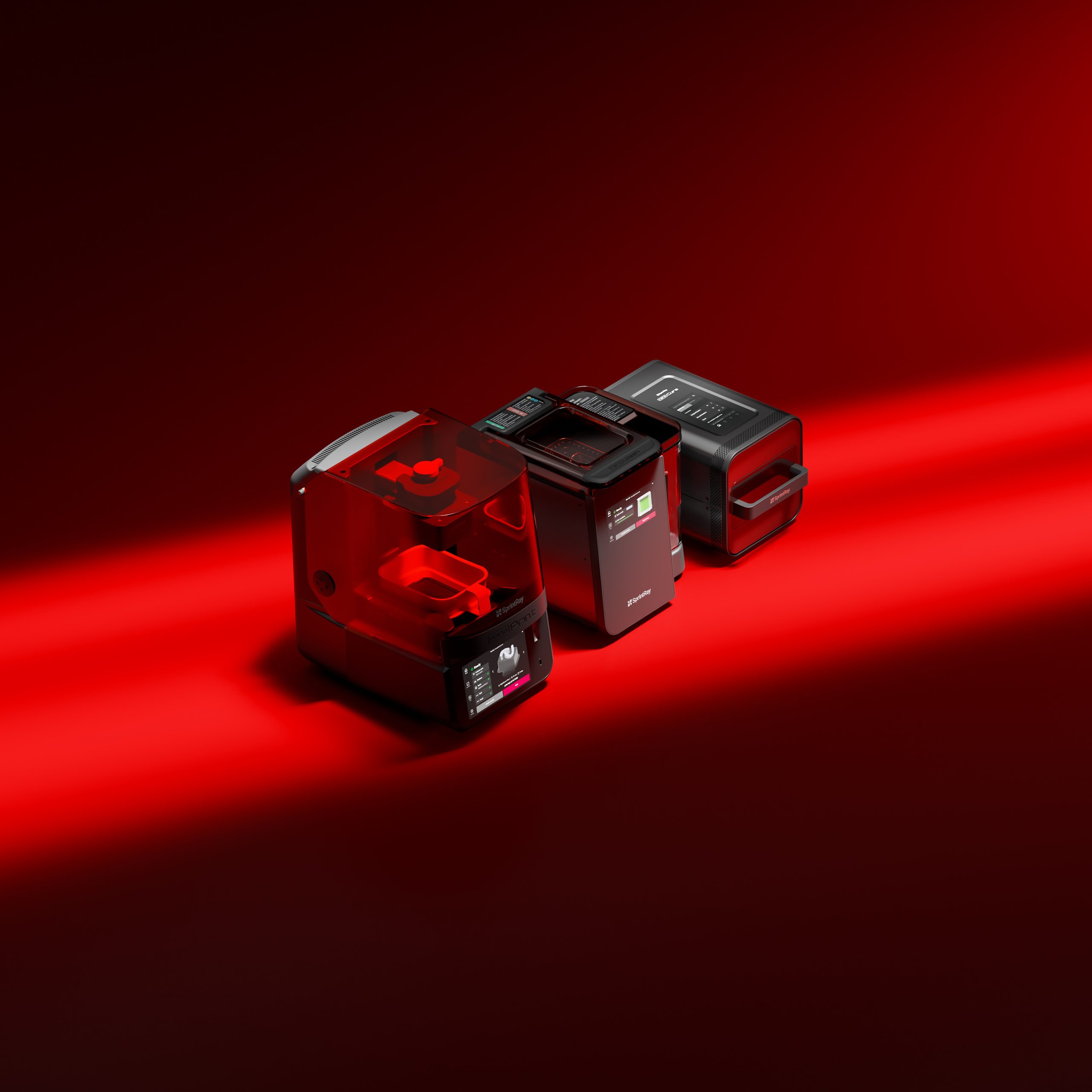
The system has three units. NanoPrint is a printer that uses a 385 nm light engine. NanoWash automates both washing and drying. NanoCure handles final post-processing. All three fit in under 30 inches of counter space, a meaningful constraint in dental operatories where space is limited. Two software features, AutoPrint and Job Handoff, link the production steps and pass case information from one machine to the next, so staff don’t have to re-enter details between stages.
The Nano Series runs SprintRay’s validated materials library, though specific indications and availability vary by market. The Canadian launch will not include NanoWash.
“We designed the Nano Series to make chairside production more intuitive and practical for the dental team,” Mansouri said.
GC partnership extends Digital Press materials
On the materials side, SprintRay and GC Corporation introduced GC GRADIA PREMi, a hybrid ceramic restorative resin made for SprintRay’s Midas Digital Press. Midas uses a capsule-based process rather than a conventional resin vat, and the new material is intended to give clinicians more options for definitive chairside restorations. Final clinical indications, performance claims and regional availability still depend on GC’s approved product labeling and regulatory review.
The partnership reflects SprintRay’s approach of developing and validating workflows with established dental materials companies instead of running a fully open materials platform. “Openness matters, but so does validation,” Mansouri said. “Our approach is to work with leading partners to broaden what clinicians can do while maintaining rigorous workflow standards.”

From Printer to Platform: Owning the Dental Workflow
SprintRay’s 3DNext launches are about owning the whole case, not just the printer. ScanOS and Foundation remove the third-party scanner handoff and place scanning in the same cloud account as design and production. The Nano Series is sized for the single-patient jobs that dominate chairside work, and the GC partnership keeps materials validated rather than open, so clinicians stay inside SprintRay’s workflow from scan to restoration.
This push toward integrated systems comes as 3D printing in dentistry shifts from the lab into the practice. Speaking at 3D Printing Industry’s AMA: Healthcare event, AM Research VP of research Scott Dunham said about 15% of US dental practices now run a 3D printer on site. He also noted that the average dental printer price has fallen from about $65,000 in 2015 to just over $10,000. Dunham pointed to labor shortages as a main reason clinics and labs are automating, and Formlabs has responded with a version of its Form 4 3D printer bundled with hardware that handles much of the post-print process. That is the same pain point SprintRay’s NanoWash and NanoCure, along with its Job Handoff software, are designed to address.
On the lab side, rivals are also building closed loops around their own equipment. At IDS 2025, Carbon showed a connected dental production ecosystem that uses AI-driven workflows to raise lab throughput, while Prodways Machines introduced its Dental Pro Automated Line, which combines resin printing and post-processing in one streamlined process. 3D Systems has taken a similar approach in prosthodontics, pairing its NextDent 300 3D printer with matched base and tooth materials to produce a monolithic denture in one continuous print.
Across chairside and lab alike, the competition is moving from who sells the best printer to who controls the whole workflow. With Foundation, SprintRay wants the case to start in its own ecosystem, beginning with the scan.
Register now for AMA: Software 2026. Join 3D Printing Industry on 22 October for expert presentations, panel discussions and live audience Q&A exploring the software shaping additive manufacturing. Register here.
To stay up to date with the latest 3D printing news, don’t forget to subscribe to the 3D Printing Industry newsletter or follow us on LinkedIn.
Explore the full Future of 3D Printing and Executive Survey series from 3D Printing Industry, featuring perspectives from CEOs, engineers, and industry leaders on the industrialization of additive manufacturing, 3D printing industry trends 2026, qualification, supply chains, and additive manufacturing industry analysis.
Featured image shows SprintRay Nano Series featuring NanoPrint, NanoWash, and NanoCure. Photo via SprintRay.