

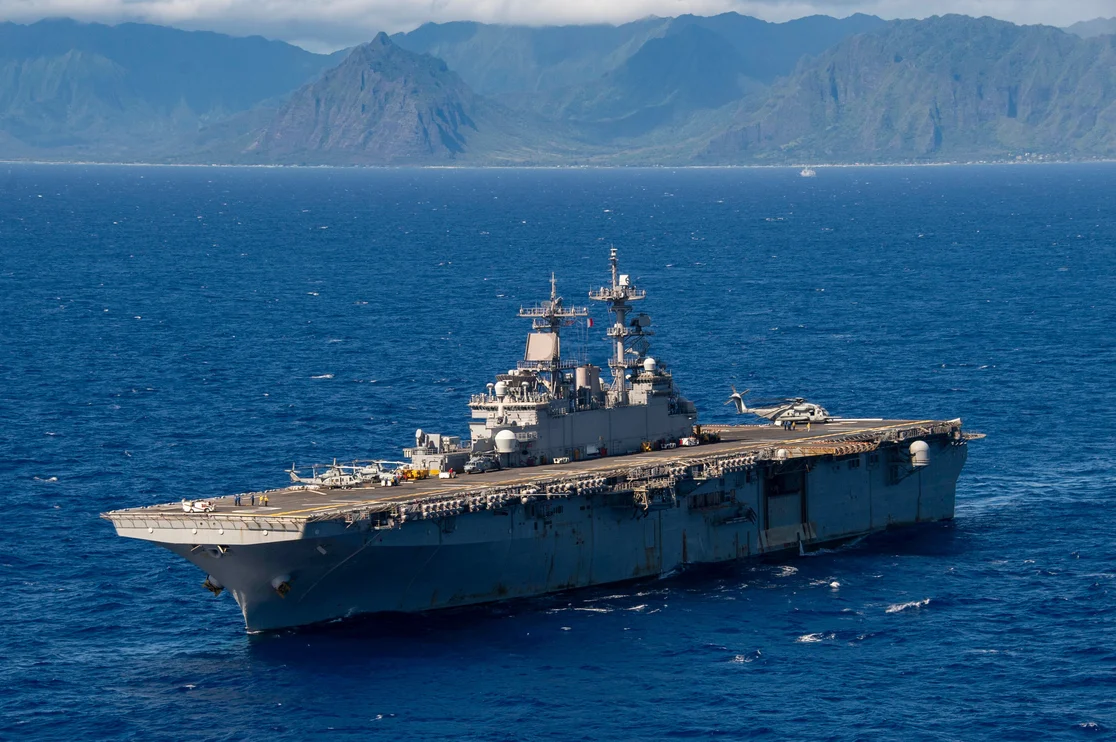
Snowbird Technologies, a Florida-based developer of ruggedized manufacturing systems, has produced 316L stainless steel components aboard the USS Essex (LHD-2) during the Rim of the Pacific Exercise (RIMPAC) 2026.
The demonstration formed part of a distributed manufacturing experiment led by the Naval Postgraduate School’s Consortium for Advanced Manufacturing Research and Education (CAMRE).
During the vessel’s transit from San Diego to Hawaii, Snowbird’s SAMM Tech platform produced components using laser-wire Directed Energy Deposition (DED) with nitrogen shielding gas. Integrated CNC machining was then used to achieve the required final geometry and surface finish.
Combining both processes within the same containerized system is intended to allow near-net-shape metal parts to be produced and finished without transferring them to separate manufacturing equipment.
“SAMM Tech was designed to bring advanced manufacturing capabilities directly to the warfighter, wherever the mission requires,” said Karl Wojtkun, Vice President of Business Development at Snowbird Technologies.
“Successfully producing and machining stainless steel components aboard USS Essex demonstrates the potential of expeditionary manufacturing to reduce logistics burdens, improve readiness, and deliver critical parts closer to the point of need.”

Combining additive and machining at the point of need
SAMM Tech, or Snowbird Additive Mobile Manufacturing Technology, is a modular manufacturing platform combining metal and polymer additive manufacturing, CNC machining and digital engineering tools.
Its metal 3D printing capability is based around the Meltio Engine Blue, a laser-wire DED system integrated into the platform.
Wire feedstock is deposited to create the near-net-shape component before material is removed through CNC machining. This allows geometries and surface finishes that cannot necessarily be achieved through the deposition stage alone to be produced within the same deployable system.
Snowbird is targeting the platform at maintenance, repair and sustainment applications in remote and resource-constrained environments. Carrying out both stages within one system can reduce the amount of separate manufacturing infrastructure required at the point of need.
Following the shipboard phase, SAMM Tech was moved to Schofield Barracks in Hawaii, where it continued supporting CAMRE’s distributed manufacturing activities. Snowbird confirmed the transition from USS Essex to the land-based site on July 15.
This second phase evaluated the platform in land-based operations while supporting a wider advanced manufacturing network involving joint and multinational participants.
Expanding Snowbird’s RIMPAC testing
Snowbird previously participated in CAMRE manufacturing demonstrations during RIMPAC 2024. During that exercise, the system was used to manufacture a replacement component after a reverse-osmosis pump failed, allowing USS Somerset to continue participating. The 2026 deployment positions the platform within CAMRE’s wider distributed manufacturing experiment, with operations moving from USS Essex to a land-based site at Schofield Barracks.
“NPS CAMRE’s RIMPAC experiment provides a unique opportunity to evaluate advanced manufacturing technologies in realistic operational conditions,” added Wojtkun.
“As military logistics become increasingly distributed, the ability to print, machine, and deliver critical parts at the tactical edge will play an important role in sustaining readiness and supporting future operations.”
FLEETWERX is also supporting the experiment. The organization operates under a Partnership Intermediary Agreement connecting the Naval Postgraduate School with industry, academia and government to evaluate technologies in military environments.
RIMPAC 2026 is hosted by the Commander of the U.S. Pacific Fleet and led by the Commander of the U.S. 3rd Fleet. This year’s exercise includes forces from 31 nations, approximately 40 surface ships, five submarines, more than 140 aircraft and over 25,000 personnel.
From shipboard repair to distributed manufacturing
Hybrid metal additive manufacturing at sea has already been demonstrated elsewhere in the U.S. Navy. A Phillips Additive Hybrid system combining Meltio wire-laser DED with Haas CNC machining was installed aboard USS Bataan in 2022. Sailors later used the system to produce a stainless steel sprayer plate for a de-ballasting air compressor in 2023.
More recently, the Navy equipped its Danville training facility with 24 additive and hybrid manufacturing systems, including 12 Meltio-based hybrid machines. The systems are being used to train sailors enrolled in the Afloat Training Program on equipment comparable to that deployed aboard Navy vessels. Together, these efforts show the Navy developing both the manufacturing hardware and operator base needed to support production closer to the point of need.
3D Printing Industry is inviting speakers for its 2026 Additive Manufacturing Applications (AMA) series, covering Energy, Healthcare, Automotive and Mobility, Aerospace, Space and Defense, and Software. Each online event focuses on real production deployments, qualification, and supply chain integration. Practitioners interested in contributing can complete the call for speakers form here.
To stay up to date with the latest 3D printing news, don’t forget to subscribe to the 3D Printing Industry newsletter or follow us on LinkedIn.
Explore the full Future of 3D Printing and Executive Survey series from 3D Printing Industry, featuring perspectives from CEOs, engineers, and industry leaders on the industrialization of additive manufacturing, 3D printing industry trends 2026, qualification, supply chains, and additive manufacturing industry analysis.
Feature image shows USS Essex Conducts Amphibious Assault Operations During RIMPAC 2022. Photo via Donita Burks.







