

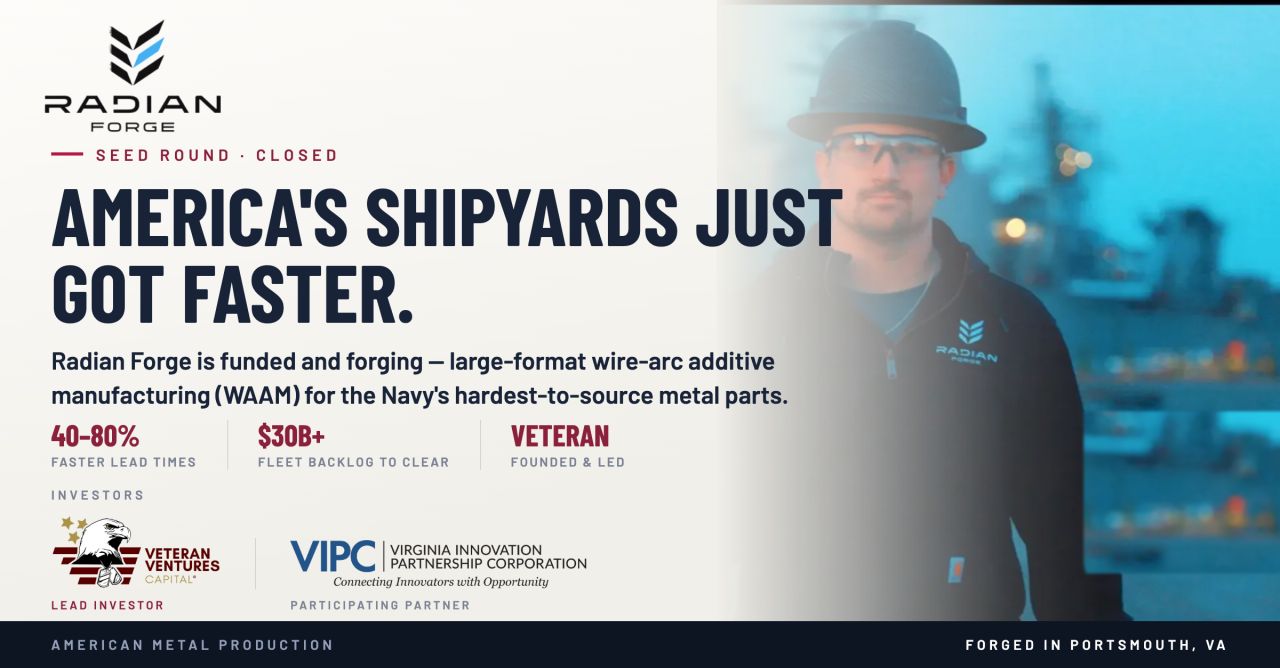
Radian Forge, a Virginia-based maker of large metal components using wire arc additive manufacturing (WAAM), has closed a $2.5 million Series Seed Preferred round. Veteran Ventures Capital (VVC) led the round through its Fund II, announced on September 15, 2026. The Virginia Innovation Partnership Corporation (VIPC) and Radian Forge’s existing investors also took part. The company will use the capital to scale large-format WAAM production for the U.S. naval, maritime and defense industrial base.
Joshua Weed, General Partner at VVC, led the investment and will join Radian Forge’s Board of Directors. The round comes as the United States pushes to rapidly expand shipbuilding and repair capacity and to ease production bottlenecks across the maritime supply chain.
Large-format WAAM next to the shipyards
Radian Forge is headquartered in Portsmouth, Virginia, close to some of the country’s largest naval shipbuilding and repair facilities. The company uses large-format WAAM to produce large, precision-grade metal components for naval, maritime and defense programs. WAAM is a directed energy deposition process in which a robot-guided welding arc melts metal wire and builds a part layer by layer. That makes it suited to big components that would otherwise come from castings or forgings.
According to the company, its WAAM parts have material properties between those of castings and forgings. The process cuts production lead times by 40% to 80%, and each WAAM robot needs only a single operator. For a maritime sector where replacement parts can take months to source through traditional foundries and forges, those two figures are the core of Radian Forge’s pitch.
CEO Jeff Yeager, a service-disabled U.S. Marine Corps veteran who founded the company, framed the investment around delivery speed. “Radian Forge is building the capacity to put critical components into the hands of our customers in weeks, not months,” Yeager said. “This investment allows us to move faster and scale that capability.”

Manufacturing capacity as a readiness issue
VVC presents the deal as a national security investment rather than a purely commercial one. “The United States cannot sustain naval power or rebuild its fleets without a responsive manufacturing base capable of producing critical components at the speed of the mission,” Weed said.
Yeager echoed that view, saying VVC recognizes the lead-time problem as a readiness issue as much as a manufacturing one. He added that this outlook made the firm the kind of partner Radian Forge wanted.
VVC invests in dual-use national security technologies and focuses on companies led by veteran entrepreneurs and operators. Its portfolio spans defense, aerospace, advanced manufacturing and cybersecurity. It includes Vatn Systems, Hidden Level, Cambium, Agile Space Industries, Turion Space, Hybron Technologies and Asylon Robotics.
State backing for the Portsmouth expansion
The seed round builds on support Radian Forge has already received from the Commonwealth of Virginia. In February 2026, Governor Abigail Spanberger announced that the company would invest $10.5 million to expand its Portsmouth operations, creating 53 new jobs. The state approved a $265,000 Opportunity Fund grant to support the project.
VIPC’s participation in the seed round is a direct equity investment on top of that earlier grant, extending Virginia’s financial commitment to the company. Together, the state backing and VVC’s lead investment position Radian Forge to add WAAM capacity in one of the country’s main naval shipbuilding and repair hubs.
Investment Flows Toward Large-Format WAAM for Defense
Radian Forge’s strategy is to put production capacity where the Navy’s demand is. By running WAAM in Portsmouth, next to major shipbuilding and repair yards, the company aims to replace the long queues for castings and forgings with parts printed on demand.
The U.S. naval supply chain is where much of that growth is happening. AML3D has installed its largest ARCEMY WAAM platform at a U.S. Navy Additive Manufacturing Center of Excellence to produce large defense components, with the goal of qualifying them for safety-critical use.
Government-backed programs are funding the process too. America Makes’ $4.5 million IMPACT 3.0 awards, funded by OSD ManTech, included dedicated awards for WAAM and DED sensing and control, aimed at cutting lead times in casting and forging. Welding giant Lincoln Electric, meanwhile, is using close to a decade of production-scale WAAM experience to build infrastructure for making large metal defense parts at scale.

Private capital is also backing WAAM specialists on both sides of the Atlantic. DEEP Manufacturing received DNV Approval of Manufacture in October 2025 for WAAM-built pressure vessels and hull structures. It is expanding in the United States with a 50,000 sq ft Houston facility, part of a planned $10 million investment in U.S. advanced manufacturing by the end of 2026. In Amsterdam, MX3D raised €7 million in a Series A led by EDF Pulse Ventures to deploy its M1 Metal AM System and print-on-demand services internationally.
WAAM has moved from demonstration pieces to funded production capacity. The next test is qualification, and whether printed naval parts can reach the fleet as quickly as investors expect.
Register now for AMA: Software 2026. Join 3D Printing Industry on 22 October for expert presentations, panel discussions and live audience Q&A exploring the software shaping additive manufacturing. Register here.
To stay up to date with the latest 3D printing news, don’t forget to subscribe to the 3D Printing Industry newsletter or follow us on LinkedIn.
Explore the full Future of 3D Printing and Executive Survey series from 3D Printing Industry, featuring perspectives from CEOs, engineers, and industry leaders on the industrialization of additive manufacturing, 3D printing industry trends 2026, qualification, supply chains, and additive manufacturing industry analysis.
Featured image shows Radian Forge has closed a $2.5 million Series Seed Preferred round. Image via Radian Forge.







