Where is AI unlocking advantages? Explore what is possible at AMA: Software 2026.
Australian aviation engineering company Plane Support has received approval from the Civil Aviation Safety Authority (CASA) to manufacture cabin air conditioning ducting for the 214B helicopter using additive manufacturing (AM). The authorization was issued under CASA’s Australian Parts Manufacturer Approval (APMA) framework. It covers ducting components for the 214B (B-1) and opens a route to a locally produced, approved supply of parts that can be difficult to source.
McDermott Aviation, the largest 214B operator worldwide, started the project to improve the availability of replacement parts for its fleet. Development took close to two years, and both companies worked in consultation with CASA throughout.
“An aircraft waiting on a component you can’t easily get hold of is an aircraft that isn’t working,” said John McDermott, Founder and President of McDermott Aviation. “Being able to have approved parts made here in Queensland gives us far more control over that.”
Scanning and Redesigning the Original Ducting
Plane Support began by 3D scanning original 214B ducting to build digital models of the components. Engineers then reverse engineered the parts and redesigned them for AM, retaining their original form, fit, and function.
For the project, the company set up a dedicated aerospace AM laboratory centered on the Markforged FX10 industrial 3D printer. It also built the quality systems, production controls, and inspection methods needed to meet CASA’s airworthiness requirements.
“Ducting sounds simple until you try to reproduce it. These are complex shapes that have to fit exactly and perform in the aircraft just as the originals do, and we had to prove every step of that to CASA,” said Jason Hazell, Director of Engineering at Plane Support.
“We didn’t have an established process to follow, so we developed our own procedures, quality systems and inspection methods and worked them through with CASA. That groundwork now gives us a pathway for other components and other aircraft types,” he added.

Type Certificate Responsibility and Local Capability
The authorization expands the scope of Plane Support’s CASA Part 21K AM capability.
“We own the Type Certificate for this aircraft, so keeping it supported sits with us. Jason and his team have spent almost two years getting this right,” McDermott said. He noted that the outcome also matters for the manufacturing capability being developed in Australia.
“McDermott Aviation brought decades of knowledge of operating and maintaining this aircraft and we brought the engineering, manufacturing and approvals side,” Hazell said.
Approved Printed Spares for Hard-to-Source Aircraft Parts
As Type Certificate holder, McDermott Aviation is responsible for supporting the 214B, including components that are hard to obtain. The CASA approval gives it a local, approved source of cabin ducting. It also gives Plane Support a pathway it says can extend to other components and aircraft types.
Honeywell Aerospace faced a comparable problem with the ATF3-6 turbofan on the Dassault Falcon 20G, of which around a dozen engines remain airborne. Maintenance engineers often run into supply chain issues when sourcing replacements, and the #4/5 bearing housing is difficult to manufacture and can be cost-inefficient to order in small quantities. In 2020, Honeywell received Federal Aviation Administration (FAA) certification for a 3D printed version of this flight-critical part, which it said cut lead time from about two years to two weeks. Like McDermott, Honeywell is responsible for supporting the equipment involved. Honeywell produced its part in-house, while the 214B ducting is made by a separate manufacturer for the Type Certificate holder.
BAE Systems Regional Aircraft hit a similar gap on the BAe 146 regional jetliner when its supplier could no longer obtain the injection molding tooling for a plastic window breather pipe. BAE Systems’ central engineering team in Warton produced example parts that were used to secure European Aviation Safety Agency (EASA) Form 1 approval for a 3D printed replacement in 2014, and a commercial 3D printing supplier then made the required quantity. The approach avoided £14,000 in new tooling and cut part costs by 60 percent. BAE said it was looking at printed replacement parts across several different commercial aircraft types, in line with the pathway Plane Support describes.
For the 214B, cabin ducting can now be produced in Queensland under approval from Australia’s own regulator.
Register now for AMA: Software 2026. Join 3D Printing Industry on 22 October for expert presentations, panel discussions and live audience Q&A exploring the software shaping additive manufacturing. Register here.
To stay up to date with the latest 3D printing news, don’t forget to subscribe to the 3D Printing Industry newsletter or follow us on LinkedIn.
Explore the full Future of 3D Printing and Executive Survey series from 3D Printing Industry, featuring perspectives from CEOs, engineers, and industry leaders on the industrialization of additive manufacturing, 3D printing industry trends 2026, qualification, supply chains, and additive manufacturing industry analysis.
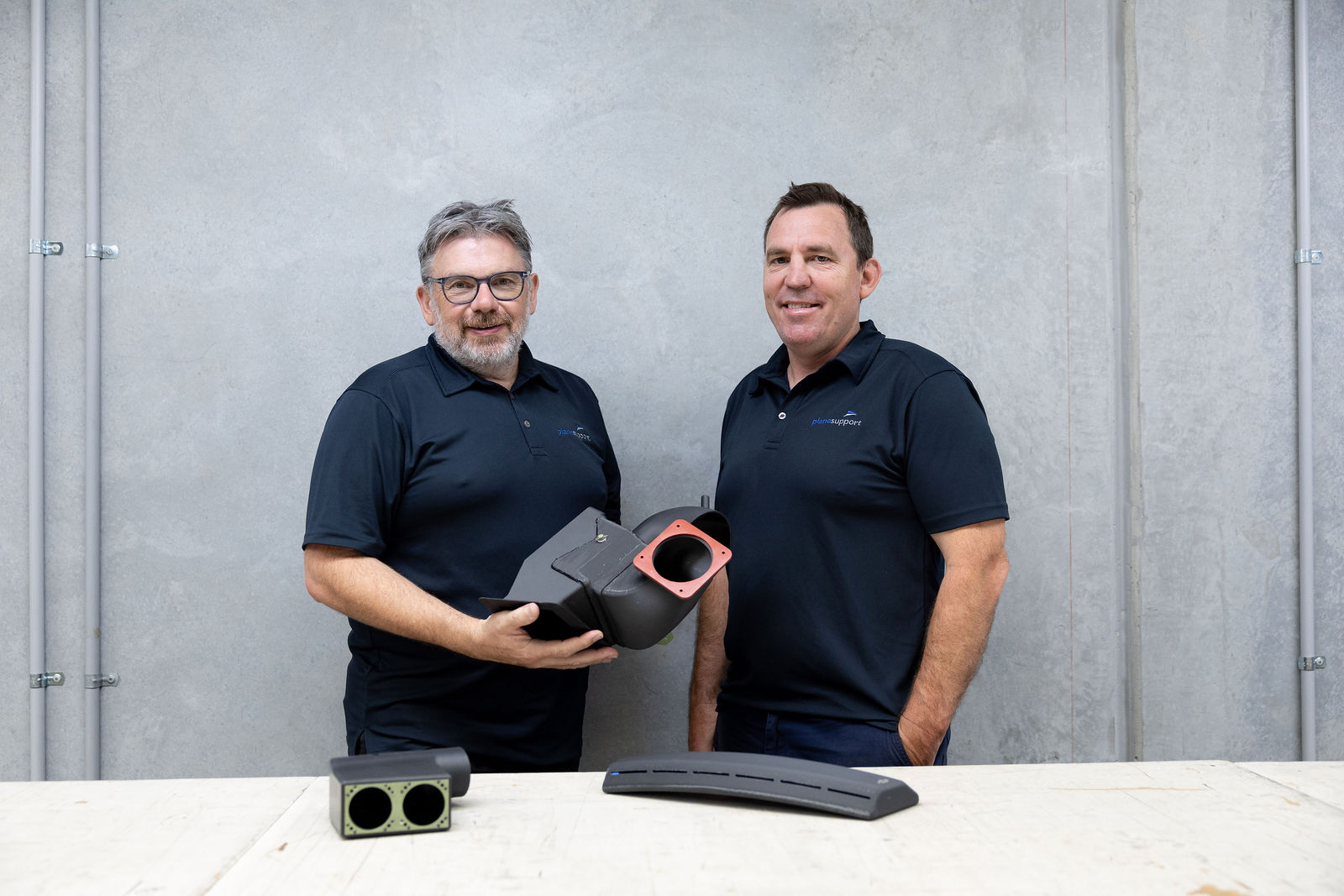
Featured image shows Plane Support Director of Engineering, Jason Hazell, and Director of Manufacturing and Maintenance, Fraser Wright holding 3D printed 214B helicopter parts. Photo via Plane Support.