

PharmaTher Holdings is building a range of 3D printed peptide products for a new U.S. compounding pathway. The first two are oral tablets of KPV and BPC-157 designed to release their dose in the colon. It is timed to the U.S. Department of Health and Human Services (HHS) policy that lets qualified Section 503A pharmacies compound six named peptides under conditions. KPV and BPC-157 are the only two of the six cleared for oral use.
Both products are built on PharmaTher’s M3DICINES platform. They use CORR3CT (COntRollable Release in 3D printed Colonic Targeting), a patent-pending technology from Singapore-based Craft Health. The tablets are designed to pass through the stomach intact and release the peptide in the colon. PharmaTher is aiming them at gastrointestinal conditions where delivering the drug to a specific site may make a difference.
A new U.S. pathway sets the timeline
The HHS Enforcement Discretion Policy Regarding 503A Compounding Using Certain Peptide Bulk Drug Substances was scheduled for publication in the Federal Register on October 30, 2026. It covers BPC-157, Epitalon, KPV, MOTS-c, Semax and TB-500. In practice, it sets terms under which 503A pharmacies can compound these peptides.
The conditions are specific. Peptide supply must come from an FDA-registered manufacturer with the required documentation. Each prescription must be for a named patient, and serious adverse events must be reported. Oral formulations also need documentation showing adequate absorption in humans. Neither KPV nor BPC-157 is FDA-approved, but both can now be prescribed and compounded orally under these rules.
PharmaTher says it will design its products around the conditions from the start. Its pitch to prescribers and pharmacies is a documented, quality-controlled alternative to unregulated peptides.
The move builds on groundwork the company laid earlier in the year. In July, it began evaluating whether Craft Health’s CraftMake printer could produce personalized peptide doses for the same six peptides, before the policy was in place.

How CORR3CT targets the colon
CORR3CT is a 3D printed “pill-in-pill” tablet: a drug-loaded core inside a shell that responds to pH. The shell is designed to resist stomach acid and hold back release until the lower intestine. Extra printed layers shift the release point further toward the colon.
The evidence so far comes from the lab. In a peer-reviewed in vitro study published in 2023, CORR3CT tablets loaded with the steroid budesonide delivered up to 75% of the dose to a simulated colon. A commercial comparator released more than 90% of its dose before reaching the same point. The study is proof of concept for controllable colon targeting with 3D printing. CORR3CT is also covered by a published U.S. patent application assigned to Craft Health.
PharmaTher’s first indication is left-sided ulcerative colitis. About 30–60% of ulcerative colitis patients have inflammation in the descending colon, which most oral budesonide products are not designed to reach.
The case for both peptides rests on early research: KPV has shown anti-inflammatory activity in mouse models of colitis. In one colon-targeted study, it worked as well as free KPV at a concentration 12,000 times lower. BPC-157 has limited early experience in human ulcerative colitis, given rectally.
Craft Health’s CEO said the delivery mechanism is the point. “We built CORR3CT to put a dose where the disease is,” said Dr. Wei Jiang Goh, Co-Founder and Chief Executive Officer of Craft Health. “CraftMake prints at room temperature without heat or UV, making it well suited to fragile molecules such as peptides.”
Product partner, not consumer brand
The colon-targeted tablets are the first entries in a wider portfolio. A BPC-157 chewable or orally disintegrating tablet aimed at the upper gastrointestinal tract is also in development. Doses are printed on CraftMake systems from a validated digital recipe, in patient-specific strengths and small, economical batches.
PD Labs, a 503A compounding pharmacy, serves as PharmaTher’s U.S. Center of Excellence. PharmaTher plans to develop and run these products there in a working pharmacy, and to build a model it can repeat with other partners.
The commercial strategy deliberately avoids selling directly to consumers. PharmaTher plans to sell through healthcare companies, telehealth platforms and pharmacies that already have patients, distribution and their own peptide products. Partners could add specialized peptide products without building their own formulation or pharmaceutical 3D printing capability. The company says the platform could later support multi-peptide products pursued through FDA approval, and colon-targeted versions of established gastrointestinal drugs.
“We are not trying to compete for patients with large telehealth brands that sell undifferentiated, commodity peptide products,” said Fabio Chianelli, Chairman and Chief Executive Officer of PharmaTher. “Our focus is the product itself—building niche, personalized peptide solutions where formulation and delivery matter, starting with a colon-targeted strategy for KPV and BPC-157, made possible by our pharmaceutical 3D-printing platform.”
Printing pills that release where they’re needed
PharmaTher’s strategy is to compete on where a dose is released rather than on the peptide itself. It plans to sell its 3D printed colon-release designs through pharmacies and telehealth platforms that already have patients, rather than competing with them for consumers.
Programmed gut release is already the strongest proven use case for 3D printed drugs. Triastek has completed a First-in-Human study of T21, a 3D printed drug for moderate to severe ulcerative colitis. Imaging showed accurate delivery and controlled release in the colon. The three-layer T21 tablet uses an enteric layer to survive stomach acid and a delay layer that erodes in the intestine before the core releases. The structure is close to CORR3CT’s.
Researchers are also applying the approach to fragile molecules and new printing processes. Triastek’s collaboration with BioNTech is developing oral RNA pills. The design protects mRNA in the gastrointestinal tract and releases it where absorption is best. That is a problem peptides share. In academia, Charles University and partner institutions produced intestine-targeted tablets combining SLS-printed cores with FDM-printed coatings. The tablets released no drug in simulated stomach conditions for 120 minutes, then released it steadily in intestinal conditions.
Colon targeting through 3D printing has been demonstrated, in the lab and in early human studies. PharmaTher’s test is whether the same approach can work under compounding rules, one prescription at a time.
To stay up to date with the latest 3D printing news, don’t forget to subscribe to the 3D Printing Industry newsletter or follow us on LinkedIn.
Explore the full Future of 3D Printing and Executive Survey series from 3D Printing Industry, featuring perspectives from CEOs, engineers, and industry leaders on the industrialization of additive manufacturing, 3D printing industry trends 2026, qualification, supply chains, and additive manufacturing industry analysis.
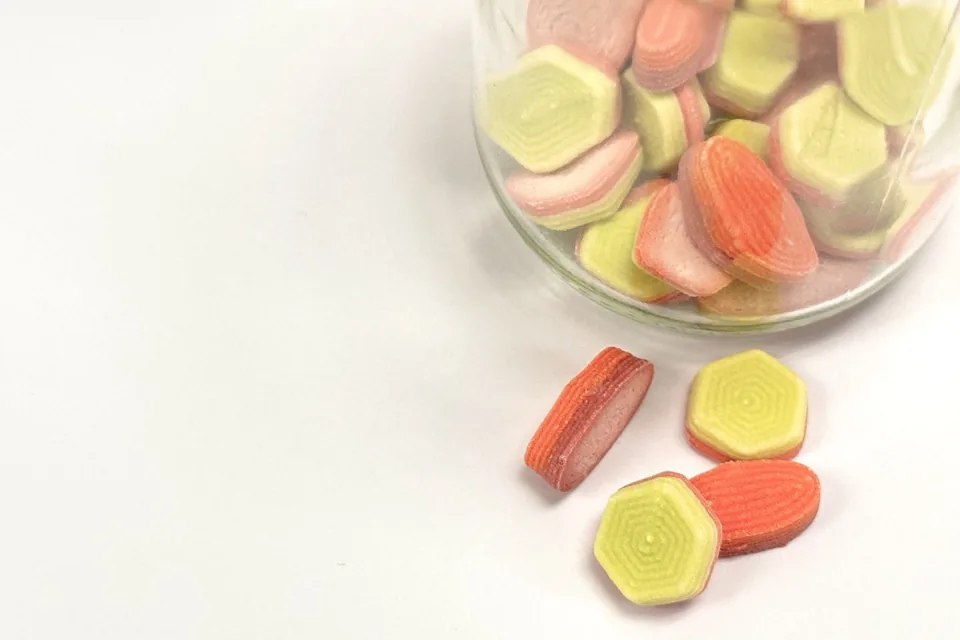
Featured image shows Multilayer tables. Photo via PharmaTher.







