

Where is AI unlocking advantages? Explore what is possible at AMA: Software 2026.
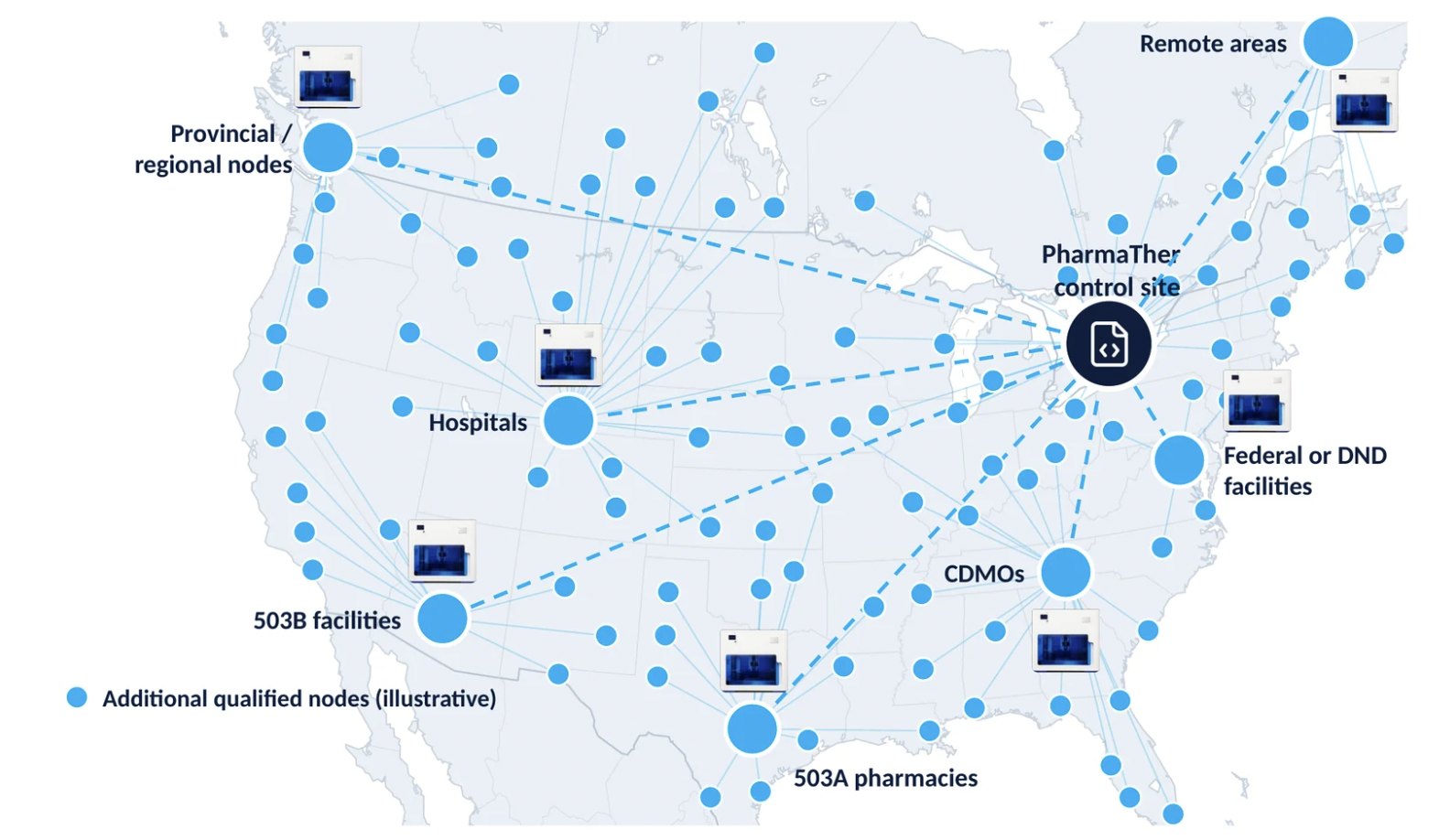
Canadian specialty pharmaceutical company PharmaTher Holdings has launched the M3DICINES National Network Program, an initiative to build a distributed network of qualified sites across North America that produce personalized medicines on CraftMake pharmaceutical 3D printers. The program will begin with U.S. 503A compounding pharmacies before expanding to hospitals, 503B outsourcing facilities, contract development and manufacturing organizations (CDMOs), research institutions and government facilities.
Each qualified site, which the company calls a “node,” will be able to print PharmaTher products, licensed formulations, partner programs and research supply. Over time, these nodes are also intended to produce medical countermeasures during national emergencies. The target areas are personalized dosing, rare and ultra-rare diseases, discontinued medicines, drug shortages, clinical trial supply and emergency preparedness.
PharmaTher, listed on the Canadian Securities Exchange (CSE: PHRM) and the OTCQB (PHRRF), holds exclusive North American distribution rights to Craft Health’s CraftMake systems, CraftControl software, CraftBlends materials and related services. The two companies jointly develop M3DICINES formulations using CraftBlends materials.
One Formulation, Any Dose
The network runs on a single set of validated formulations and quality standards, organized in four stages. First, PharmaTher and its development partners, including Craft Health, develop and validate formulations along with the digital recipes for each dose. Each partner site then installs a CraftMake system and completes qualification and training with PharmaTher’s support. Qualified sites go on to print medicines for individual patients, PharmaTher’s own products, partner programs, and research and clinical supply. Finally, any of these sites can be enrolled in PharmaTher’s planned National Emergency Preparedness Node Network.
According to the company, a single validated formulation on the CraftMake platform can print any dose and can combine multiple medicines and release profiles within one unit. Printing takes place at room temperature without heat or UV curing, which PharmaTher says makes the process suitable for peptides and other heat-sensitive drugs. Every printed dose is tied to a digital batch record.
Rather than maximizing printer sales, PharmaTher expects each productive node to generate revenue through formulations sold to 503A pharmacies, white-label and CDMO programs, consumables, software and service, research and clinical supply collaborations, and potential government readiness contracts. Since any validated formulation can run at every qualified site, each new node extends the reach of the full product portfolio.
“The printer gets us into the pharmacy. Our products, our formulations and the network create the value,” Chianelli said.

Filling the Gaps Left by Mass Production
PharmaTher positions the program as an answer to conventional drug manufacturing, which it says only pays off at runs of hundreds of thousands to millions of identical units. Telehealth patients often find personalized prescriptions limited to injections or a few fixed strengths, and children with rare diseases are commonly dosed from adult tablets split at home. Citing U.S. National Institutes of Health figures, the company notes that about 95% of the roughly 10,000 known rare diseases lack an FDA-approved treatment.
It also points to medicines dropped because demand fell too low, shortages tied to centralized overseas production, and clinical trials that need many strengths in batches of only a few hundred units.
“Mass manufacturing was built to make the same medicine millions of times. The M3DICINES Network is built to make the right medicine for one patient, close to where that patient is,” said Fabio Chianelli, Founder, Chairman and CEO of PharmaTher.
Stockpiling Inputs, Not Pills
In normal times, nodes would handle commercial work. During an emergency, PharmaTher would release validated digital recipes so qualified sites could print the doses needed locally, in the strengths and forms patients require, rather than relying solely on stockpiles of finished medicines.
The approach mirrors U.S. policy: a 2025 executive order directs the Strategic Active Pharmaceutical Ingredients Reserve to hold ingredients for about 26 critical drugs instead of finished doses, and the Administration for Strategic Preparedness and Response (ASPR) is piloting point-of-need manufacturing. PharmaTher plans to demonstrate the node network within 12 months and will pursue readiness contracts with ASPR and Defence Research and Development Canada (DRDC), positioning the network as a complement to national stockpiles.
Distributed Manufacturing as Emergency Infrastructure
PharmaTher’s M3DICINES Network is built on a simple premise: in a crisis, the bottleneck is often not the medicine itself but where and how it is made.
The U.S. government is already funding similar thinking on the pharmaceutical side. Battelle and 3D pharmaceutical company Aprecia received a DARPA agreement to advance the EQUIP-A-Pharma research program, funded by ASPR’s Office of Industrial Base Management and Supply Chain. The program pairs Battelle’s small-scale chemical synthesis platform with Aprecia’s Z-Form Flex 3D printing technology, initially targeting two essential drugs and aiming to set up agile sites that produce both the active ingredients and the finished tablets in one location. Battelle has framed the goal as enabling point-of-need manufacturing for military operations and responding to public health emergencies such as drug shortages.

Outside pharma, Michigan’s Project DIAMOnD has tested the distributed node model at scale. Launched by Automation Alley and funded by Oakland and Macomb counties, the project connected over 300 manufacturers in Michigan, forming the country’s largest network of blockchain-connected 3D printers. Started in 2020 as a PPE production network in response to supply chain failures exposed by COVID-19, it later evolved into a distributed printing web for all kinds of parts, with every machine linked to a decentralized cloud so production can continue through disruptions like pandemics. The initiative has since opened its Digital Transformation Center to businesses beyond its membership network.
Together, these efforts point to a shift in preparedness thinking: capacity spread across many qualified sites, with designs held digitally and printed on demand, may prove more resilient than warehouses of finished goods.
Register now for AMA: Software 2026. Join 3D Printing Industry on 22 October for expert presentations, panel discussions and live audience Q&A exploring the software shaping additive manufacturing. Register here.
To stay up to date with the latest 3D printing news, don’t forget to subscribe to the 3D Printing Industry newsletter or follow us on LinkedIn.
Explore the full Future of 3D Printing and Executive Survey series from 3D Printing Industry, featuring perspectives from CEOs, engineers, and industry leaders on the industrialization of additive manufacturing, 3D printing industry trends 2026, qualification, supply chains, and additive manufacturing industry analysis.
Featured image shows Illustrative map of the M3DICINES Network. Image via PharmaTher.







