
OpenAI has released GPT-6 Astra, and among the benchmarks in a broad capability launch covering coding, cybersecurity, and computer use is one aimed squarely at 3D geometry: BenchCAD, which tests whether the model can reconstruct a 3D object as editable CAD code rather than a static mesh, working only from a handful of photos.
While nothing in OpenAI’s release is framed around 3D printing; specifically, CAD is the format every printable file starts from, which is why this result is worth flagging for anyone working in design or manufacturing.
OpenAI is rolling Astra out first to a limited set of organizations, with broader access to ChatGPT Plus, Pro, Business, and Enterprise users, and developers through the OpenAI API, Microsoft Azure, and AWS Bedrock, following in the coming days.

What BenchCAD actually measures
BenchCAD tests whether a model can look at multi-view renders of an object and reconstruct it by writing CAD code, rather than generating a mesh directly. That distinction matters on its own terms: a mesh is a shape you can look at, while CAD code is a shape you can edit, parametrize, and drop into standard design software.
Working with tools, Astra scored 95.9% on BenchCAD’s mean voxel IoU metric, which measures how closely the reconstructed geometry overlaps with the original object, up from 83.3% for OpenAI’s prior model, GPT-5.6 Sol, and ahead of the 84.3% reported for Anthropic‘s Claude Fable 5.1. OpenAI also said Astra reached that score at roughly 43% lower estimated API cost than Sol and 86% lower than Fable 5.1 in the tested configurations.
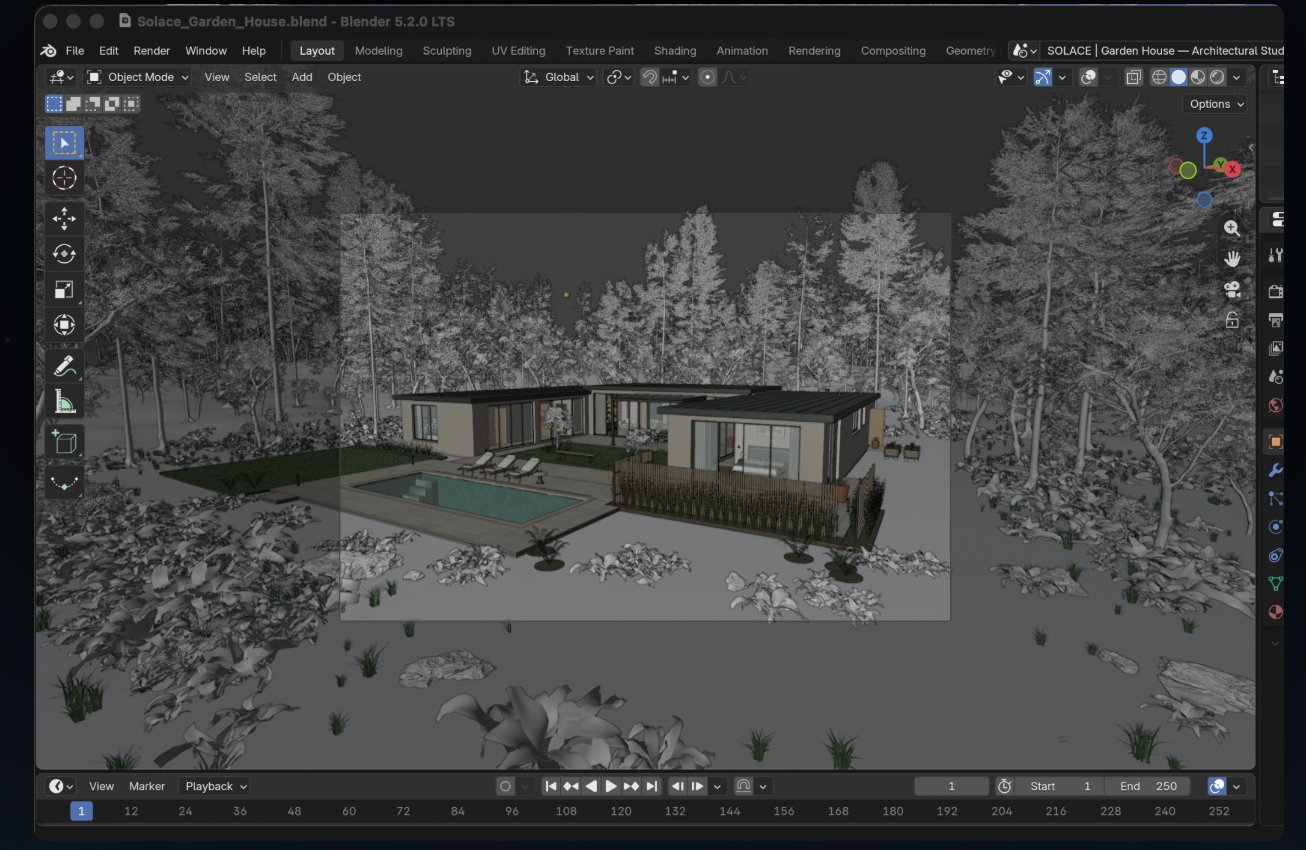
OpenAI paired that result with a demonstration outside the benchmark: Astra modeling a house in Blender and converting it into a walkable scene in Unreal Engine 5, framed as a way for designers and clients to explore a layout before it’s built. It’s a different application from reconstructing a single part, but it draws on the same underlying skill BenchCAD measures, turning a static reference into structured, editable geometry.

Why This Is Worth Watching for AM
A frontier model generating parametric CAD from photos, rather than a picture or a fixed mesh, is closer to what an AM workflow needs than any prior general-purpose model result, and the jump from 83.3% to 95.9% on BenchCAD suggests that capability is moving quickly.
CAD code that can be edited and parametrized is a meaningfully different output than a static mesh, and getting a model to produce it reliably from just a handful of photos is the kind of building block AM-adjacent tools tend to get built on top of.
The benchmark itself measures geometric overlap against clean, multi-view renders made for evaluation, so it’s still a step removed from scanned or photographed real-world parts and the dimensional tolerances that ultimately decide whether a file prints correctly. That’s less a limitation than a next milestone: the natural question now is how this capability performs once someone points it at an imperfect photo of a real, physical part rather than a rendered test image.
AI-Powered Scan-to-CAD Is Already an AM Industry, Not a Future One
Astra’s BenchCAD result lands in a space additive manufacturing has been actively building tools for already: the scan-to-CAD bottleneck, where mesh or point-cloud data from a 3D scanner can’t be used directly in CAD software, and converting it into editable, printable geometry has traditionally required either manual redrawing or specialized reverse-engineering software. Closing that gap faster and cheaper is exactly the problem a growing set of AM-focused companies are racing to solve.
Backflip, founded by Markforged’s Greg Mark and David Benhaim, has built its whole strategy around that exact bottleneck. The company’s newest foundation model cut part digitization costs from roughly $1,500 to $10 per part, trained to build CAD “the way engineers actually do, breaking down a bulk geometry, then rebuilding it feature by feature,” producing output that opens directly in standard CAD software rather than a static mesh.
Hardware makers have moved in the same direction: Creality partnered with KVS Ltd to deliver an integrated scan-to-CAD workflow, letting an engineer scan a damaged part and reconstruct it within minutes, ready for CNC machining or 3D printing.
Against that backdrop, Astra’s photo-to-CAD result isn’t introducing a new problem to AM, it’s a general-purpose model showing up in a race that specialized AM tools have already been running for a while.
3D Printing Industry is inviting speakers for its 2026 Additive Manufacturing Applications (AMA) series, covering Energy, Healthcare, Automotive and Mobility, Aerospace, Space and Defense, and Software. Each online event focuses on real production deployments, qualification, and supply chain integration. Practitioners interested in contributing can complete the call for speakers form here.
To stay up to date with the latest 3D printing news, don’t forget to subscribe to the 3D Printing Industry newsletter or follow us on LinkedIn.
Explore the full Future of 3D Printing and Executive Survey series from 3D Printing Industry, featuring perspectives from CEOs, engineers, and industry leaders on the industrialization of additive manufacturing, 3D printing industry trends 2026, qualification, supply chains, and additive manufacturing industry analysis.
Featured image shows a Blender model. Image via OpenAI.